Report confirms detainees held in small cages at Alligator Alcatraz
Published in News & Features
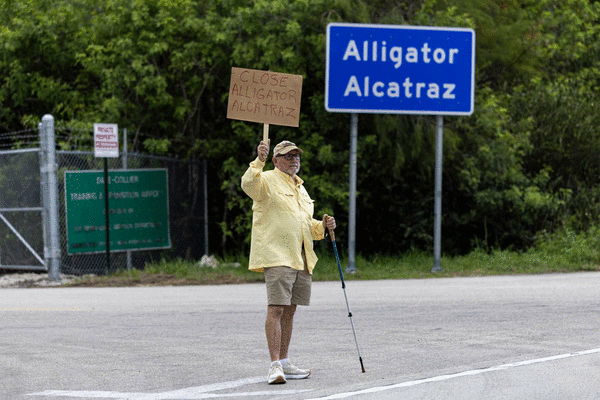
Nearly 80 detainees were held in small metal cages at the Everglades detention site state leaders called “Alligator Alcatraz,” according to a new report by the Department of Homeland Security’s independent watchdog.
“The use of such restrictive spaces is highly unconventional and does not align with standards for humane treatment,” the report by the department’s Office of Inspector General said.
The cages were used as “calming areas,” it said.
Each measured about 18 square feet of floor space. Detainees were held “for periods ranging from several minutes to nearly 2 hours,” according to the report.
The report was based on records from mid-July 2025 to mid-January and an unannounced inspection of the detention center at end of that month.
It concluded that the site did not provide detainees with sufficient living space, creating cramped conditions for people who spent most of their time in their housing units, which may have harmed them physical and mentally.
“Use of these small metal enclosures for any reason is unprecedented among detention facilities OIG has inspected and presents significant risks to detainee health and safety,” the report said.
The office made 10 recommendations to improve oversight of the detention center management and operations. However, it administratively closed the recommendations because the site ceased operations in June.
According to the report, U.S. Immigration and Customs Enforcement provided “timely responses to our requests for information and did not delay or deny access to information we requested.”
The detention site was located at the Dade–Collier Training and Transition Airport and was a pillar of Florida’s broader Immigration Enforcement Operations Plan, which details how the state should carry out arrests and mass deportations.
Gov. Ron DeSantis invoked emergency powers to build it. But in the weeks after its inauguration on July 4, 2025, allegations of poor conditions and mistreatment quickly began circulating among detainees’ relatives, immigration advocates and nonprofits.
Former detainees also began speaking publicly about their arrests and experiences inside. One of them was Fernando Eduardo Artese, 63, from Broward County. Artese, a dual citizen of Argentina and Italy, was deported to Italy last year. He described Alligator Alcatraz as “a concentration camp” during a phone interview with the Tampa Bay Times while he was detained there. Artese was one of the detainees to mention the existence of ‘the box.’
State authorities firmly denied allegations about the cages and other mistreatment when the detention center was open.
Stephanie Hartman, a spokesperson for the Florida Division of Emergency Management, refuted the allegations to the Times last year, saying “officers are highly trained and follow all federal and state detention protocols.”
Inside, detainees told the Times that guards were violent and forced them to either eat their food during scheduled mealtimes or throw away what was not eaten. Saving food for later was not permitted. Detainees also said there was a lack of medical attention, among other problems.
“The absence of well-defined standards at detention facilities increases the risk that detainees may not receive appropriate care,” according to the report.
A group of Florida Democrats in Congress introduced a bill to cut off funding for Alligator Alcatraz and any immigration detention facility located in or near the Everglades. The bill never passed, but it was one of the most serious efforts toward forcing the detention center to close.
The move came after the lawmakers visited and described the center as crowded, unsanitary and bug–infested. Hundreds of immigrants with no criminal charges ended up there, according to records obtained by the Times and Miami Herald. The detention site was built to hold up to 3,000 migrants.
In a statement after this story was first published, the Department of Homeland Security said: “All detainee facilities are clean, and any allegations of inhumane conditions or excessive use of force are FALSE,” referring questions to the state of Florida as the complex’s manager.
The Florida Division of Emergency Management did not respond to requests for comment. However, DeSantis’ office said in a statement that “at least ten million illegal aliens entered our country under the Biden administration and Florida decided to do something about it.
“The left-wing media wants to focus on a confinement area for violent criminal aliens who have proven they cannot remain peaceful while awaiting deportation. While it adheres to all federal standards for criminal confinement, we’d make it even smaller if we could,” the office said.
Monday morning, at a Lakeland news conference, DeSantis said he hadn’t read the report. Like he has previously, DeSantis brushed off reports about mistreatment at Alligator Alcatraz, saying that people will accuse the state regardless.
“I think some of this stuff is going to be characterized in a certain way no matter what,” DeSantis said.
The Homeland Security department’s management response to the report did not address the recommendations.
“Department of Homeland Security contended the state — not the Department — maintained authority over the facility’s day-to-day operations.”
________
(Times staff writer Romy Ellenbogen contributed to this report.)
©2026 Tampa Bay Times. Visit at tampabay.com. Distributed by Tribune Content Agency, LLC.






Comments