Colorado has 6th-lowest rate of kindergarteners vaccinated against measles
Published in News & Features
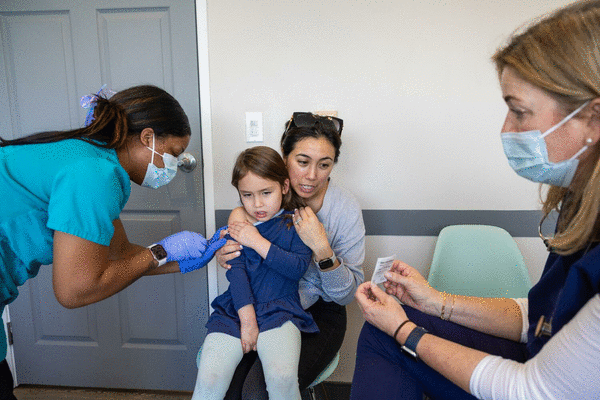
DENVER — Colorado had one of the lowest measles vaccination rates in the country for kindergarteners during the last school year, but that appears to reflect a large number of kids arriving at school without records, rather than an unusually high opt-out rate.
The Centers for Disease Control and Prevention estimated about 87.7% of kindergarteners in Colorado had received both measles shots, according to recently released data from the 2025-2026 school year.
Colorado’s rate was the sixth-lowest in the country and well below the 95% threshold infectious disease experts recommend to keep the virus from spreading.
Children typically receive their first dose of the measles, mumps and rubella shot at about 1 year and their second dose between 4 and 6. Kids in outbreak zones can get a dose at six months.
Interestingly, however, the data doesn't suggest that parents are opting out of vaccines en masse. About 4.5% of kindergartners in Colorado had a nonmedical exemption for at least one vaccine, compared to a 4% average nationwide. (The CDC data doesn't break down how many parents exempted their children from all vaccines versus a subset.)
About 0.2% of kindergarteners had a medical exemption, both in Colorado and nationwide.
The largest share of kids who weren't vaccinated in Colorado were "noncompliant," meaning their parents hadn’t submitted proof of immunization or an exemption form, said Dr. David Higgins, president of the Colorado chapter of the American Academy of Pediatrics.
In many cases, those parents aren't rejecting vaccines, but their children fell behind, or they moved from another state and forgot to bring copies of their shot records, Higgins said. Another factor is that states differ slightly in how they define noncompliance, he said.
"That is a part of what drives Colorado's low ranking, despite the exemptions being similar to national trends," he said in an email.
If all of the noncompliant children received their shots, Colorado would reach 95% coverage — though that isn't likely, since a share of parents would use the exemption form instead of getting their kids vaccinated, Higgins said.
The share of kindergarteners up-to-date on the measles, mumps and rubella combination shot in Colorado peaked at 91.1% during the 2019-2020 school year, and has slowly fallen since. The nonmedical exemption rate hit its low point in 2021-2022, when about 3% of parents opted their children out.
Nationwide, the share of kids with any exemption has risen for four consecutive years, while vaccination rates fell for the shots for measles, mumps and rubella; polio; tetanus, pertussis (whooping cough) and diphtheria; and chickenpox.
Schools submitted their vaccination data between October and mid-January, said Hope Shuler, spokeswoman for the Colorado Department of Public Health and Environment. Legally, parents have 30 days after learning their children are out of compliance to start catching them up or file an exemption, she said.
"Compliance fluctuates during the school year as schools work with families to obtain immunization documentation for their students," she said in an email.
Schools may be reluctant to exclude children, however, given the academic consequences of missing class.
Earlier this year, Colorado had a 10-person measles outbreak that centered on two schools in Broomfield. The schools had vaccination rates over 95%, but dozens of unvaccinated students exposed to sick classmates had to stay home for three weeks.
So far this year, Colorado has reported 24 measles cases, six hospitalizations and no deaths. Last year, 36 people got sick, which was the highest toll in at least a decade.
As of Friday, the CDC had recorded 3,294 measles cases nationwide — more than at any point since the early 1990s. Of those, 267 people needed hospital care.
Two recent infant deaths in Pennsylvania involved measles, though the virus' role is controversial.
One of the deceased, a six-week-old girl, died of measles, with a genetic condition contributing. The other was a boy who died almost immediately after birth of a ruptured spleen, with a measles infection that passed from his mother before birth listed as a contributing factor. Health officials in Pennsylvania disagreed about whether the virus inflamed the spleen and caused it to rupture.
------------
©2026 MediaNews Group, Inc. Visit at denverpost.com. Distributed by Tribune Content Agency, LLC.





Comments