Chicago Mayor Brandon Johnson reveals $882 million budget gap for 2027
Published in News & Features
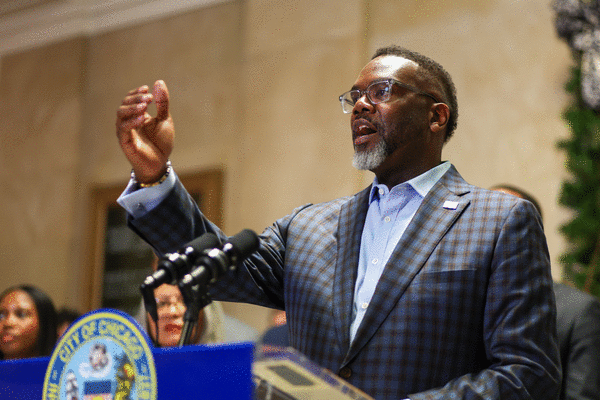
CHICAGO — Mayor Brandon Johnson’s administration on Thursday unveiled a projected $882.4 million hole in the 2027 budget, officially starting the clock for another slugfest with aldermen over how to close the gap before the end of this year.
The mayor cast the predicament as all too predictable in a briefing with reporters in which he blamed historic fiscal mismanagement as well as his council opponents who stymied his progressive agenda.
“As we prepare to put forward our 2027 budget proposal in the coming weeks, we will learn from the lessons of 2026,” Johnson said. “My administration’s values have not changed. We will not balance this budget on the backs of working people. We will continue to fight for progressive, equitable revenues that ask those who can afford to contribute more to actually do more.”
Johnson refused to outright rule out hiking property taxes in a city election year to deal with the still-colossal shortfall, and offered his new revenues that have overshot their projections this year as examples of alternatives.
“The proposals that we had put forward that have called for structural changes to our budget again have overperformed, and that’s going to remain my focus,” Johnson said. “And obviously, when I present my budget in a little bit over a month, you can anticipate that that will remain my focus.”
In the weeks to come, Johnson’s budget team must come up with a mix of cuts, efficiencies and fresh or expanded revenues that will prove palatable enough to 26 — or 25, if he’s open to casting a tie-breaker — members of the City Council. His proposal, which he is set to present to aldermen next month, will have both political and financial implications: Johnson and all 50 seats on the council are up for re-election in February, and the city already suffered from a pair of ratings agency downgrades earlier this year, driving up the cost to borrow and driving down confidence in the city’s credit-worthiness.
Johnson will have to steer this fall’s negotiations from a politically diminished position after a majority of the council last fall revolted against his 2026 budget package, instead passing their own version for the first time in 40 years. The mayor ultimately chose to neither sign or veto the $16.6 billion alternative package that landed at his desk with less than two weeks to go before a city government shutdown.
But on Thursday he said he will continue to try to find ways to tax the rich, again attacking the debt sale measure advanced by aldermen as “reckless and immoral governance.”
“Collaboration is not just simply about acquiescing to someone’s demands,” Johnson said. “I mean, I get it. There is a speck in my eye. There is, right, because I’m human, but what I’m saying is that I’m not going to allow people who have a logjam in their eye to judge the speck that’s in mine.”
Johnson did not rule out layoffs but said he hopes to avoid them, especially in the Police and Fire departments. “The idea of having to cut first responders is not something that I or nor the people of Chicago want to see take place,” he said.
The budget gamesmanship will kick off as election season gears up. Though he has not declared his reelection bid yet, Johnson’s political team has scheduled a “special” announcement on Sept. 13, and he continues to use the last budget fight to position himself as a bulwark against members of his aldermanic opposition that he’s taken to calling the “Corporate Caucus.”
The mayor claimed next year’s deficit could have been much worse without the success of revenues he pushed for as part of this year’s budget, as his finance team initially projected the gap could climb to $1.2 billion.
For its part, the council opposition has accused his administration of sabotaging the sale of vehicular and other city debt they included in their budget package that passed, in order to score a political win.
Under baseline assumptions and no major changes to the budget, the city’s future deficits would grow to $943 million in 2028 and $1 billion in 2029. Under the positive outlook, gaps would shrink to $575 million and $442 million, respectively, while the negative outlook forecasts a 2028 deficit of nearly $1.4 billion and $1.75 billion in 2029.
Costs next year are expected to rise by just over $500 million compared to this year’s budget, driven by a $160 million increase in pension and bond payments, a $266 million increase in settlements and judgements, employee benefits, and fuel and energy pressures from the war in Iran and federal policies, according to a handout of budget hole talking points the Johnson administration gave reporters prior to the Thursday briefing.
Johnson also still plans to make a $364 million extra, or “advance” pension payment — a continuation of a policy from Mayor Lori Lightfoot to keep the city’s retiree funds from going underwater, according to the handout. Lightfoot had tucked away extra money in the city’s reserves — thanks to an influx of pandemic relief funding — to make that pension advance. That well has run dry, forcing Johnson’s team to draw down from the city’s main operating fund to keep pension afloat.
The city also assumes it will continue picking up the $175 million share of the cost of non-teacher pensions for Chicago Public Schools workers – a cost Lightfoot tried to shed. Budget officials are counting on making that payment the following two years, as well. In all, pension costs for 2027 will rise to $2.94 billion.
Though briefing documents suggested the city was pursuing another “global” settlement to resolve a number of outstanding police misconduct cases, administration officials would not disclose which cases.
“If we do not have those challenges, we have a much different forecast,” Johnson told reporters. Total settlements were projected to be $401 million, according to briefing materials, which Johnson’s acting budget director Johnathan Ernst said was the city being “very very transparent” about the true cost.
Last year the city budgeted $82.6 million for Chicago police settlements, with an even greater amount paid for in bonds, for example. Ernst said the costs will remain high for the next several years before tapering off. “This right now, this looks like our peak.”
Chicago’s long term debt service payments — another continued drag on the overall budget — will jump from $2.16 billion to nearly $2.5 billion in 2027.
The $882 million figure is not a surprise. The mayoral-appointed task force whose job was to present a menu of long-term options to attack the city’s debts reported in May that the city’s main operating fund faced a $680 million structural shortfall that should persist “even under baseline assumptions.”
Johnson, a former Chicago Teachers Union organizer, has so far avoided city worker layoffs and furlough days to make ends meet, but has trimmed the city’s headcount by eliminating vacant positions.
He’s had a spotty record on the revenue front. Two of his biggest progressive pushes — the Bring Chicago Home effort to raise transfer taxes on pricier real estate sales and a bid for this year’s budget to reinstitute a city head tax corporations would have to pay on employees — failed at the ballot box and with aldermen, respectively.
His proposal to raise property taxes in his second budget not only broke a key campaign promise but led to an early aldermanic rebellion. And his calls for Springfield to pass new taxes on the rich that the city does not have authority to enact have fallen on deaf ears so far.
But these last few months, Johnson has all but confirmed his fourth budget plan will again incorporate some form of so-called “progressive revenue.”
Other taxes Johnson boosted or created have performed well this year, though. That includes an extended tax on online sports bets and charges on social media advertising. Raising the tax on personal property leases and rentals — a tax Johnson proposed but his council opposition pushed up more, to 15%, has also outperformed expectations. That tax applies to cars and equipment, but also digital goods like cloud computing and common software used by businesses.
Aldermen have also gone along with the mayor’s record-breaking sweeps from the city’s economic development funds known as TIFs, but Johnson’s team suggested Thursday the city would not count on another big sum from them next year, projecting a $156.7 million “decrease in TIF surplus availability.”
While only an “initial projection,” Johnson’s team is counting on surplusing just $330 or $340 million from the city’s TIFs, netting the city around $76 million.
That’s a dramatic drop from last year’s $1 billion surplus, which gave the city a $228 million revenue boost and $553 to CPS.
Last week, Johnson separately announced his plans to close an $85.1 million projected deficit for this year with a mix of refinancing and, possibly, using the last of the city’s federal pandemic relief dollars. Neither solution is a long-term fix.
____
©2026 Chicago Tribune. Visit at chicagotribune.com. Distributed by Tribune Content Agency, LLC.




Comments