All of North Carolina is in a drought. When will relief come?
Published in News & Features
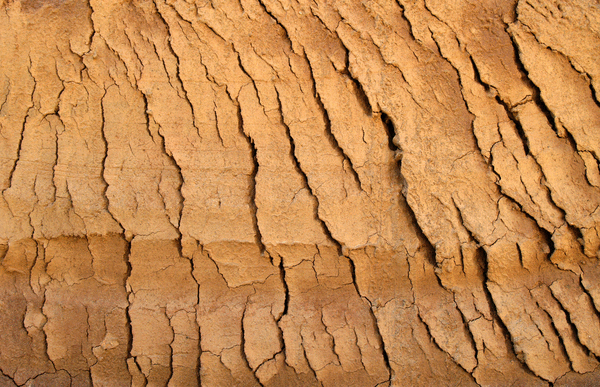
RALEIGH, N.C. — All of North Carolina is under a drought with about 95% of North Carolina now experiencing severe and extreme drought, prompting water restrictions in some parts of the state.
More than 40 water systems throughout the state have mandatory or voluntary water restrictions related to the drought on Friday, according to North Carolina’s Department of Environmental Quality’s Division of Water Resources.
“Near record heat, negligible rain and increased water demand is going to accelerate the decline in river and lake levels over the next few weeks,” said Klaus Albertin, chair of the North Carolina Drought Management Advisory Council. “Reservoir systems are starting to see the impact of increased demand and low inflows.”
Wake and Durham counties were two of the counties to move from “severe drought” to “extreme drought,” according to data released on Thursday from the North Carolina Drought Management Advisory Council.
Mecklenburg County, and other counties near the Charlotte metro, and some parts of western North Carolina moved into extreme drought in late March and early April.
What does extreme drought mean?
About 22% of the state, or 30 counties, is under an extreme drought, the second highest drought classification.
Historically observed impacts of an extreme drought, according to the state’s drought advisory council, include:
—Voluntary conservation is requested even in areas with sufficient water levels and mandatory restrictions become more severe.
—Outdoor burn bans are implemented and wildfires can be harder to contain.
—Landscaping and greenhouse businesses lose revenue.
—Less hay is produced and farmers have to seek the crop out of the state.
—Dying aquatic life, fewer trout are stocked.
An unusually dry spring
Raleigh’s primary drinking source, Falls Lake, has always been full on April 1 except for this year, and only 1.71 inches of rain has fallen in central North Carolina since March 1, according to the National Weather Service.
“Obviously, our region experiences wet and dry periods,” said Phil Badgett, a meteorologist with the National Weather Service’s Raleigh office. “Some persist longer than others. This dry period has been longer than many in the past decade or more. It seems to have our attention more because of the time of year. We associate spring with showers and the color green. Yet, this spring has not produced as one would expect. It is concerning that a warm and very dry spring may lead to dry soils, even higher temperatures and fewer thunderstorms during the summer to meet all our water needs.”
Raleigh Water, which provides water to 650,000 customers in Wake County, will implement mandatory restrictions on irrigation on Monday, April 20, The News & Observer previously reported. In Charlotte, residents are asked to voluntarily reduce their water consumption, The Charlotte Observer reported.
“Model forecasts have generally been like a dart board in the past month,” Badgett said. “At times, they indicate a wetter pattern change, but the next day it is gone. There is hope one day, then despair the next. When will we get a pattern change and rid ourselves of the persistent ridge over the Southeast?”
When will we get rain next?
The Climate Prediction Center is forecasting rain in the next two weeks but likely not for another 10 days, Badgett said, adding the last week of April shows a 40-50% change of above average rainfall.
And weather forecasts for May are mixed with the Climate Prediction Center stating some models predict “wetness for May over the Southeast” but “the recent historically bad drought lowered soil moisture levels,” he said.
“In other words, droughts can perpetuate themselves,” he said. “More soil moisture may lead to more rainfall in the warm season. Dry soils may very well lead to less rainfall.”
But there is “strong support” for a wet and rainy June, July and August, and there’s a 60% chance of an El Niño, a weather pattern that could bring additional rain in late summer and fall.
“North Carolina’s water resources rely on the proximity of the Gulf and Atlantic to provide the state with ample rain and generally short duration droughts,” Badgett said. “It looks as if it is just a matter of time for mother nature to tap into the rich resources again.”
_____
©2026 Raleigh News & Observer. Visit newsobserver.com. Distributed by Tribune Content Agency, LLC.






Comments