Senators spurn budget request for NIH overhead cost cap
Published in News & Features
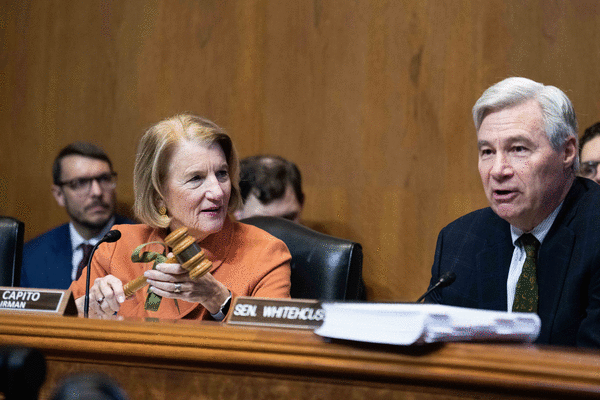
WASHINGTON — Key senators are already dismissing a renewed attempt by the White House to cap medical research overhead costs, well before they start drafting fiscal 2027 spending bills.
Top Republican appropriators, including committee Chair Susan Collins, R-Maine, and Labor-HHS Appropriations Subcommittee Chair Shelley Moore Capito, R-W.Va., said Tuesday that they do not support a uniform cap on what’s known as indirect costs for research funded by the National Institutes of Health.
Indirect costs are expenses incurred by research institutions that are not directly tied to a research project but are necessary for supporting it — like utilities or building maintenance. Typically these costs are reimbursed by the NIH, and range for major research institutions between 30 and 70% of the total grant, according to studies. Right now there’s not a uniform cap, there are percentages that are negotiated between the institutions and the federal government.
President Donald Trump’s budget proposal for fiscal 2027 proposes a 15% cap on these costs, just as the administration did last year.
Congress rejected the idea in the fiscal 2026 spending cycle. Separately, federal courts have blocked agencies from installing such a cap.
The administration in the 2027 NIH budget justification says that such spending by researchers is “unclear and often ambiguous,” and the proposed policy would shine a light on where the money is going.
“I’ve made very clear that I do not think a 15% one-size-fits-all cap on indirect costs for medical research projects makes sense,” Collins said in a brief interview, adding that she didn’t know why the administration would again propose a cap when Congress put in language specifically blocking such a cap for the current fiscal year.
“We’re willing to work with them on another approach — the FAIR model,” Collins added.
That stands for Financial Accountability In Research, a model developed by the research community in collaboration with the federal government as an alternative to the proposed cap. It aims to increase accountability and transparency when tracking and reimbursing institutions for facility and administrative costs without a uniform cap.
Capito also endorsed the FAIR model, saying that she and her fellow subcommittee members are “looking at it closely.”
Labor-HHS-Education Appropriations Subcommittee member Sen. Katie Britt, R-Ala., has been a vocal supporter of the NIH during her time in the Senate in part because of the large research institutions in her state. When asked about the cap, she said, “We will take a look at this but it is essential that the research is not inhibited as we review it more responsibly.”
Legal battles
The NIH last year announced it would immediately cap indirect costs, with a maximum federal contribution of 15% for new and existing grants.
Soon after the policy announcement, 22 state attorneys general sued the administration to halt implementation. In March 2025, U.S. District Judge Angel Kelley in the District of Massachusetts issued a permanent nationwide injunction on the policy, which was later upheld by the U.S. Circuit Court of Appeals for the 1st Circuit.
The administration did not appeal the 1st Circuit’s decision.
Although the NIH’s proposed cap on indirect costs is blocked, Congress could approve such a cap through the legislative process.
While Collins and Capito have both expressed interest in the alternative model, that might pose difficulties considering the range of entities that receive NIH dollars.
“Most people would agree that thoughtful review of indirect costs would be warranted,” said Erik Fatemi, principal at Cornerstone Government Affairs and previously a Senate Appropriations staffer under former Sen. Tom Harkin, D-Iowa. “The trick is reaching consensus on what’s the best alternative. It shouldn’t come as a surprise to anyone that it’s difficult to come to that consensus when you look at the range of entities across the country that receive NIH funds.”
©2026 CQ-Roll Call, Inc., All Rights Reserved. Visit cqrollcall.com. Distributed by Tribune Content Agency, LLC.






Comments