US and Iran holding marathon talks with Pakistan on ending war
Published in News & Features
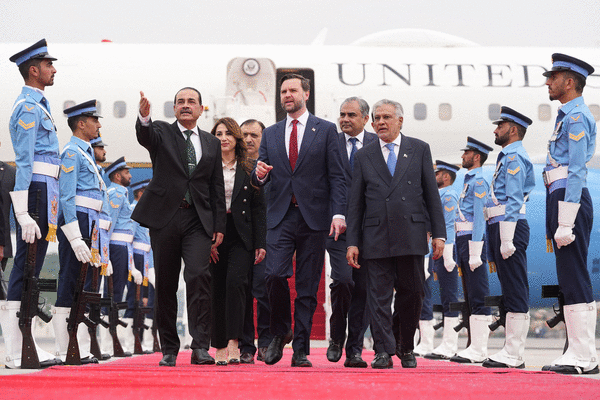
The U.S. and Iran engaged in marathon negotiations with Pakistan, taking their second break after 14 hours, with Iranian state media saying “some differences remain.”
The Iranian government said in a post on social media that both sides were exchanging “expert texts” as the talks in Islamabad moved into Sunday. Talks were expected to resume shortly and there was no immediate official comment from the U.S. or Pakistan.
President Donald Trump, leaving the White House Saturday afternoon to attend a UFC fight in Miami, described the talks as “very deep” but also downplayed their significance and once again claimed an early victory.
“Whether we make a deal or not makes no difference to me,” he told reporters. “And the reason is because we’ve won.”
Vice President JD Vance and negotiators Jared Kushner and Steve Witkoff and Pakistani mediators met with the Iranians beginning at 5:30 p.m. Saturday in Pakistan. The Iranian team included Parliament Speaker Mohammad-Bagher Ghalibaf, a veteran of the Islamic Revolutionary Guard Corps, and Foreign Minister Abbas Araghchi, the officials said. After a break, a second round of talks resumed until about 3:30 a.m., when negotiators said they were taking an hour’s rest.
Teams of experts joined the main negotiators after the first hour, Iran’s semi-official Tasnim news agency reported. Those technical discussions in Islamabad focused on the Strait of Hormuz, a potential ceasefire extension and phased sanctions relief, mostly avoiding the core issues that the Trump administration said drove it to war, according to a U.S. official and a Pakistani official familiar with the matter.
Those issues include Iran’s support for armed proxies, and the nuclear and missile programs that were at the heart of Trump’s stated reasons for attacking Iran beginning Feb. 28.
“We have goodwill, but we do not have trust,” Ghalibaf told reporters after arriving in Islamabad, according to Iran’s semi-official Fars news agency. “In the upcoming negotiations, if the American side is prepared for a genuine agreement and to grant the rights of the Iranian nation, they will see readiness for an agreement from us as well.”
Tasnim said that Tehran’s 71-member delegation also included the Islamic Republic’s central bank governor Abdolnaser Hemmati.
Trump sought to ramp up pressure on Iran ahead of the talks, posting on social media Saturday morning “everyone knows that they are LOSING, and LOSING BIG!” He told reporters late Friday that he expected the Strait of Hormuz, the critical waterway that has become Iran’s main point of leverage, would be opened “pretty quickly” and warned that he could resume military action if the strait doesn’t reopen.
Although the ceasefire has broadly held across the Middle East, the inability of oil tankers and other vessels to easily transit the strait — along with continued fighting between Israel and Hezbollah in Lebanon — has threatened to complicate the talks in Islamabad.
Israel, which is not party to Saturday’s negotiations, has continued to strike towns in southern Lebanon. The Israeli military said it launched more than 200 strikes against Hezbollah in the past 24 hours.
While talks got off to a fitful start, two U.S. Navy ships — the USS Frank E. Peterson and the USS Michael Murphy — transited the strait and operated in the Arabian Gulf, according to the U.S. military, as the first steps toward clearing the mines that the U.S. says Iran planted in the waterway.
“Today, we began the process of establishing a new passage and we will share this safe pathway with the maritime industry soon to encourage the free flow of commerce,” according to a statement from Admiral Brad Cooper, the commander in the war theater.
A regional intelligence official told Axios that the warships were forced to turn back after encountering threats from the IRGC. Iran’s semi-official Fars news agency said the nation’s armed forces monitored a U.S. destroyer seen moving from Fujairah toward the Strait of Hormuz and conveyed this to the US via Pakistani mediators. The U.S. vessel returned from the strait after Tehran warned that it would be targeted, according to Fars.
The U.S. statement made no mention of such incidents.
Before arriving in Pakistan, Ghalibaf stressed on social media that a ceasefire in Lebanon is one measure that “must be fulfilled before negotiations begin.” The other is the “release of Iran’s blocked assets,” he added, without being more specific.
Also on the agenda will be the fate of Iran’s uranium stockpile and missile production, as well as U.S. sanctions against the Islamic Republic and broader military presence in the Middle East. Many of those issues were the same that the two sides failed to resolve in February negotiations before the war began.
Trump has alternated between threatening to wipe out “a whole civilization” and saying a U.S.-Iran deal “could be the Golden Age of the Middle East.” Iran, which has said more than 3,000 people have been killed in U.S.-Israeli airstrikes, has been defiant, confident that its control of the strait — and with it about a fifth of global oil flows — will force the White House to accede to its demands.
In remarks to reporters on Saturday, Trump was asked about reports that China is preparing to send weapons to Iran. “If China does that, China is going to have big problems,” he said.
Pakistan has played a key role in helping strike a two-week ceasefire earlier this week, which came hours before a deadline set by Trump. The U.S. president had threatened to dramatically escalate attacks on Iran, including power plants and other civilian infrastructure, if there was no deal — strikes that may have constituted potential war crimes if acted upon.
Such U.S. attacks would have risked Iran carrying out retaliatory strikes against Gulf states, potentially triggering a humanitarian crisis and inflicting lasting damage to global energy production.
———
(With assistance from Dan Strumpf, Tooba Khan, Catherine Lucey, Bilal Hussain, Golnar Motevalli and Faseeh Mangi.)
©2026 Bloomberg L.P. Visit bloomberg.com. Distributed by Tribune Content Agency, LLC.






Comments