US and Iran agree to ceasefire, easing energy-crisis fears
Published in News & Features
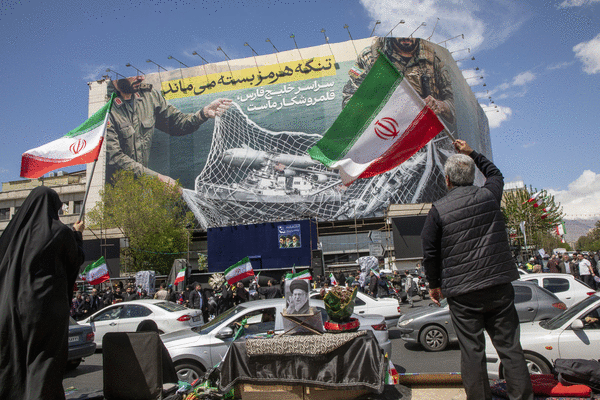
The U.S. and Iran agreed to a two-week ceasefire and Tehran pledged to reopen the Strait of Hormuz, a last-ditch deal that saw President Donald Trump vow to pursue talks rather than escalate the war.
Trump announced the agreement on Tuesday night, shortly after mediator Pakistan implored him to rethink a threat to unleash massive devastation on Iran if it didn’t meet his demands. While it wasn’t clear when the truce will take effect — with reports of ongoing hostilities rife across the Persian Gulf — the accord helped ease fears of a protracted global crisis.
Iran has gone through a “regime change” and the U.S. will now discuss sanctions relief with the Islamic Republic, Trump said in a social-media post on Wednesday. “There will be no enrichment of uranium,” he said — a reference to efforts by Washington and Israel to curb Iran’s nuclear programme.
Oil and gas prices plummeted on news of a deal, which paves the way for a potential resumption of energy supplies through Hormuz. The critical waterway — through which about fifth of oil and liquefied natural gas supplies typically flows — has been effectively shut for the duration of the near six-week conflict.
Brent crude fell as much as 18% to $91 a barrel, while European natural gas futures posted their biggest decline in more than two years, shedding as much as 20%.
Still, Hormuz appeared to remain largely blocked on Wednesday, as shipowners try to understand if they can safely transit the vital waterway.
Trump’s ceasefire announcement represented a dramatic climb-down from an warning earlier Tuesday that “a whole civilization will die tonight, never to be brought back again” if Iran didn’t give in. His threatened attacks on Iran’s civilian infrastructure, including power plants, may have been considered war crimes if they were carried out.
In a separate posting on Truth Social on Wednesday, Trump announced plans to impose 50% tariffs on U.S. imports from any country that sold weapons to Iran.
Iranian Foreign Minister Abbas Araghchi said in a statement that “for a period of two weeks, safe passage through the Strait of Hormuz will be possible via coordination” with Iran’s military and that if attacks on its territory are halted, “our Powerful Armed Forces will cease their defensive operations.”
Despite the agreement, Kuwait, Saudi Arabia, Bahrain and the United Arab Emirates, as well as Israel, reported missile and drone attacks by Iran. Kuwait’s army on Wednesday said it’s still dealing with “intense” attacks.
The U.S. expected orders to stand down from strikes would take time to reach Iran’s Islamic Revolutionary Guard Corps, Axios reported. Such lags are typical in conflicts, with hostilities often continuing before gradually tapering off.
Explosions occurred at Iran’s Lavan Refinery after the start of the truce, the semi-official Mehr reported, without saying where it got the information.
U.S. Vice President JD Vance said in an interview in Budapest that Trump has achieved Washington’s military objectives in Iran, having set out to “decimate” Iran’s ability to wage conventional war, while describing the truce as “fragile.”
Both the U.S. and Iran are portraying the ceasefire as a “victory,” but significant differences remain between their demands to bring the war to a complete end, according to Mona Yacoubian, a senior adviser with the Middle East Program at the Center for Strategic and International Studies.
“Iran says it will allow free passage for the next two weeks through the Strait of Hormuz, but in coordination with Iran’s armed forces. If the U.S. agrees to that, that is a huge concession to Iran,” she said on Bloomberg TV.
Financial markets rallied on the developments. MSCI’s Asia Pacific Index jumped 5.1% to a five-week high and S&P 500 futures jumped 2.8%. Bonds surged, with benchmark U.K. yields tumbling by 22 basis points.
While markets breathed a sigh of relief, the ceasefire addressed a crisis Trump helped create when the U.S. and Israel launched the war in late February. Although Trump claimed to have stopped Iran’s nuclear program, there’s been no mention of its missile or drone programs or support for proxy groups.
Pakistani Prime Minister Shehbaz Sharif, a key mediator, said Tehran, Washington and their allies had agreed to a complete ceasefire, including in Lebanon, where Israel is waging a parallel campaign against the Iran-aligned Hezbollah militia.
Israeli Prime Minister Benjamin Netanyahu disputed that, saying the temporary deal doesn’t extend to Lebanon. The Israeli military on Wednesday said it had carried out its largest operation against Hezbollah since the start of the Iran war, targeting more than 100 of the militia’s command centers and military sites within 10 minutes.
Sharif invited all sides to Islamabad to continue negotiations. White House Press Secretary Karoline Leavitt said discussions about the next phase of talks were ongoing but “nothing is final.”
Iranian President Masoud Pezeshkian confirmed the Islamic Republic would participate, according to a statement by the Pakistan PM’s office.
The complete terms of a possible pact weren’t disclosed. Trump only said the U.S. had received a 10-point proposal from Iran, describing it as “a workable basis on which to negotiate.”
Iran’s demands include its continued control of the Strait of Hormuz, acceptance of its nuclear-enrichment activities, the lifting of all primary and secondary sanctions, and a withdrawal of U.S. combat forces from the region, according to a statement by its Supreme National Security Council carried by state media.
The two-week ceasefire can be extended by mutual agreement, though Iran will enter talks with “complete distrust,” its state media said.
The focus will be on Hormuz and whether ships can pass safely through the vital waterway. While some vessels have made it through the strait in recent weeks, they’ve generally not been from countries Iran views as hostile or having at least tacitly supported the U.S. and Israeli strikes.
More than 800 freighters are stuck inside the Gulf, mostly waiting to leave, and shipowners and insurer groups have warned that more details will be needed to determine if safe transit is possible.
-------
—With assistance from Dana Khraiche, Eric Martin, Tooba Khan and Carla Canivete.
©2026 Bloomberg L.P. Visit bloomberg.com. Distributed by Tribune Content Agency, LLC.




Comments