'Never had a clue': Questions remain after Coral Springs vice mayor's tragic death
Published in News & Features
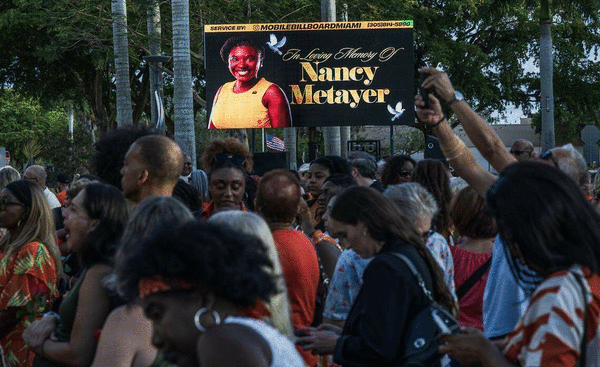
MIAMI — Nancy Metayer Bowen appeared to be living her best life. Successful, involved, happy, loved by her friends, family and community — and getting ready for a congressional run.
The 38-year-old posted herself on Instagram at community events, from political rallies to parades to little league baseball games. She posted herself assuming her role as the vice mayor of Coral Springs, the first Black woman and Haitian American to do so. And every year, she posted photos and videos of herself and her husband to celebrate their wedding anniversary. Complete with cute emojis, her Instagram bio indicated the most important things to her: “Wife. Fur Mama. Vice Mayor. Environmentalist. Rattler.”
Her husband Stephen Bowen did not post on social media as often as his wife did, but he did share his interests. His posts were either photos of himself and his wife or videos of himself at the gun range shooting targets. His Instagram bio reads: “God. Husband. Armed.”
Police arrested Bowen, 40, on Wednesday, on charges of murdering his wife in their Coral Springs home and tampering with evidence. He is being held in Broward County jail. Coral Springs Police Chief Brad Mock said the case is being investigated as a domestic violence incident.
Metayer’s death sent shockwaves through South Florida. Her friends say she was caring, funny and outgoing. She was a pillar in the Haitian-American community and a rising star in the local Democratic Party. She was planning to run in the Democratic primary for the seat held by Rep. Sheila Cherfilus-McCormick. It was all cut short. No one seems to understand why.
There’s no apparent paper trail documenting any alleged domestic violence at this time. Bowen does not have a violent criminal history. Those who knew the couple told the Herald there were no glaring red flags.
Lauderdale Lakes City Commissioner Easton Harrison described himself as a little brother to Metayer, and “very close” with her family. The two started out at the YMCA as community health workers and went back at least a decade.
“What I will say is that nobody could have seen something like this coming,” said Harrison , who attended the couple’s nuptials.
Harrison, who declined to discuss his friend’s personal life, had a T-shirt made for Friday night’s vigil in Metayer’s honor at Coral Springs City Hall, one of several planned around South Florida in the coming days. The orange T-shirt, which he wore and also had distributed, read: “We say it because Nancy never got the chance... STOP THE VIOLENCE.”
“I can’t make any sense out of it, because Nancy was a little sister to me,” Democratic State Rep. Marie Paule Woodson told the Herald. “We have met the husband several times. Me and my husband, every function that we go to; sometimes they sit with us. We talk. I never, never had a clue that something like that would have happened.”
In the days after her death, police have said little about Bowen’s potential motive. It is unclear whether police have ever been called to the home regarding domestic violence, as the Coral Springs Police Department denied the Herald’s public records request for prior calls of service, citing an active investigation.
According to a police affidavit, Bowen told his uncle he killed his wife because he “couldn’t take it anymore.”
The dynamics of Metayer and Bowen’s relationship are unknown to the public, but what is known is that domestic violence is more common than what people may assume. More than 1 in 3 women and 1 in 4 men in the United States have experienced rape, physical violence and/or stalking by an intimate partner in their lifetime, according to the National Domestic Violence Hotline.
Experts note that Metayer’s death underscores how domestic violence can happen to anyone, regardless of class, career, race or gender.
“It is a public health crisis,” said Cecile Houry, Chair of the Miami-Dade County Domestic Violence Oversight Board. “It is happening way too often, everywhere, at every level of society, in every pocket of our communities.”
In the days since Metayer’s shocking death, the councilwoman’s family and the city’s Instagram have dropped Bowen from her name, using Metayer only — a name that defined not just her Haitian lineage but her roots in activism, a path that some who knew her said ushered her into politics.
For those who gathered and placed burning white candles at a makeshift memorial bearing photos of the councilwoman at the vigil, it was impossible to ignore the circumstances of her death as friends rewound conversations to search for signs they may have missed.
“I’m surprised like everybody else. I mean, stunned would be a better word. The specifics about how we got here, I have no idea,” said Ebony Chrispin, a lobbyist and friend of Metayer who attended the vigil.
Most people who spoke to the Herald say they were blindsided by the news. They preferred to speak about Metayer’s career and her passion for service, rather than her relationship, which she also kept intensely private.
But the timeline of events revealed in the police affidavit and 911 call show how quickly her colleagues and family members mobilized to find her on Wednesday. The response was almost immediate.
Metayer missed two meetings on Wednesday at 8:30 a.m. and 9 a.m. By around 10:20 a.m., police were outside the white two-story house she shared with her husband in a gated community in Coral Springs. About an hour later, Bowen’s parents arrived at the house, but didn’t have any way to access the property. By 2 p.m., Bowen’s own family members were telling police to “break down the door” to get into the house.
As word spread around city hall that morning that Metayer hadn’t shown up, city employees told Police Chief Mock that they were concerned about the vice mayor’s whereabouts. Maj. Edmond DeRosa sent officers to the house. When they arrived at 10:21 a.m., there were no cars in the driveway and no one appeared to be home. Standing outside the house, police saw two holes “consistent with damage caused by projectiles” on the side of the house and drywall debris on the ground, according to the affidavit.
By the time police got to the Coral Springs house, Bowen was trying to find a place to put the weapon he used to shoot his wife three times, according to the affidavit.
His uncle Owen Small told police that his nephew knocked on his door around 10 a.m. and asked him to “hold something for a couple of weeks” but warned him not to touch it without gloves. It was his shotgun. According to the affidavit, Bowen confessed to his uncle that he shot his wife the night before and went downstairs to sleep.
Bowen left his uncle’s house around noon to find another place to stash his weapon, his friend’s apartment in Plantation, the affidavit said. After Bowen left his uncle’s house, family members called 911 just before 2 p.m. Police released audio of the 911 call on Friday.
A woman, whose name is redacted from the audio, told the 911 dispatcher that a possible crime had been committed and that the police officers at the Coral Springs house needed to “break the door down” to get inside. The dispatcher explained that officers needed a reason or a warrant to force their way into the home. Small got on the phone and said, “I’m gonna give you a reason.” He then told police what his nephew had confessed to him.
Police then forced their way through the glass sliding door at the back of the Coral Springs house. They found Metayer’s body in the second-floor bedroom.
Ruth Jeannoel, a friend of Metayer who works with survivors of abuse with her organization Fanm Saj, described Metayer as a fanm vanyan, a courageous woman, in Haitian Creole. She was proud of her Haitian heritage and a fierce advocate for issues that mattered to her, including environmentalism and racial justice. The two friends met years ago while working for different social justice organizations. Their work was often very heavy, so they leaned on each other to smile and laugh, Jeannoel said.
“We never know what somebody is going through. It’s really hard to speak of her as in past tense, but she is, and she was an amazing human being,” she said. “An amazing community organizer, an amazing community public servant who held the role very delicately, who listened to her constituents.”
Jeannoel joined the hundreds of other community members gathered in Coral Springs on Friday evening at the vigil in Metayer’s honor. Among them was Linda Parker, the president and CEO of Women In Distress of Broward County, who said Metayer’s death hit close to home. Coral Springs Mayor Scott Brook sits on WID’s board of directors.
The nonprofit has seen an uptick in domestic violence cases, she said, including both instances of long term abuse and instances where a partner “snaps” without previous signs of domestic abuse.
“It gets harder and harder to try to make sense of these things at the end of the day. The increase in domestic violence in Broward County is pretty profound,” Parker said. “We’re just seeing such a large number of cases. And cases that are resulting in death.”
While there is still very limited information on what led to Metayer’s death, Parker said it’s important for people, especially women, to stay vigilant .
“There’s a number of things at play that we just don’t know, and we may never know because (Bowen) may never say anything,” Parker said. “It’s very scary. It makes you look at your own relationships differently.”
Metayer’s death has also made Chrispin reflect on a relative who “was in a long-term marriage with someone who’s physically abusive, and we had no idea until one day he put her in the hospital.”
“That breaks my heart more than anything else that she was living with, just this insulated life that we didn’t know about,” she said. “Horrifying to think about it.”
©2026 Miami Herald. Visit miamiherald.com. Distributed by Tribune Content Agency, LLC.



Comments