Commentary: Attack on birthright citizenship highlights Trump's white nationalist ambitions
Published in News & Features
In the summer of 1868, the 14th Amendment was ratified, granting birthright citizenship to “All persons born or naturalized in the United States.”
Crafted in the aftermath of the Civil War, the landmark legislation was aimed at providing citizenship to formerly enslaved people. The amendment directly undid the ruling of the 1857 U.S. Supreme Court case of Dred Scott v. Sandford, which stated that enslaved people were not U.S. citizens.
More than 150 years after the amendment’s ratification, President Donald Trump signed an executive order in January 2025 that offered a redefined interpretation of who exactly is entitled to birthright citizenship.
The proposed presidential directive suggested that citizenship should not be extended to children born within the U.S. or its territories to parents who are undocumented or have temporary visas.
The order — which would affect all children born to parents without permanent legal status in the U.S. after Feb. 19, 2025 — argued that “the Fourteenth Amendment has always excluded from birthright citizenship persons who were born in the United States but not ‘subject to the jurisdiction thereof.’”
This retconning of the 14th Amendment aligns with the Trump administration’s continued crusade to demonize nonwhite citizens, which kicked off when he first ran for president in 2015.
The administration has continually placed travel bans on Muslim-majority countries; scaled back diversity, equity and inclusion (DEI) measures at the federal level; tried to craft immigration and refugee services in a way that prioritizes white people; perpetuated the “anchor baby” myth; ramped up spending for Immigration and Customs Enforcement; attempted to expedite deportations; created an increased surveillance state on undocumented people as ICE raids have besieged immigrant communities over the last year; and housed detained migrants in poorly and dangerously run detention centers.
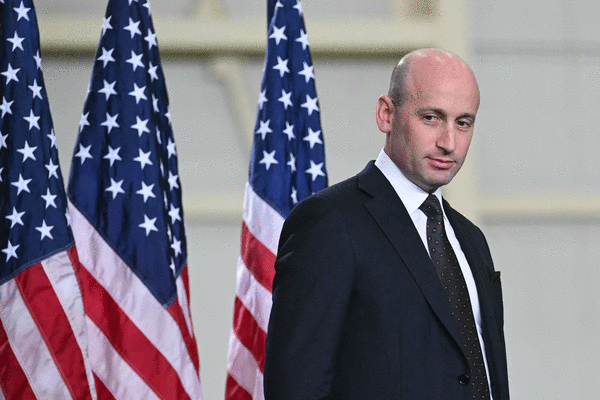
Stephen Miller, the front man for Trump’s deportation campaign, claimed that the U.S. would essentially be a utopia if there were no immigrants.
Trump’s border czar Tom Homan has openly shown contempt for judges’ rulings on deportation processes when dealing with Latino immigrants.
With the help of other cronies like Kristi Noem, Gregory Bovino, Kash Patel, Brendan Carr, Marco Rubio and Karoline Leavitt, the Trump administration has virtually crafted the Avengers of white nationalism.
Immediately after the order’s signing, several federal judges from across the country blocked its implementation, ruling that it’s unconstitutional. However, in June the Supreme Court ruled that district courts couldn’t authorize nationwide injunctions of the executive order.
After that decision, the American Civil Liberties Union filed a nationwide class-action lawsuit — officially known as Trump vs. Barbara — to block Trump’s executive order last June in New Hampshire on behalf of all the children who would be affected by the directive. The district court judge presiding over the case granted a preliminary injunction, which prevented the order from being enforced. In December, it was announced that the Supreme Court would review the district court’s ruling.
On April 1, the Supreme Court will be presented with oral arguments from both sides — though a decision on the case will not be reached until the end of the Supreme Court’s session in late June or early July.
Ahead of these presentations, the deputy director of the ACLU Immigrants’ Rights Project, Cody Wofsy, spoke with The Times about the case.
Wofsy explained that the only legally sound way for the executive order to be implemented would be through an official amendment to the Constitution, which would need to be approved by the states. He highly doubted something like that would even pass.
However, the attorney noted that a lack of legality wouldn’t necessarily stop the Trump administration from denying people citizenship.
“If there were no lawsuits, the government would be treating all these children as if they were not citizens,” Wofsy said. “What I’m saying is that’s illegal, but that the government does illegal things sometimes.”
Wofsy also further delved into the particularities of the court case, stating that the Trump administration wants to require that parents of babies born in the U.S. be “domiciled” in the country.
“That means somebody who resides here and has the intention to reside here indefinitely,” he said. “One problem for [the Trump administration] is that for most of the babies who are being targeted by the executive order, their parents are domiciled here.”
Additionally, he noted that there is currently no domicile requirement within the 14th Amendment and that there is already legal precedent for a constitutional interpretation that asserted that stance.
The 1898 Supreme Court case of United States vs. Wong Kim Ark affirmed the right to citizenship of a child born in California to two parents who were Chinese nationals. The landmark ruling set the legal groundwork for any child born within the U.S. to be considered a citizen, regardless of their parents’ residence status.
The Supreme Court brief put forth by the Trump administration mentioned that court case but argued that the ruling “does not cover children of aliens who are not ‘permitted by the United States to reside here.’”
Wofsy called out the legal move for its perversion of what political representation should be.
“Citizenship is not a policy tool to be wielded just because the people temporarily in office would rather the electorate looked different from the way it does,” he said. “[In] America, the people elect their representatives, the representatives do not pick who the people are going to be.”
A positive outcome for the Trump administration could create a permanent second‑class caste of people whose citizenship can be questioned.
“This would be the starting gun to a much broader attack on citizenship and belonging in this country more generally,” Wofsy said. “And we know who the targets of those attacks would be. It would be communities of color. It would be vulnerable populations in this country who already have their citizenship and their belonging in America questioned on a regular basis.”
In terms of enforcement, this new reality would make it so that the thousands of children born monthly since Feb. 19, 2025, would effectively be rendered undocumented immigrants, with virtually no avenue to get any type of legal status.
Wofsy said these kids would be “subject to immediate harms” and that they could be arrested, detained and deported from the U.S.
“They’re going to grow up living in fear of immigration enforcement and having their families torn apart,” he noted. “It also means they’d be denied passports, ordinary access, Social Security cards and various kinds of programs, including early life nutrition as they get older.”
The executive order’s implementation could also create a logistical nightmare for people who have nothing to do with those who are being targeted. For example, it could affect members of religious communities that may not have traditional documentation and people who’ve lost their documentation due to natural disasters.
“What if you need to prove the immigration status of your parents, maybe decades before questions are being raised about citizenship?” Wofsy said. “[It could] potentially strip citizenship from unknown numbers of people who not only should be citizens under the Constitution as it’s written, but even should be citizens under the executive order rules but maybe can’t prove it.”
Wofsy called the Trump administration the “most anti-immigrant administration that we’ve seen in at least 100 years” and pointed at the ultimate goal of all its restrictive policies.
“They want to turn the clock back to a time when the country was less free, less equal and more than anything more white,” he said. “Overall, it is a vision of America that says that nonwhite populations coming here, enjoying the fabric of America, is a bad thing. I don’t think that is what the American people believe. I don’t think that’s what they voted for and I do not think that this assault on birthright citizenship reflects American values.”
©2026 Los Angeles Times. Visit at latimes.com. Distributed by Tribune Content Agency, LLC.





Comments