Leaked ICE documents show feds earmark $47 million for Florida law enforcement agencies
Published in News & Features
MIAMI — The Trump administration appears to have allocated some $149 million to dozens of law enforcement agencies across Florida for participating in immigration enforcement partnerships to round up undocumented immigrants across the state, according to a leaked financial ledger.
The ledger, obtained by independent journalist Ken Klippenstein and attributed to U.S. Immigration and Customs Enforcement, does not make it immediately clear whether the money has yet been disbursed or whether the figures are preliminary numbers from the federal government.
But the document suggests Florida agencies have been assigned more funding than those in any other state through the federal 287(g) program — a controversial initiative that deputizes local officers to carry out limited immigration enforcement duties. The ledger contains entries for 53 state and local agencies in Florida with dates spanning from Jan. 26, 2025 to March 23, 2026.
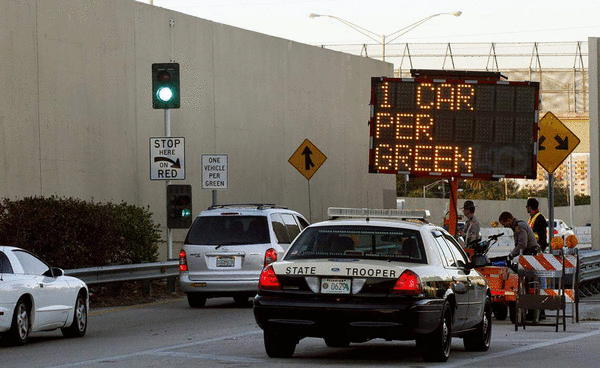
The lion’s share appears to be directed toward the Florida Highway Patrol, with more than $100 million in potential funding listed in the ledger. That includes two entries — $13.6 million and $1.1 million — with award dates of September 2025 and February 2026, respectively. An additional estimated payment of $89 million is listed with a “TBD” date. The agency has long been Florida’s primary vehicle to crack down on illegal immigration, with troopers arresting immigrants on the state’s highways.
Other agencies for which ICE has assigned funds include the Florida Fish and Wildlife Conservation Commission, $5.5 million and the Florida Department of Law Enforcement, 3.8 million. Both have award dates from last September.
There are also about $101.5 million in payments marked “TBD,” an acronym for “to be determined,” on an award date, according to the document.
It’s widely known that Florida has the largest number of 287(g) programs of any state in the country. But the document shows that the Trump administration is willing to make massive investments into local police departments that participate in the president’s mass deportation campaign all across the United States.
The Miami Herald reached out to the Department of Homeland Security to ask about whether the document corresponds to payments allocated or already disbursed. The agency did not respond.
Nationwide, 287(g) partnerships have exploded since President Donald Trump, who has touted local law enforcement as a key cornerstone of his immigration agenda, returned to the White House last year.
Nowhere is this more evident than in Florida, where there are 281 local and state agencies with over 300 agreements, according to a Miami Herald analysis of ICE data. Dozens of Florida law enforcement agencies have signed up for more than one version of the 287(g) program.
Altogether, Washington had designated roughly $47.8 million to 53 Florida agencies with award dates between January 2025 and this past Monday, with the bulk — about $35.5 million, or 75% — categorized for “equipment,” according to the leaked ledger. Fifty-one agencies were assigned $100,000 each for “transport,” according to the document.
The remaining funds include $7.7 million in salaries and bonuses across 24 agencies, according to the document. For example, Florida Highway Patrol was assigned $1.1 million in salary payments in February, while Lee County Sheriff’s Office was allocated $2.8 million for “incentive” payments.
The document showed $10.6 million in line-item entries across 23 agencies with award dates marked “TBD.”
Rapidly expanding program
The Herald also reached out to over a dozen local and state agencies about whether they had received the payments described in the ledger. That includes FHP, the Florida Department of Lottery Services and the Florida Fish & Wildlife Conservation Commission. At the local and county level, that includes Pinellas County, the Palm Beach County Sheriff’s Office as well as the police department in Miami Springs and the Key West Police Department.
The chief of the Miami Springs Police Department confirmed to the Herald on Wednesday it had received $115,000 from ICE, as listed on the leaked ledger, but did not specify the date of receipt.
The Glades County Sheriff’s Office and the Florida National Guard said that they had not requested funds or expected to request any future funding. Both were listed as “to be determined” for funding and award dates.
The Pinellas County Sheriff’s Office, in response to Herald questions, said it has not yet received ICE funding. That agency is listed in the ICE document obtained by Klippenstein, who specializes on national security issues, but the monetary amount and award date are listed as “to be decided.”
In September, DHS said there were 8,501 officers nationwide trained under the task force model, which grants local cops the authority, during routine policing, to arrest people suspected of violating immigration law. At the time, the federal agency touted that starting Oct. 1, DHS would be able to “fully reimburse” the salary, benefits, as well as partial overtime of officers of agencies participating in the 287(g) program.
It also said law enforcement agencies would be eligible for “quarterly monetary performances based on the successful location of illegal aliens provided by ICE and overall assistance to further ICE’s mission to defend the homeland.”
ICE has an entire section of its website dedicated to helping law enforcement understand the 287(g) program. The agency, which is in charge of immigrant detention and deportations, says that it helps keep communities safe “from potentially dangerous criminal aliens.” It also says that through the 287(g) program, ICE trains officers in immigration law, multicultural communication and avoiding racial profiling.
But advocates, experts and community leaders in Florida have raised opposition to the expansion of the 287(g) program. They say that it makes communities less safe because immigrants will not feel safe reaching out to their police departments. They also point to research showing that immigrants are convicted of crimes at lower rates than their U.S.-born counterparts. High-profile cases of the Florida Highway Patrol erroneously arresting U.S. citizens over the last year have also raised alarm over racial profiling.
©2026 Miami Herald. Visit at miamiherald.com. Distributed by Tribune Content Agency, LLC.






Comments