Florida Senate votes to require citizen verification for voters, restrict IDs accepted at the polls
Published in News & Features
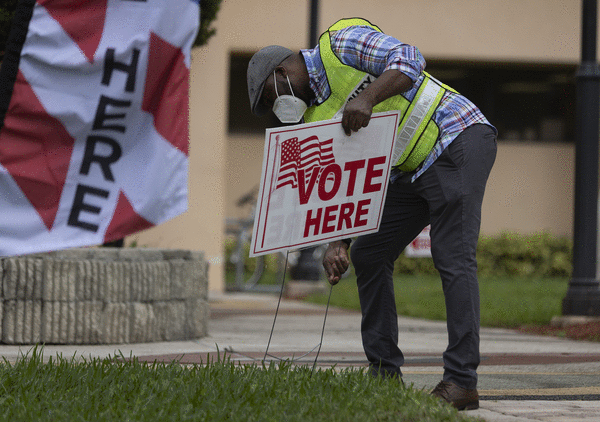
Republicans in the Florida Senate passed legislation Thursday requiring citizenship verification for all registered voters in the state, a central element of President Donald Trump’s demands for sweeping election-law changes.
The measure also would restrict the kinds of IDs Florida voters can use to identify themselves at the polls. Student IDs and retirement center IDs would no longer be valid; driver’s licenses, state ID cards, military ID and licenses to carry concealed weapons would still be accepted as proof of voter identity.
Voting rights advocates and Democrats said that House Bill 991 sounds as if it contains common-sense safeguards. But they warned that it could cause chaos for the voting public and election administrators — and prevent untold numbers of citizens from voting.
Sponsors made one major concession to critics: delaying the effective date. Instead of going into effect on July 1, just weeks before the Aug. 18 primary and months before the Nov. 3 general election, the provisions won’t be effective until after this year’s midterm election.
Opponents said there isn’t any evidence of more than a handful of noncitizens voting or other voter fraud in Florida elections. “There is no reason for these changes,” said state Sen. Tina Polsky, a Broward-Palm Beach county Democrat. “There is no evidence of noncitizens voting.”
The sponsor, state Sen. Erin Grall, R-Vero Beach, cited two criminal prosecutions of noncitizen voting — but said that supported her view of the need for change, not the opponents’ view that there isn’t a major problem.
“Some of you know people who have lost the election by a very small vote margin. So what is our tolerance for fraud and lack of integrity?” Grall said. “And yes, we have safe elections in Florida, but they don’t stay safe and secure if we don’t pay attention to the large gaps that exist where we can address additional fraud.”
Key provisions
Citizenship verification: The state voter registration database would be matched with the driver’s license database at the Florida Department of Highway Safety and Motor Vehicles, which has been verifying citizenship as part of bringing state drivers into compliance with federal REAL ID requirements.
Grall said so many people would have their citizenship verified that the behind-the-scenes process would be invisible to most people.
Opponents pointed to more than 800,000 people with driver’s licenses and state ID cards that don’t have REAL ID. And they could be flagged and required to present proof of citizenship — a birth certificate or passport — to stay registered.
And people who change their registrations, by changing political party affiliation or changing their names — mostly women through marriage and divorce — would be forced to prove their citizenship.
Identification: The legislation would scale back the IDs voters can present at the polls. Democrats argued strongly against removing student identification and retirement system identification, which have been accepted for decades for Florida voting.
They said many college students don’t have driver’s licenses and many older residents of retirement communities also haven’t renewed their licenses because they no longer drive. As a result, Democrats warned, those groups could be prevented from casting ballots.
Grall said it was a matter of ensuring people aren’t using counterfeit ID. Polsky suggested it was a ploy. “This is disenfranchisement. And we know it’s going to affect certain communities more than others. And isn’t that the point of the bill?” Polsky said.
Trump has pushed Congress hard to enact new restrictions on voting, including citizenship verification, in time for this year’s elections. He wants voter ID requirements nationwide, something Florida already has — and the new legislation is tightening.
House Bill 991 passed the Senate 27-12.
All Republicans, except state Sen. Alexis Calatayud of Miami-Dade County, voted yes. All Democrats voted “no.”
_____
©2026 South Florida Sun-Sentinel. Visit sun-sentinel.com. Distributed by Tribune Content Agency, LLC.






Comments