Minnesota Gov. Tim Walz staked his last year in office on a fraud fight that's already struggling
Published in News & Features
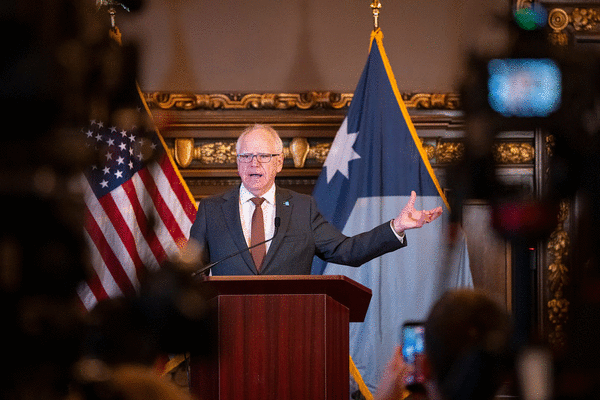
MINNEAPOLIS — Gov. Tim Walz has flooded state legislators with ambitious proposals to fight fraud in government programs, holding a series of briefings in recent weeks meant to show he’s on top of a problem that has largely defined his last act as governor.
But opposition from Republicans, skepticism from some fellow Democrats and a shrinking window of time raise doubts of whether the DFL governor can muster the political momentum to solve a complex crisis that threatens to stain his legacy.
Walz’s push comes after the Trump administration put a national spotlight on Minnesota’s fraud crisis, tarnishing his political reputation and prompting him to end his bid for re-election. With about 10 months left in office, he’s now seeking to reshape how Medicaid services are administered, modernize decades-old IT systems and expand existing fraud-fighting resources. One of his most significant proposals would centralize the administration of Medicaid services at the state level.
“It’s my intention that we leave Minnesota with the strongest program integrity and that we have a good step forward into a modernization effort that should have happened a long time ago,” Walz told reporters Tuesday, March 10. “I think the only way you can get some of these big things done is, you do them going out the door.”
It’s not clear how much — or if any — of his agenda will make it through Minnesota’s narrowly divided Legislature in an election year when every lawmaker is on the ballot.
The governor is already facing pushback from GOP legislators, who have questioned why Walz waited until his final year to propose such major changes. Walz’s office has circulated a timeline showing the many steps it’s taken in response to fraud — from halting payments to providers in high-risk programs to appointing a state fraud czar — but the vast majority came over the past year.
“The governor said this was an issue eight years ago when he came into office,” Rep. Paul Torkelson, R-Hanska, said of Walz’s proposal to centralize the administration of Medicaid. “Well, why didn’t we start addressing it eight years ago?”
Walz’s lame-duck status and historically tepid relationship with lawmakers at the Capitol could also get in the way of his proposals. As Walz unveiled his proposal to centralize Medicaid administration, DFL Sen. John Hoffman scolded him for not informing legislators about it ahead of time.
“Major structural changes to a system that serves hundreds of thousands of Minnesotans require thoughtful collaboration between the executive branch and the Legislature,” Hoffman, who chairs the Senate Human Services Committee, said in a statement.
Walz said he was disappointed by Hoffman’s response but insisted a complete overhaul of the state’s human services system is needed. The governor called Minnesota’s system “a bit of an outlier,” saying many states have more oversight and control of where money is going.
He wants the state Department of Human Services (DHS) to handle the administration of Medicaid services, shifting some work away from counties and cutting out managed care organizations like Blue Cross and Medica. Ending the state’s eight contracts with managed care organizations — which handle benefits for more than 80% of Minnesotans enrolled in Medicaid — would require legislative approval.
DHS Commissioner Shireen Gandhi said Walz’s proposals aren’t “business as usual.”
“These are bold ideas to address major challenges head-on,” she said. “The governor today is starting an important conversation about how we deliver and oversee the social services.”
But Torkelson, who co-chairs the powerful House Ways and Means Committee, declared the proposal “dead on arrival” and said Walz is trying to “put more responsibility on a state agency that acts irresponsibly.” A notable share of the fraud that’s been documented in Minnesota in recent years has occurred in programs run by DHS.
Rep. Kristin Robbins, R-Maple Grove, said Walz should work with legislators to upgrade the state’s antiquated IT systems rather than proposing sweeping structural changes that would take effect after he leaves office.
“I think the most helpful thing he could do in the last 10 months of his term is to help us really get the technology piece done, and then leave it to the next governor and the next administration to look at what should possibly be centralized,” said Robbins, who is running for governor and chairs the Fraud Prevention and State Agency Oversight Committee in the Minnesota House.
The technology upgrade is one of the few areas where Walz and lawmakers seem to be in alignment. The governor said he will offer a proposal to revamp the system in his supplemental budget package later this month.
Torkelson said he could support an additional proposal from Walz to study how the state’s human services system should be structured.
Beyond those changes, it may be difficult for Walz to find many more points of agreement. In the fight against fraud, Republicans have zeroed in on improving oversight power for legislators while Democrats have raised concerns about the privatization of social services.
Walz recently proposed a separate package of anti-fraud measures that included the creation of a statewide Office of Inspector General — something both Democrats and Republicans support. But even that proposal has stalled amid partisan disagreement over the details.
The governor has described Minnesota as being “at a crossroads” when it comes to fighting fraud and called on legislators from both parties to unite behind a joint proposal.
“We know this is a big undertaking,” Walz said. “It needs to happen.”
--------
—Jessie Van Berkel of the Minnesota Star Tribune contributed to this story .
©2026 The Minnesota Star Tribune. Visit at startribune.com. Distributed by Tribune Content Agency, LLC.




Comments