He has the mind of a child. His mom fears he's dying in the Tarrant County Jail
Published in News & Features
FORT WORTH, Texas — A man with intellectual and developmental disabilities has been in the Tarrant County Jail for more than a year, and his mother is growing more worried about his health and well-being with each passing day.
Since December 2024, Shawn Fraraccio, 26, has been held on a charge of continuous violence against a family member. In this case, Fraraccio’s mother, Christy Bridgman of Azle, is the alleged victim, but she told the Star-Telegram her son has the cognitive capacity of a 6- to 8-year-old, and she wants him released from custody.
Bridgman said Fraraccio once weighed over 200 pounds, but when she last visited him, he was skinny, unshaven and appeared disheveled. Bridgman added that Fraraccio showed signs of self-inflicted injuries from banging his head against his cell wall. Bridgman believes Fraraccio is going to seriously hurt himself, and since he’s alone in a single cell, no one is going to find him until it’s too late.
“He looks like he’s dying,” Bridgman said. “He’s meat and bones.”
According to Bridgman, Fraraccio is unable to care for himself. She said she previously had to help him bathe, shave and brush his teeth, and she’s seen no evidence jail staff are providing her son with that level of assistance. Additionally, Bridgman suspects staff aren’t giving Fraraccio his seizure medication as prescribed.
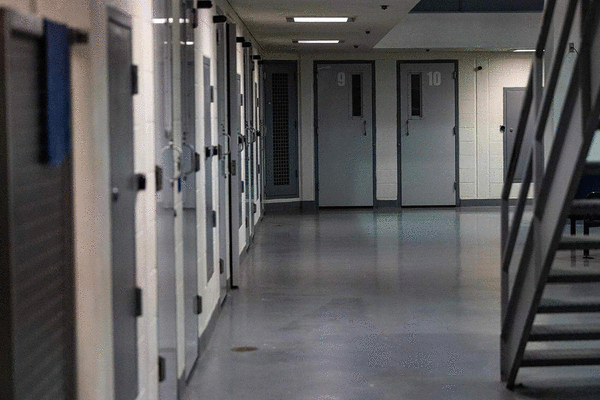
A Tarrant County Sheriff’s Office spokesperson couldn’t discuss Fraraccio’s medical care, but she did say Fraraccio was housed near the nurse’s station in the jail’s infirmary, and that he has his own toilet and is given the chance to shower every other day, per minimum jail standards.
The spokesperson said Fraraccio is also receiving additional attention that most inmates don’t get. Fraraccio has, for example, a more comfortable mattress, the spokesperson said. And he is allowed to change clothes three times a week as opposed to once a week, which is standard. As for Fraraccio’s diet, the spokesperson said he has the opportunity to request a liquid supplement “to ensure proper caloric intake.”
When asked about Bridgman’s concern that Fraraccio is being left unattended in his cell, the Sheriff’s Office spokesperson said jail staff perform checks every 20 minutes “in areas where inmates are known to be assaultive, potentially suicidal, mentally ill or who have demonstrated bizarre behavior.” The spokesperson said that exceeds the state minimum standards, which call for checks every 30 minutes on at-risk or high-risk inmates.
Why has Fraraccio remained in Tarrant County Jail without being convicted of a crime?
Fraraccio was arrested twice in December 2024 on suspicion of domestic violence. Court records showed he was accused of striking his mother both times with his hand.
Bridgman said the first time Fraraccio was arrested, someone in her apartment complex overheard the altercation and called the police. The second time, Bridgman said she was on the phone with someone from My Health My Resources of Tarrant County during an altercation with Fraraccio. The MHMR representative became alarmed and called police.
MHMR is a state-contracted nonprofit that provides mental health services and services to the intellectually disabled. The organization partners with the Tarrant County Sheriff’s Office to offer resources to jail inmates as well.
Regarding the abuse allegations, Bridgman said Fraraccio sometimes gets agitated and acts out, but Bridgman doesn’t believe he knows what he’s doing. She described Fraraccio’s behaviors as child-like.
A Tarrant County grand jury indicted Fraraccio in March 2025. His court-appointed attorney did not respond to a request for comment.
In May 2025, Fraraccio was deemed incompetent to stand trial. A county mental health magistrate ordered him to remain in jail without bond until he can be placed in a State Supported Living Center, or SSLC, for people with intellectual disabilities. Once there, Fraraccio will be evaluated to see if he can gain the competence needed to proceed with his criminal case.
Susan Garnett, chief executive officer of MHMR, said placement decisions are in the hands of Texas Health and Human Services, the state agency that oversees the SSLCs. MHMR is virtually powerless to intervene to have someone moved from a jail to an SSLC.
Once an intellectually disabled defendant enters the judicial system, the process has to run its course, said Garnett. It can take months or even years for someone like Fraraccio to be admitted to an SSLC. In the interim, those individuals often remain in jail with no options unless prosecutors move to dismiss the charges.
A spokesperson for the District Attorney’s Office said Fraraccio’s case is essentially on hold until “competency is restored” in an SSLC. But Bridgman said she’d been told it could be another year before her son is admitted into one of those facilities. Even then, Bridgman doubts Fraraccio’s competency can ever be restored.
Garnett said delays in moving an inmate to an SSLC are the norm. There are only 2,700 SSLC beds in Texas, Garnett said, and only a portion of those are classified as “forensic beds” for people facing criminal charges.
As the victim in this case, Bridgman said she filed an affidavit of non-prosecution with the District Attorney’s Office asking the prosecutor to drop the charges against Fraraccio, but she hasn’t received a response.
When asked about that, the spokesperson for the District Attorney’s Office said they “may take into account and factor in an affidavit of non-prosecution when making case decisions.”
The affidavit does not, however, guarantee the prosecutor will decline to pursue criminal charges. The District Attorney’s Office spokesperson provided the following statement to the Star-Telegram regarding the decision to prosecute Fraraccio:
“The safety of our community is our goal. Medical professionals have told us this defendant needs to be in a state supported living center. Our concern is for the safety of his mother, his safety and the safety of the community in general. Mr. Fraraccio needs the proper care to accomplish this goal.”
On March 10, Bridgman and her supporters appealed to the Tarrant County Commissioners Court to expedite Fraraccio’s move to an SSLC. Bridgman said she decided to go public with Fraraccio’s story and bring it to the attention of the commissioners because she feared her son will die in custody.
Since Tarrant County Sheriff Bill Waybourn took office in 2017, more than 70 inmates have died in Tarrant County Jail from causes ranging from malnutrition and dehydration to use of force by jail staff, as was the case with Anthony Johnson, whose death was ruled a homicide.
The Sheriff’s Office has said there have been fewer in-custody deaths in Tarrant County than in Dallas, Harris and Bexar counties. According to data shared by the Sheriff’s Office, from 2017 through 2025, there were 109 deaths in Bexar County, which encompasses San Antonio and has a similar jail capacity as Tarrant County. The Dallas County and Harris County jails are larger. Dallas County saw 77 inmate deaths between 2017 and 2025 and there were 140 in Harris County during that time.
Garnett said there were probably five or six inmates in Tarrant County like Fraraccio who are awaiting transfer to an SSLC. She couldn’t speak directly to Fraraccio’s case because of privacy restrictions, but Garnett said it’s discouraging and often heartbreaking when someone with intellectual and developmental disabilities languishes in jail because of a lack of state resources and an unwillingness on the part of prosecutors to fully consider the defendant’s cognitive capacity.
_____
©2026 Fort Worth Star-Telegram. Visit at star-telegram.com Distributed by Tribune Content Agency, LLC.






Comments