For Israel, Iran war culminates battle begun by Hamas attack
Published in News & Features
At dawn on Saturday, Oct. 7, 2023, as rockets and gunmen poured into Israel from Gaza, Hamas military chief Mohammad Deif declared the Jewish state finished: “To our brothers in the Islamic resistance in Lebanon, Iran, Yemen, Iraq and Syria, the day has come.”
The day did come, but not the one Deif imagined.
He’s dead, along with a generation of fellow Islamist leaders at the hands of Israel, which has emerged as a regional hegemon. And Hamas’ principle benefactor, Iran, is being systematically dismantled. And while the question of Palestinian statehood was thrust onto center-stage by the Gaza war, it’s out of focus again as the region’s future is recast by a joint U.S.-Israeli war on Tehran.
“This is a war of redemption that began on October 7,” Ophir Falk, foreign affairs adviser to Prime Minister Benjamin Netanyahu, said. “We took out the Islamist leadership and commanders across the region and now we’re removing the existential threat of the ayatollah’s regime that’s been terrorizing the world for 47 years.”
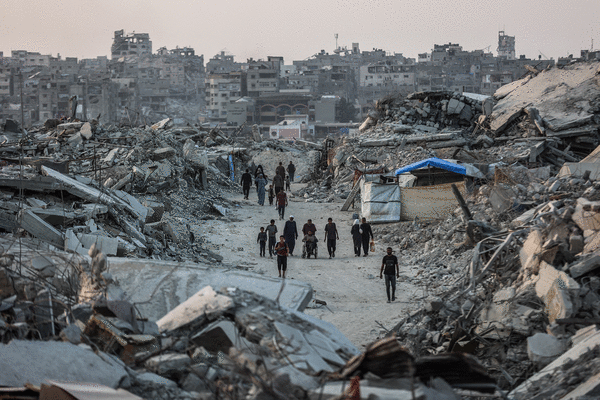
Many outside Israel don’t see the connection. For them, the 2023 Hamas attack and the brutal Gaza war it triggered — killing tens of thousands of Palestinians and reducing vast portions of the territory to rubble — are a tale of Israeli oppression and vengeance.
That has deeply tarnished its international standing and made the prospect of building ties with Middle Eastern countries more remote.
“Forget normalization,” former Saudi Arabian intelligence chief Prince Turki al-Faisal told CNN on Wednesday. “This is Netanyahu’s war.”
But perhaps more importantly, Israel’s actions since Oct. 7 have alienated many in the U.S., the country’s most important ally. Last week, Gallup released a poll that showed for the first time more Americans sympathize with Palestinians than with Israelis, 41% to 36%. That’s compared to a 54%-31% split in favor of Israel three years ago. Among 18-34 years old, the figures are even starker — barely a quarter favor Israelis.
The war with Iran has drawn similar bipartisan condemnation, with politicians and commentators across the political spectrum accusing Israel of dragging Washington into battle after Secretary of State Marco Rubio suggested that Israel’s determination to strike the country had forced the U.S. to act.
In a further sign of Israel’s precarious place in political discourse, California Gov. Gavin Newsom, a leading contender for the 2028 Democratic presidential nomination, this week said the U.S. should rethink its military partnership with Israel. He likened Israel to “an apartheid state.” That kind of language would’ve been unthinkable for a leading American politician only a few years ago.
As the war wears on, it’s also increasing the chance of friction between the U.S., which sees it as a conflict of choice, and Israel, which considers it existential. While U.S. President Donald Trump has repeatedly floated regime change, his administration has been at pains to say its targets are military and nuclear, while Israel’s are aimed at the state and at sparking an internal uprising that will topple the Islamic Republic.
“It seems the Israelis have one target list, and the U.S. has another,” said Richard Clarke, a former White House official and assistant secretary of state. “I can imagine a couple weeks from now the U.S. military saying we’ve bombed everything we want to bomb, and Trump might declare we’re over.”
Still, for most Israelis — polls show more than 80% backing the current war — the past two-and-a-half years offer a kind of straight line indicating what they now consider to have been a dangerous complacency that they successfully overcame in the name of survival.
“October 7 was a national wake-up call,” says Elad Levy, who owns a hair salon in central Tel Aviv. “We will never again let down our guard. For a lot of us, it was a kind message from God.”
Oct. 7, 2023, was both the Jewish Sabbath and an Israeli holiday. Thousands of young people were dancing at a rave in the desert 3 miles (4.8 kilometers) from the Gaza border. On military bases nearby, soldiers slept in their beds. Israel and Saudi Arabia were close to normalizing relations, even without the Palestinians in the occupied West Bank and Gaza getting much in the way of progress toward independence.
Hezbollah in Lebanon and Hamas in Gaza had tens of thousands of missiles aimed at Israel, but the assessment was they were deterred and not about to fire them. The Houthis of Yemen, despite calling for “death to Israel,” weren’t firmly on the Israeli intelligence radar — they were deemed too far away, and thus not a serious threat.
But the shock attack by Hamas brought others: with 250 hostages dragged into Gaza and gunmen still hiding around southern Israel, militias in Lebanon, Syria, Iraq and Yemen fired at the Jewish state in solidarity with Hamas.
Israel found itself in a multi-front war for which it was unprepared. It was a massive shock for Netanyahu, who’d long campaigned as Mr. Security and touted his unique ability to anticipate threats to the nation.
He’d been lured — along with most of the security establishment — into believing that Hamas wouldn’t dare. He’d encouraged Qatar to send money to Gaza, permitted some Gazans to work in Israel and boosted Gaza Islamists as a counterweight to the more secular Palestinian Authority based in the West Bank. It was a kind of divide-and-conquer strategy to prevent Palestinian sovereignty.
As he sprung into action on that day, pale and shaken, Netanyahu was considered to be done. In the middle of a corruption and bribery trial, presiding over the worst security lapse in the country’s history, he would resign or be forced out, according to a chorus of commentators.
Yet today, Netanyahu, 76, along with Trump — another figure then widely dismissed as a has-been — are together, in the Israeli leader’s words, “changing the face of the Middle East.”
That began in Gaza, which the Israeli military bombarded, leaving more than 72,000 dead, according to the Hamas-run health ministry, sparking a global backlash and leading to an international arrest warrant for Netanyahu.
In Israel, while there has been muted criticism of the war’s conduct, the overwhelming focus was on freeing the hostages and the legitimacy of a war against a group that openly seeks Israel’s destruction. The political battle in Israel was over fighting harder, not pulling back.
Netanyahu’s reinvention
It was a moment when Netanyahu sought to reinvent himself once again. The son of an historian, he faced his Neville Chamberlain moment by, many said, remaking himself as Winston Churchill, persuading his U.S. ally to join him in defeating his enemy.
He did that first with President Joe Biden and then Trump. But those close to Netanyahu see a different historical figure as a model: Franklin Roosevelt, U.S. president during the Japanese attack on Pearl Harbor. Rather than cowing after that failure, Roosevelt turned it into the basis for U.S. military supremacy and Allied victory over Germany and Japan in World War II.
Netanyahu followed a similar path, promising on Oct. 8, 2023, to remake the Middle East. Israeli security officials say the country was lucky Hezbollah didn’t invade from the north as Hamas hoped, instead limiting itself to shooting missiles over the course of a year.
Methodically, the Israeli military and intelligence services took on their regional enemies, killing their leaders, and taking out many of their Lebanese operatives when their pagers blew up in their pockets in a spectacular 2024 attack. A ground incursion into Lebanon followed soon after. There were numerous air sorties over Syria, Iraq and Iran.
Israel also used the opportunity the war presented to further take control of the West Bank, where Jewish settler violence against Palestinians has soared, making the prospect of a Palestinian state even more remote.
Israel is pouring money into its military while many of its young people turn rightward and more religious. It has remade its security doctrine, placing troops outside its borders, setting up a department to defeat the Houthis, and shifting focus from its opponents’ intention to their capacity. The aim now is to strike first rather than wait and react to an attack.
Today, if Israel sees that an opposing military or militia can threaten it, it will act preemptively. That’s considered by many a violation of international law. So far, the U.S. under Trump has backed Israel.
And global markets have too. After initially plummeting, Israeli assets rose during the course of the war. Israeli stocks have been among the world’s best performers since the start of 2025, rising 114% in dollar terms. Foreign investment has picked up.
In the past past week, stocks have slumped globally with the war causing an effective closure of the Strait of Hormuz and oil prices spiking. Yet the Tel Aviv Stock Exchange 35 Index, the country’s benchmark equities gauge, gained almost 7% in dollars. It was the world’s second-best performer, while the shekel strengthened more than any other currency.
Netanyahu is no longer being written off. Even those who despise him suspect he may be reelected this year.
“If this round ends quickly, Netanyahu will proudly ride it to the ballot box,” lamented Aluf Benn, editor-in-chief of Haaretz, Israel’s left-leaning daily newspaper, in a column expressing anger that “the masses in Israel and the countries of the region have been cast in the role of cannon fodder and collateral damage.”
Indeed, many around the globe watch what’s happening in Iran with alarm — remembering the “forever wars” of the U.S. in Iraq and Afghanistan. Frustration with the war in countries such as the United Arab Emirates, where cities like Dubai and Abu Dhabi are being targeted by Iranian drones and missiles, is rising.
Regional and military experts say they’re horrified by what they consider poor planning by Israel and the U.S. for what follows in Iran. That’s only heightened by reports Trump may be considering ground troops in Iran, and by others saying Washington and Israel are working on getting Kurdish forces to take up arms against the Iranian government.
In Israel, however, there is cautious optimism, despite ongoing missile attacks. The broad sense is that the country is in a much stronger position geopolitically and militarily than two-and-a-half years ago.
And no matter what emerges in Iran, it will be weaker and less of a threat. Israel’s ultimate goal is to see a new Iranian government that, like the monarchy before the 1979 Islamic revolution, has warm relations with it and the US. Few, whether in Israel or outside, are betting on that happening soon. There’s just as much chance that Iran is Balkanized, turned into a failed and lawless state.
Meanwhile, Israel hopes that Iran’s decision to fire upon Gulf Arab states — despite most of them not wanting the war and barring U.S. and Israeli forces from using their airspace for offensive purposes — will win those countries over to the Jewish state’s side.
That’s far from guaranteed. Arab populations were appalled by the suffering of Palestinians during the war in Gaza. And many of their governments are increasingly concerned about Israel’s military forays abroad.
The biggest concern for Israel is the growing disillusionment with it in the U.S. The fear is that Trump — who faces tough midterm elections in November — loses patience with the war before Iran’s military capacities are destroyed. Already, American gasoline pump prices have risen along with oil prices.
“We need to pray that Trump doesn’t balk,” wrote Ben Caspit, an anti-Netanyahu commentator in Maariv newspaper.
———
(With assistance from Ben Bartenstein, Peter Martin and Chris Miller.)
©2026 Bloomberg L.P. Visit bloomberg.com. Distributed by Tribune Content Agency, LLC.





Comments