Trump demands Iran relent while US aims to calm energy markets
Published in News & Features
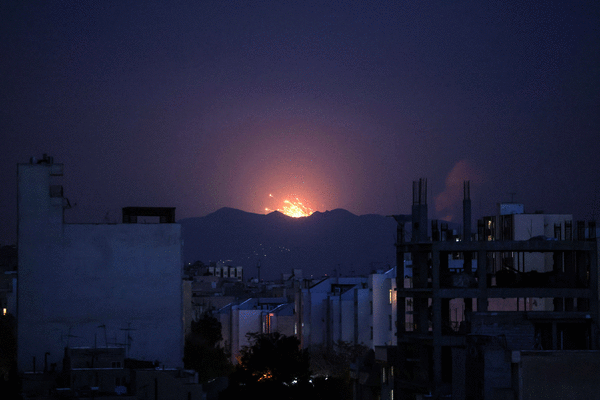
WASHINGTON — President Donald Trump demanded Iran capitulate in the war’s seventh day, suggesting a longer timeframe for the conflict even amid energy-market tumult and worries about whether the U.S. has the military stockpiles to carry on the fight indefinitely.
Trump called for “UNCONDITIONAL SURRENDER!” and noted a plan for the U.S. and its allies to select a “GREAT & ACCEPTABLE Leader(s).” Hours later, he hosted defense industry executives at the White House to underscore the need to step up production of critical weapons systems.
“They have agreed to quadruple Production of the ‘Exquisite Class’ Weaponry in that we want to reach, as rapidly as possible, the highest levels of quantity,” Trump posted on social media after the meeting, referring to the most expensive U.S. hardware. He repeated that the U.S. has “a virtually unlimited supply” of medium- and upper-medium grade munitions.
The White House also pushed back on worries around surging energy prices. U.S. crude futures ended the week above $90 a barrel — more than $20 above last Friday — and notched the biggest weekly percentage gain on record in data going back to the 1980s. Brent crude settled above $92 a barrel after both benchmarks touched the highest levels in more than two years during the session.
White House press secretary Karoline Leavitt cited “tangible actions” to ease what she said was a predicted spike, including Trump’s pledge to provide insurance to cargo vessels in the region and even U.S. Navy escorts if needed.
She also suggested in a Fox News interview that “drilling expeditiously at home” and tapping newfound markets in Venezuela would help calm markets, while National Economic Council Director Kevin Hassett told Bloomberg Television the administration has “many, many” tools to address the surge in oil prices. U.S. prices at the pump rose Friday to the highest since September 2024.
Oil traders are warning $100 could be on the horizon sooner rather than later as shipping through the Strait of Hormuz remains at a near-total halt and energy exporters are scrambling for routes out of the region. Citigroup Inc. estimated that the crude oil market is losing about 7 million to 11 million barrels a day of supply ecause of the disruption through Hormuz, a chokepoint for a fifth of global oil flows.
Iran on Friday warned that it would strike U.S.- and Israel-linked ships in the strait.
With no clear timeline for the end of military operations, countries in Europe and Asia also have been moving to bolster the region’s defenses.
Ukrainian President Volodymyr Zelenskyy said he ordered his forces — who have gained expertise during the four-year-old Russian invasion — to help “guarantee the required security” in response to a U.S. request to aid in protecting the Middle East against Iran’s Shahed drones.
Italy intends to send air-defense systems, as well as counter-drone capabilities, to the Gulf, Defense Minister Guido Crosetto said Thursday. South Korea said it’s in talks with the U.S. about the possible redeployment of weapons, including Patriot air-defense systems. France has authorized U.S. military support aircraft not involved in operations in Iran to use Istres Air Base, AFP reported.
NATO said it was boosting its missile defense posture following the downing on Wednesday of an Iranian missile heading toward Turkish airspace.
German Chancellor Friedrich Merz warned the U.S. and Israel against waging an “endless war” that could lead to the disintegration of Iran, a new migration crisis in Europe and lasting economic damage.
Iran fired a barrage of missiles and drones targeting a number of Gulf countries overnight and into Friday, with particularly powerful blasts heard in Kuwait. Bahrain and Saudi Arabia were also attacked. Missile alerts were sent in Dubai on Friday for a second day, although residents were quickly given the all-clear.
Israel — acting with the U.S. — maintained airstrikes on the Islamic Republic. The country’s forces “significantly expanded” a ground presence inside Lebanon, where forces have stepped up their assault on Tehran-aligned Hezbollah, and unleashed a wave of airstrikes on Beirut’s southern suburbs.
The U.S.-Israeli war has left at least 1,332 people dead in Iran so far, and dozens of others have been killed elsewhere in the region in retaliatory strikes. Six U.S. troops have been reported killed. In all, around a dozen countries have been embroiled in the conflict.
Posting before Trump’s comments demanding surrender, Iran’s President Masoud Pezeshkian said that some countries have initiated efforts for mediation. While the Islamic Republic is “committed to lasting peace,” he said, it will continue to defend itself.
Earlier this week, Iran denied a report that its Ministry of Intelligence reached out to the U.S. to negotiate a resolution.
Trump vowed on Thursday to “totally demolish” Iranian forces, telling NBC he wanted to “clean out” Iran’s leadership structure and had names in mind to take over. That suggested the U.S. sees regime change as the ultimate goal, after days of conflicting explanations for why it launched the war and how the administration saw it playing out.
Israel Defense Forces Chief of Staff Eyal Zamir said strikes have neutralized more than 60% of Iran’s ballistic missile launchers. Iran’s navy has also suffered devastating losses.
Iran is poised to elect a successor to Supreme Leader Ali Khamenei, who was killed on Feb. 28, the first day of the war. Mojtaba Khamenei, the slain leader’s second-oldest son, is in the running. Trump said he was a “lightweight” who wouldn’t change the regime’s policies and insisted on being personally involved in picking the country’s next leader.
Airlines remain hamstrung by the conflict, with the number of canceled flights to Middle East hubs surpassing 23,000 since fighting began. Thousands of passengers remained stranded in the Gulf region, although on Friday Emirates said it’s aiming for a return to full network operations in coming days.
Arab states reported intercepting Iranian projectiles overnight into Friday. Bahrain said a unit at its Sitra refinery, the region’s oldest, caught fire after being struck by a missile. Qatar thwarted an attack targeting Al Udeid Air Base, a U.S. military facility. The U.S. suspended operations at its embassy in Kuwait.
Saudi Arabia said it had intercepted multiple missiles and drones overnight. The kingdom is diverting millions of barrels of crude to a port on its Red Sea coast, helping the world’s top exporter maintain supplies.
(Hadriana Lowenkron and Devika Krishna Kumar contributed to this report.)
©2026 Bloomberg L.P. Visit bloomberg.com. Distributed by Tribune Content Agency, LLC.






Comments