Hundreds of San Diego County schools, parks and care facilities are near potentially dangerous oil wells, data show
Published in News & Features
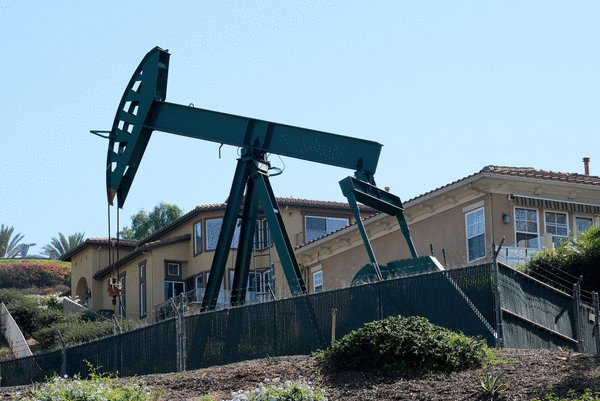
SAN DIEGO — Hundreds of schools, child cares, parks and other care facilities around San Diego County are located near idle oil wells, which can emit toxic gases, a new study finds.
They’re among the nearly 4,500 wells statewide that an analysis of state data by the Center for Biological Diversity found are within 3,200 feet of such sensitive locations. That’s the minimum distance state law requires new oil and gas drilling to be from such sites.
Idle wells no longer produce oil or gas, but because they remain unplugged, they can emit explosive gases like methane and toxic chemicals like benzene, said Emily Diaz-Loar, a staff scientist at the environmental nonprofit. The group has pushed to speed up capping idle wells.
California has prohibited new drilling within 3,200 feet of these sensitive sites based on studies of the health harms of pollutants coming from oil and gas activity. Idle wells can also release harmful pollutants, yet thousands of idle wells remain unplugged within these health protection zones.
“Children, seniors and sick people are more sensitive to the pollutants that can potentially come from these idle wells, because their immune systems are not as strong or not as developed,” Diaz-Loar explained. “That’s why we chose to focus on these sensitive sites in particular, and the number of idle wells that are surrounding them.”
An analysis performed for The San Diego Union-Tribune found at least 25 idle oil wells close to sensitive locations around the county — 29 K-12 schools, 73 parks or recreation areas, 38 child care facilities, 19 residential care facilities for the elderly and 53 healthcare facilities.
One oil well in National City is near four schools and five health care facilities, for example.
Another several are near the U.S.-Mexico border; both San Ysidro High School and Sunnyslope Elementary are shown to be within 3,200 feet of one. That area is also dealing with effects of other toxic pollutants stemming from the Tijuana River Valley sewage crisis.
Nearly half of the county’s idle wells are in the South Bay, most of them concentrated around Imperial Beach. More are located in central San Diego, in neighborhoods including Clairemont, Mission Valley, Point Loma and Carmel Valley.
Others are scattered around North County, from Escondido to Oceanside. Countywide, most of the idle wells are in areas near the coast.
“Even though San Diego County doesn’t have the same super-high number of idle wells as other counties in California, like L.A., for instance, residents should still be aware,” she said.
The nonprofit performed in-depth analyses of five counties — Kern, Los Angeles, Ventura, Santa Barbara and Monterey. San Diego was not among them, but it was included in an interactive map showing the sensitive areas near wells.
Of the counties analyzed in depth, Los Angeles County had the highest concentration of idle wells, with more than 2,800 of them within 3,200 feet of a sensitive site. Nearly a third of those have been unplugged for more than a century, and 90% are within the city of Los Angeles.
“Older wells can be more likely to leak explosive gasses and toxic chemicals, and in an urban area with such high population density, the presence of these idle wells is potentially very dangerous,” Diaz-Loar said.
She pointed to one pre-school that is within 3,200 feet of 328 idle wells.
To address the issue, the Center for Biological Diversity is pushing for faster plugging of idle wells, prioritizing the effort near sensitive locations and making oil and gas companies pay for it. It also wants more methane monitoring of idle wells within 3,200 feet of sensitive locations.
California has tried to accelerate the pace of plugging idle oil wells in recent years. One new state law enacted in 2024 set requirements for oil and gas companies to plug certain percentages of their idle wells each year — between 5% and 15% each year at first, but larger shares after 2027.
But if a well is deserted or an operator insolvent, the state can be responsible for plugging it. It has plugged and abandoned around 1,400 wells, at a cost of nearly $30 million, since 1977.
©2026 The San Diego Union-Tribune. Visit sandiegouniontribune.com. Distributed by Tribune Content Agency, LLC.






Comments