Illinois' Cook County top prosecutor circulates policy outlining process for charging federal immigration agents
Published in News & Features
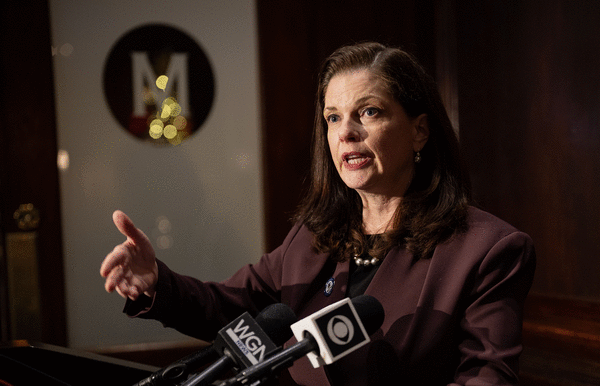
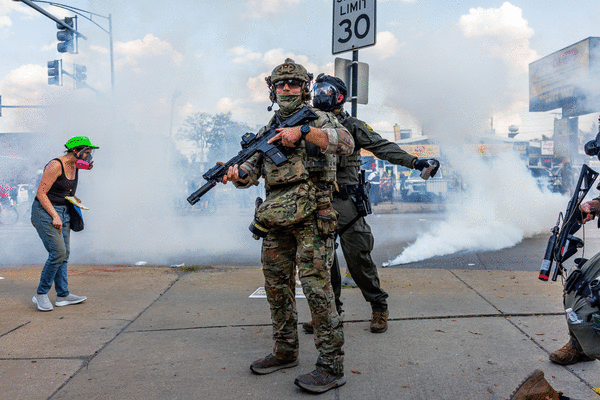
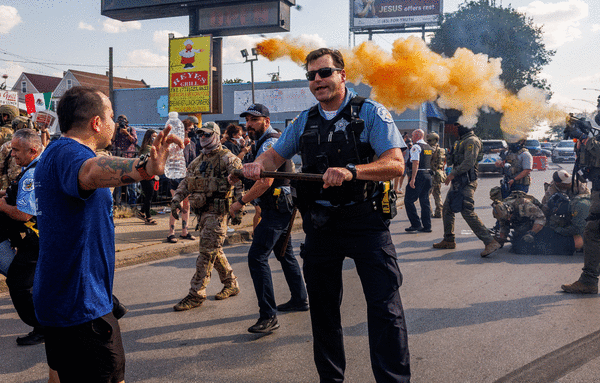

CHICAGO — The Cook County state’s attorney’s office on Thursday released a protocol outlining the steps for filing charges against federal immigration agents, marking the first official policy from the office on the topic amid uproar over agents’ conduct in the Chicago area and a public feud between the mayor and State’s Attorney Eileen O’Neill Burke.
The policy document provides a legal analysis of the rare and complex scenario that would involve an on-duty federal agent being charged by a state prosecutor and is meant to guide law enforcement investigating potential offenses and line prosecutors reviewing the cases.
“No one is above the law — including both ICE agents and prosecutors,” Burke said in a news release announcing the policy. “If a federal law enforcement agent commits a crime, my office will not hesitate to act, in accordance with state law. This protocol establishes clear, legally sound guidelines to ensure we have a responsible and effective path to pursue accountability.”
The document, though, notes that prosecutors must consider federal immunity — which is not absolute but offers some protection for agents — among other factors.
The U.S. Supreme Court established decades ago that, in general, a federal officer cannot be held on a state criminal charge where the alleged crime arose during the performance of his federal duties, though charges can be brought if the officer’s actions were so egregious they could not have reasonably believed it was in accordance with their official duties
For months, advocacy groups have called on Burke, Illinois Attorney General Kwame Raoul and other local prosecutors to file charges against immigration agents accused of battering civilians and other misconduct during the Operation Midway Blitz enforcement action, even as officials threw cold water on the idea.
But the idea gained more traction after Minnesota officials attempted to begin a state investigation into the shooting of Renee Nicole Good in January, putting pressure on officials here to respond to calls for criminal prosecutions.
The protocol says that the office will review investigations conducted by law enforcement, but notes that prosecutors “do not serve the primary role of investigator in criminal cases and defer to law enforcement agencies to perform investigative duties.”
The document also says that law enforcement should collect and document evidence as it otherwise would when officers become “aware, through the report of a victim, witness, video evidence, personal observation, or other form of evidence of a death, shooting, act of violence,or use of force incident related to federal immigration enforcement activity that may constitute a felony criminal act.”
Johnson has also directed Chicago police to collect specific information when responding to the scene of immigration enforcement actions, including the names and badge numbers of ranking federal agents. It also directs police to preserve and document body-camera footage, notify supervisors if people on site allege immigration agents broke the law and complete more reports that Johnson’s team says would build a foundation for prosecution.
When evidence is in possession of a federal agency, the policy says, the state can request production of evidence or testimony through a process called a “Touhy request,” named for a 1951 U.S. Supreme Court decision.
The protocol was circulated to Raoul’s office and the Illinois State’s Attorneys Association.
In a statement included in Burke’s office’s new’s release, Raoul said: “I am proud to stand with State’s Attorney Burke and fellow prosecutors committed to using every lawful tool available to hold this administration accountable consistent with this protocol.”
The policy follows the public airing of a beef between Burke and Johnson over an executive order Johnson signed last month directing Chicago police to collect evidence, investigate and potentially refer for felony prosecution criminal charges against federal immigration agents accused of misconduct. But the order led to a rebuke from Burke, who said her office was not given ample opportunity to weigh in on the order.
In particular, her office took issue with a passage in the order that said the mayor’s office would be involved in referring cases to prosecutors, a procedure that the prosecutor’s office said would imperil potential cases by politicizing the process.
Johnson’s administration and Burke’s team had discussed the executive order via email and phone calls before the announcement, according to records obtained by the Tribune via a Freedom of Information Act request that shed more light on the rare public disagreement.
Five days before the measure was unveiled, Yvette Loizon, Burke’s policy and external affairs chief, promised to talk on the phone after a Johnson staffer flagged the policy as “time sensitive.”
But disagreement quickly emerged when Johnson’s policy chief, Sheila Bedi, reached out to Loizon an hour after the mayor announced the measure.
Bedi requested Loizon meet to discuss implementation and credited Loizon’s input for leading to changes that focused the order on potential felonies. In her response, Loizon accused Johnson of describing Burke’s support in “a callous and incorrect manner.”
“At no time did we ever approve or even see any final order, and speaking over the phone about a few sentences does not, in any way, constitute collaboration,” Loizon wrote.
In response, Bedi cited a past conversation in which she said the two had “carefully workshopped” the part of the executive order that referenced the state’s attorney’s office. She also cited Burke’s past pledges to review criminal referrals alleging federal immigration agents had broken laws.
“The Mayor had every reason to understand that the [State’s Attorney’s] Office was aligned with the approach,” Bedi wrote.
“The Mayor falsely stated that [Burke] fully supported an Executive Order that we never read or received, even after making that request directly to you,” Loizon responded. “The Mayor had absolutely no reason to make the statements he made because they are untrue.”
____
©2026 Chicago Tribune. Visit at chicagotribune.com. Distributed by Tribune Content Agency, LLC.






Comments