At 65 degrees, Chicago breaks century-old record for warmest Feb. 16 in history
Published in News & Features
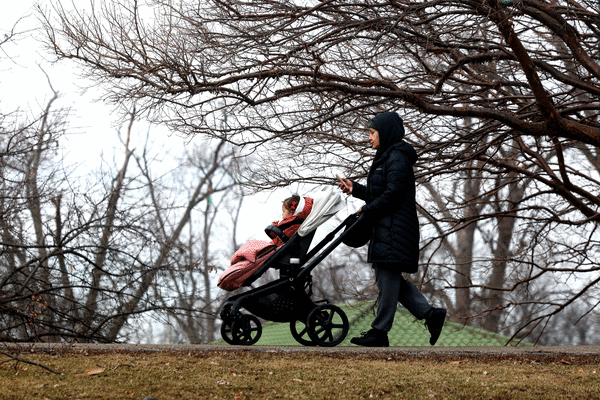
CHICAGO — After a snow-steeped and sometimes bone-chilling January, Chicago is enjoying a downright balmy — even record-setting — start to the week.
But don’t pack up your sweaters just yet.
The glimpse of spring will remain just a preview as temperatures dial back down this weekend to the brisk conditions more typical for this time of year, weather officials say.
O’Hare International Airport hit a high of 65 degrees Monday, marking the warmest Feb. 16 on record in Chicago, according to National Weather Service data. The previous bar was set in 1921 at 58 degrees.
On average, the normal temperature for Feb. 16 is 28.9 degrees, with the average temperature for the month also in the mid- to high 20s, weather service data shows.
Much of this winter has been defined by what weather officials deem “Northwest flow,” which allows air from Canada and the Arctic to spill southward, said Brett Borchardt, senior meteorologist with the National Weather Service in Chicago. This weather pattern has brought record-breaking snowfall, below-freezing temperatures and massive storms.
Following years of little snow across the Chicago area, this winter might seem to contradict scientific reports of winters getting warmer. But trends in recent decades point to an overall warming of average temperatures across all seasons from human activities such as fossil-fuel burning that release heat-trapping gases into the atmosphere. And that overall warming doesn’t rule out some occasional outliers, including extreme cold and winter storms.
Temperature variability day to day is at its highest in January and February, according to Trent Ford, Illinois’ state climatologist.
“It’s something that we see pretty much every single season,” he said.
But what’s “astounding,” Ford continued, is how wide the magnitude of that variability is starting to stretch. Ford noted that in late January, the region was 20 to 30 degrees below average for a daily high. Now, the temperatures have flipped to a mid-February extreme mild not seen in decades.
That gap is indicative of the Midwest’s changing climate, Ford said.
“When I get a day like this, obviously I want to be outside and enjoy it because it’s been so cold for so long,” Ford said. “But, really, what I think about … (is) the fact that we (broke) a record because that variability is on top of a warming trend, making it more likely that we can have these eye-popping temperatures in the middle of February.”
The flash of warm weather is supposed to stick around through at least midweek, according to Borchardt. Tuesday will see slightly cooler temperatures in the mid-50s followed by an even warmer Wednesday, which could see highs in the mid-60s — if not a little bit hotter. The record for Feb. 18 is 70 degrees set in 2017.
By Friday and into the weekend, though, “reality settles back in,” with daytime highs dipping back into the 30s and 40s, Borchardt said. The springlike temperatures are a function of a “favorable pattern” of southwesterly winds transporting unseasonably warm air to the Chicago area, Borchardt said.
Last week, the Trump administration dismantled the country’s ability to fight climate change when it repealed the scientific determination that underpins federal greenhouse gas regulations, delivering one of the most dramatic reversals of U.S. climate policy.
The administration also last week denied the state’s appeal for a disaster declaration that would have unlocked federal assistance to thousands of residents affected by heavy rains and flooding last summer, a decision that Gov. JB Pritzker denounced as politically driven.
Ford said on days like Monday, when the warm weather is a welcome respite from weeks of cold, it’s hard to see the real-time impact of overall warming. But there is a consequence of more frequent mild stretches through the wintertime, he said, from creating more conducive conditions for invasive species and animals to affecting plant growth and development.
And moves like last week’s, Ford said, make climate progress harder.
_____
Chicago Tribune’s Adriana Perez contributed.
_____
©2026 Chicago Tribune. Visit chicagotribune.com. Distributed by Tribune Content Agency, LLC.





Comments