Florida governor could brand groups as terrorists, alarming free speech advocates
Published in News & Features
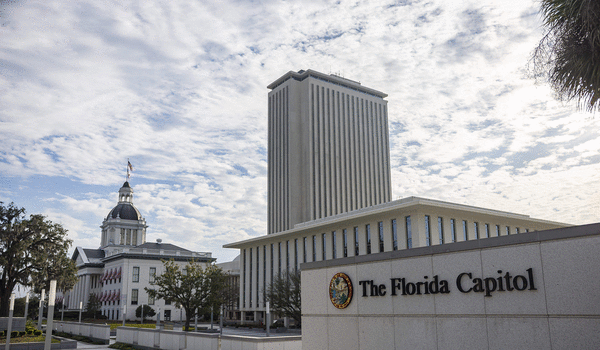
TALLAHASSEE, Fla. — State lawmakers this session are considering changing state laws that could affect what Floridians can say, write and read.
Legislators are weighing giving the governor broad powers to brand groups as “terrorist organizations” and expel college students who support them. They’re proposing forbidding the state from referring to the “West Bank” and imposing more restrictions on school books.
Several of the ideas have bipartisan support. But they’ve received pushback from free speech advocates and trade union representatives. They’ve also divided Republicans, who in recent years have decried what they said was censorship in the forms of political correctness and “cancel culture.”
Republican senators bowed to some of those criticisms on Tuesday. SB 290, backed by Agriculture Commissioner Wilton Simpson, included a provision that would have allowed more food producers to sue people for “disparagement” of their products — and recoup the attorneys’ costs.
The idea was sharply criticized online as an affront to Robert F. Kennedy Jr.’s “Make America Healthy Again” movement and as a giveaway to agricultural producers, including pesticide manufacturers.
“Big ag should be open to public criticism, especially if they’re trying to make people sick,” Republican U.S. Rep. Anna Paulina Luna, whose district includes much of Pinellas County, wrote on X on Friday.
After dozens of opponents from the nonprofit Captains for Clean Water showed up, senators voted to strip out the provision Tuesday.
“Free speech in our Constitution matters, and you all did the right thing today,” the organization’s founder, Daniel Andrews, told senators.
The House version of the bill, HB 433, still includes the language.
Across the Capitol on Tuesday, a House committee advanced HB 1471, which would allow the head of the Florida Department of Law Enforcement — chosen by the governor — to designate groups as foreign or domestic “terrorist organizations.”
Groups could be labeled as such if they engage in criminal violence, “intimidate or coerce a civilian population,” or “influence the policy of a government by intimidation or coercion.” The governor and Cabinet would have to approve any designation.
Companion bills would also make records about those decisions secret under state law.
Critics have said the bill seems targeted at college students who have protested Israel’s war in Gaza. The bill would prohibit colleges and universities from giving funding or support to terrorist organizations, and a student who promotes one would be immediately expelled.
The bill would also prohibit anyone who affiliates with terrorist organizations from receiving school choice scholarships — an apparent reaction to reports of Islamic schools receiving vouchers.
House sponsor Rep. Hillary Cassel, a Dania Beach Republican, said Tuesday that lawmakers “have an obligation to protect our residents.”
“It does not criminalize speech. It does not punish people for association or ideology,” Cassel said of the bill. “Beliefs are protected in America. Terrorist participation is not.”
But Democratic lawmakers wondered whether civil rights groups and others could be targeted by the legislation. Rich Templin, political director for the Florida AFL-CIO, told senators last week that union members were concerned about their ability to go on strike under the Senate version of the bill, SB 1632.
“When they strike, they are trying to intimidate. That’s the goal — to make change," Templin said.
In December, Gov. Ron DeSantis, following Texas’ lead, deemed the Council on American-Islamic Relations a foreign terrorist organization through an executive order. The advocacy group sued, claiming the governor had usurped the federal government, which has not deemed it a terrorist organization.
Cassel noted that the bill would allow groups to challenge their designation as terrorist organizations in court.
“This is due process, not a blacklist,” Cassel said.
DeSantis’ spokespeople did not respond to a question about whether he supported the bill or others related to free speech.
Tyler Coward, lead counsel for government affairs at the free-speech organization Foundation for Individual Rights and Expression, said the House and Senate bills “threaten free speech on college campuses by punishing students for vague and ill-defined ‘promotion’ of ideas or organizations.”
“The Supreme Court has been clear that while the government may prohibit material support for terrorist organizations — such as providing money or resources — it cannot punish independent advocacy or expression, even when that speech is controversial or offensive," Coward said in a statement.
The House on Wednesday could pass HB 1119, which would ban school materials and books that are “harmful to minors.”
It defines harmful material as anything that depicts “nudity, sexual conduct, or sexual excitement” when it “predominantly appeals to prurient, shameful, or morbid interest” and when it is deemed “offensive” to most adults “with respect to what is suitable material or conduct for minors.”
A Senate version of the bill has not yet been heard.
Also on Tuesday, a Senate committee advanced SB 1106, which would direct state agencies to use the biblical terms “Judea” and “Samaria” instead of “West Bank” in official documents. School libraries and instructional materials would also have to comply.
The bill is part of an effort in other states and Congress to align the terminology of the West Bank — the area west of the Jordan River and home to more than 2 million Palestinians — with how Israel refers to it. It has been under Israeli occupation since 1967.
But speakers noted that even the Trump administration refers to the area as the West Bank. And some Republicans wondered why they should be trying to rename an international territory when Congress hasn’t done so.
“I do have serious reservations that this bill is not ready for prime time at this point,” said Sen. Kathleen Passidomo, a Naples Republican.
The sponsor, Sen. Ralph Massullo, an Inverness Republican, said renaming it was about teaching the “truth” that the area belongs to Israel.
“Israel has called those areas ‘Judea’ and ‘Samaria,’” Massullo said. “We are just agreeing with what they, as a country, have said.”
_____
Times staff writer Jeffrey S. Solocheck contributed to this report.
_____
©2026 Tampa Bay Times. Visit tampabay.com. Distributed by Tribune Content Agency, LLC.





Comments