U.S. Energy Secretary responds to Maryland lawmakers' concerns on rising electric bills
Published in News & Features
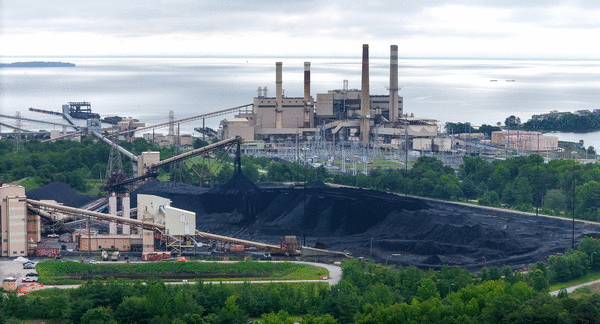
The Trump administration is monitoring planned Maryland power plant retirements as state officials warn of rising electric bills and tightening supply, U.S. Energy Secretary Chris Wright said in a Jan. 12 letter to Republican lawmakers.
Responding to concerns raised by members of the Maryland Freedom Caucus, Wright wrote that “the Trump Administration is working on a plan to prevent critical plants from retiring, and DOE is further carrying out the President’s orders to identify parts of the country with insufficient resources to meet reliability needs.”
He said recently the Department of Energy (DOE) issued emergency orders to keep coal-fired generation available in Michigan and oil- and natural gas-fired generation available in Pennsylvania. Wright said the department is evaluating “opportunities to bring more reliable and affordable energy to consumers in Maryland and throughout the United States.”
PJM Interconnection, the regional grid operator for Maryland and 12 other states, has warned that energy consumption is increasing faster than new supply, driven largely by the growth of data centers in Frederick and Prince George’s counties. Based on data from PJM and Maryland utilities, the Maryland Public Service Commission estimates that the state’s energy demand will grow at an annual rate of 0.3% to 0.32% from now through 2032. That doesn’t account for the demands of the three data centers under construction.
At the same time, electricity costs across the state are rising. Over the last five years, Maryland’s average cost of electricity rose by 1.2 cents to 15.1 cents per kilowatt-hour by the end of 2024, according to a study released in October by the Lawrence Berkeley National Laboratory. The researchers found that inflation and the cost of maintaining the grid infrastructure were the biggest drivers of costs.
Some of Maryland’s older power plants, including the coal-fired Brandon Shores and oil-fired H.A. Wagner facilities, have delayed their planned 2024 closures until 2029 to keep the grid stable. PJM officials have said in previous interviews with The Baltimore Sun that Maryland needs all available generation until replacement capacity comes online.
The state’s goal has been to phase out older energy-generation methods like coal, natural gas, propane and heating oil, but both PJM and business officials have said this is the wrong time to start, calling it too much too soon.
U.S. Rep. Andy Harris, R-Md., who was copied on Wright’s letter, agreed with the Secretary, saying the state should reconsider energy policies that take any options off the table.
“We should reconsider any plans in Maryland to take any fossil fuel energy production offline while the state is suffering so terribly from high energy prices and the possibility of rolling blackouts if we pursue the energy policy put in place by Annapolis.”
Szeliga echoed those comments. In a statement posted to her social media, she said the administration’s response shows officials are working to keep plants open and add power to the grid, calling energy affordability “a top priority.”
________
©2026 The Baltimore Sun. Visit at baltimoresun.com. Distributed by Tribune Content Agency, LLC.






Comments