San Diego judge orders 3 deported families returned, finds ICE used 'lies, deception, coercion'
Published in News & Features
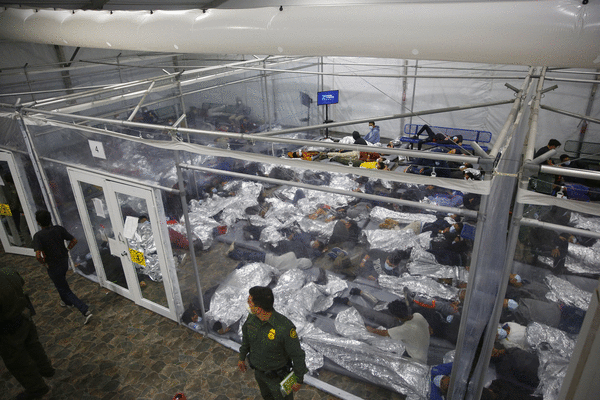
SAN DIEGO — A San Diego federal judge has ordered the Trump administration to return three recently deported families to the U.S., finding the administration unlawfully removed those families through “lies, deception, and coercion.”
The order issued late Thursday by U.S. District Judge Dana Sabraw came in litigation over the first Trump administration’s unconstitutional family-separation policy. That litigation reignited last year despite a historic settlement agreement in the case aimed at providing temporary legal protections to the previously separated families so that they can seek asylum in the U.S.
Sabraw has repeatedly ruled in recent months that the Trump administration has violated terms of the settlement, which was agreed to by the Biden administration in 2023.
Most recently, the American Civil Liberties Union, which represents the separated families and others covered by the settlement, argued that the Trump administration had once again violated the agreement by unlawfully deporting several families who were legally in the U.S. on parole. Sabraw once again agreed with the ACLU and ordered the federal government to facilitate and pay for returning three of those families to the U.S.
“Each of the removals was unlawful, and absent the removals, these families would still be in the United States and have access to the benefits and resources they are entitled to under the Settlement Agreement,” the judge wrote. “The removals at issue here clearly violated the spirit of the Agreement … and the manner in which each of these removals was affected, in addition to being unlawful, involved lies, deception, and coercion.”
The ACLU had also argued last week that about two dozen other individuals covered by the settlement who have legal parole status in the U.S. have been detained in recent months by immigration authorities for unknown reasons. While acknowledging that some of those detentions could be legitimate, ACLU attorneys argued that the government should be ordered to at least explain why it has detained those individuals.
Sabraw followed that recommendation and ordered the government to provide the ACLU with information regarding the basis for each detention, writing that “it should be easy” for the government if they have followed the law when detaining individuals with valid immigration parole status.
In a separate order issued earlier Thursday, Sabraw rejected an argument from government attorneys that the families and others covered by the settlement should have to pay increased fees that were imposed on immigrants by the passage last year of the One Big Beautiful Bill Act. Those fees include a $100 payment for individuals applying for asylum, a $550 fee associated with work authorization applications and a $1,000 fee for individuals granted parole into the U.S.
Sabraw ruled that the settlement exempted those covered by it from paying such fees, and ordered the government to rescind any payment requests it has already made and “refrain from imposing those fees going forward.”
The judge’s orders issued Thursday are part of a renewed legal fight that ignited last May over allegations by the ACLU that the Trump administration has been violating nearly every aspect of the 2023 settlement. That agreement came out of a lawsuit filed by the ACLU in 2018 that challenged the first Trump administration’s policy of systematically separating families arriving at the U.S.-Mexico border.
Sabraw has overseen the case from the start, ruling in 2018 that the separation policy was unconstitutional. Upon approving the settlement in 2023, he said the separation of families represented “one of the most shameful chapters in the history of our country.” The ACLU called the settlement the most important ever in the storied civil rights organization’s history.
One component of the agreement barred the federal government, for at least eight years, from reenacting immigration policies that systematically separate children and parents. The other component mandated that the government provide the families it had separated parole to legally enter the U.S. and give them access to certain services, such as legal support for immigration and work authorization claims.
Sabraw ruled at least twice last year that the Trump administration was violating certain provisions of the settlement.
In Thursday’s ruling, he recounted the story of one mother who was deported last year to Honduras with her three children, the youngest of whom was born in the U.S. and is a U.S. citizen. He wrote that the mother — who was separated by the government from her 5-year-old daughter in May 2018 while seeking asylum at the U.S.-Mexico border — was attending weekly check-ins with U.S. Immigration and Customs Enforcement officers and had valid parole in the U.S. until 2027.
Despite being entitled to certain protections by the settlement and following the rules she was supposed to, ICE officers told her that she’d been ordered removed from the country, demanded that she self-deport and outfitted her with a GPS ankle monitor, according to Sabraw’s findings.
“As a result of the ankle monitor and … frequent check-ins, (the mother) lost her job and was under tremendous physical, emotional, and financial stress,” Sabraw wrote. The judge then quoted from a declaration the mother submitted from Honduras, in which she declared that she “reached deep desperation, and felt I was now reliving the trauma” from when she was separated from her daughter in 2018.
The government did not dispute the facts surrounding the deportation of that family, but argued that the mother and her children had voluntarily chosen to self-deport. Sabraw ruled the family was lied to, deceived and coerced and “did not voluntarily depart the United States.” He wrote that the two other families he ordered the government to return were deported under “strikingly similar” circumstances.
The judge also found that at least one of the deported families was removed from the U.S. in direct violation of a court order he issued last year staying all such removals.
In court filings and at a hearing last week, the ACLU had flagged several additional deportations. Sabraw noted in his order that the government already agreed to return two other families that it deported, and the sides were negotiating regarding the return of a third family.
_____
©2026 The San Diego Union-Tribune. Visit sandiegouniontribune.com. Distributed by Tribune Content Agency, LLC.





Comments