'People are forgetting:' Holocaust survivors recall their stories as antisemitism rises
Published in News & Features
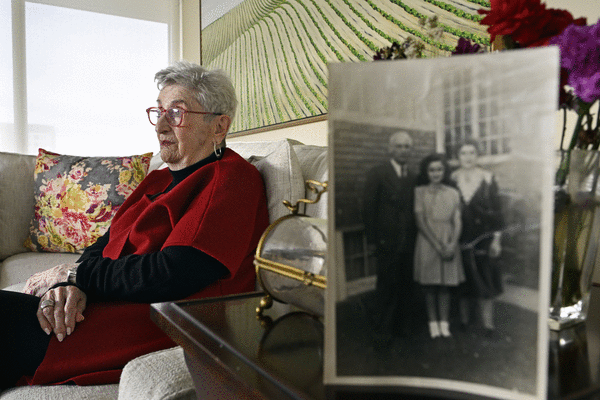
BALTIMORE — Martha Weiman’s parents told her and her brothers to stay in an upstairs bedroom the night of November 9, 1939, so they wouldn’t see what was about to happen in their beloved hometown of Bocholt, Germany. They peered out anyway.
They saw Nazi soldiers smashing the windows in the synagogue across the street and setting the building on fire. They saw men hauling out prayer books, piling them in the streets and torching them. Then several burst in, arrested their father and took him away to a place called Buchenwald.
The Baltimore Sun interviewed three survivors of the Holocaust, where at least six million Jews perished, and two grown children of survivors, all from Baltimore, in commemoration of Jan. 27, the date long recognized as International Holocaust Remembrance Day. As diverse as their stories are, each agreed with an idea the blunt-talking Weiman shared:
“The Holocaust is ancient history for some people,” she said. “But it’s not that ancient. I’m still here. People are forgetting. And that’s not a good thing.”
The Holocaust came to an end 81 years ago, and those who lived through it are a dwindling, elderly few.
Nearly all who are still alive today were children at the time. About 70% will be gone within a decade. At a time when antisemitism has once again been rearing its head around the world, survivors like Weiman, now 91 and living in Towson, and their children say they’re determined to share what they know as powerfully, as often and for as long as they can.
A last-minute plea
Felicia Graber and Veronica (Vera) Kastenberg, both of Baltimore, are dismayed to see that memories of the genocide are fading — that nearly half of Americans can’t name a single Nazi concentration camp, for example, and 40% believe no more than 2 million Jews lost their lives — let alone by witnessing the spike in antisemitic acts in the U.S. since the terror attacks of Oct. 7, 2023, that killed more than 1,200 people in Israel.
“I never, ever dreamt that Americans would take to antisemitism,” said Graber, 85, of Upper Park Heights, a child survivor and native of Poland who emigrated to the U.S. in 1963. “It’s clearly a lack of knowledge and education. It’s important that we all spread the word as much as we can.”
Graber’s stories are a mix of childhood memories and tales her father, Salomon Lederberger, shared with her in a series of interviews.
Not long after she was born in German-occupied Poland in 1940, the Nazis herded the Jews of Graber’s hometown, Tarnow, into a ghetto, where they lived for years under constant threat of removal to death camps. The first roundup, on June 10, 1942, targeted the elderly.
One of her three grandparents was shot to death en route to a transport for being too slow. The others were almost certainly killed either at Belzec, an extermination camp where some 450,000 Jews died in gas chambers during the war, or shot along with hundreds of others and buried in a mass grave, she said.
Three months later, the Nazis told parents in the ghetto that their children could be taken to a concentration camp alone or go with them and face the gas chambers together. After Graber’s parents chose the latter, they were shipped to a transit point to be picked up and taken by rail to Auschwitz the next morning.
A last-minute plea from a friend somehow convinced a Nazi official that Salomon was indispensable. The three were returned to the ghetto, later escaped with the help of a smuggler, and spent the rest of the war moving from place to place under assumed Catholic names. Graber still remembers her mother drilling into her the Lord’s Prayer and how to behave in church.
Graber, who wasn’t told she was Jewish until age 7, grew up to marry an American chaplain. They eventually moved to the U.S., where she became a citizen, taught French and German, and published two books — “Amazing Journey: Metamorphosis of a Hidden Child” (2010) and “Our Father’s Voice: A Holocaust Memoir” (2012).
Vera Kestenberg’s journey has been no less amazing. An 89-year-old Cheswolde resident, she was born into a wealthy Jewish family, the Salazars, in Budapest in 1936, and grew up with a nanny and a family cook. Two years later, her mother, Klara, was alarmed to hear a Hitler speech in which the German leader declared his plan to make neighboring Austria “Judenfrei,” or free of Jews.
For about six years, affluent Jews like the Salazars lived relatively normally, even as Nazis and Hungary’s allied government imposed restrictions. That changed in 1944, when Hitler invaded Hungary and ordered Adolf Eichmann to deport 550,000 Jews to extermination camps.
The Salazars secured “Aryan IDs” for Vera, then 8, and Klara, who drilled her daughter in her new identity as “a little Catholic girl.” Vera remembers the day her mother took her to the entrance of a pedestrian tunnel in the city and told her to walk to the other end, where a family friend would greet and take her to a safer life on a farm in the countryside.
“We had the yellow stars on our coats, but my mother had sewn mine on very lightly,” she says. “As she hugged me goodbye, she tore it off and said, ‘Now you go.’ I think it was more traumatic for her than it was for me.'”
The two would later reconnect and spend months moving from one place to another amid near-constant bombing by Soviet forces. At war’s end, they reunited with Vera’s father and brother, who had managed a move from a Nazi transit camp to the Glass House, a building a Swiss diplomat, Carl Lutz, used to help thousands of Jews during the Holocaust.
After living under Communist rule for more than a decade, the Salazars moved to South America in 1956, then to Baltimore in 1958, where Kestenberg, as she became known after marrying for a second time, turned a biochemistry degree she had earned in Budapest into a long career at Johns Hopkins University researching the effects of lead paint on children.
Living in the woods
As their numbers are now in steady decline, Holocaust survivors are leaning more than ever on “second-generation survivors” to pass their stories along. For some, like Anne Pfeffer and Richard Grilli of Baltimore County, their parents’ histories are part of their own.
Pfeffer was born in 1947, two years after the end of World War II, in Bergen-Belsen, a displaced-persons camp that had served as a concentration camp during the war. About 52,000 prisoners had died there, mostly of disease and starvation.
When he was in the mood, her father told her of his exploits during the war. What she heard was a tale of courage and miraculous escapes. “Indiana Jones had nothing on my father,” she said.
Joseph Kalichman grew up in Josefov, a town in southeastern Poland. After Hitler invaded the country in 1939, the Nazis implemented laws designed to degrade and isolate Jews, and Joseph and his father, Moishe, lived much of the time with resistance guerrillas outside town.
One day in 1942, with the men in the woods, Nazi officers rounded up some 2,000 of the city’s Jewish women and children, Joseph’s mother and sister among them, and marched them into a forest. They were shot and buried in a mass grave.
The following February, Joseph himself was one of about 5,000 men and boys who were rounded up and packed on trains bound for the Majdanek extermination camp. The Germans sent 4,000 to the gas chambers on the first day. Joseph was one of the 1,000 set to die the next morning.
That afternoon, though, he noticed a door in the prison wall that the Germans used to deliver supplies. He slipped through the opening that night, and by the time armed and mounted guards learned of the escape, he was making his way through the Polish woodlands.
Joseph’s next few months were the stuff of movies — dodging pursuers’ bullets, finding refuge in a farmhouse, believing at one point he’d been shot to death, and traveling among partisan camps in the woods until he’d completed the 109-mile return to Josefov.
After rejoining the guerrillas, he found his father’s remains in a forest outside town. He identified Moishe by the tefillin — leather boxes containing Torah scrolls for daily prayer — beside him.
Pfeffer describes those adventures — and Joseph’s later life as a prosperous builder in Upstate New York — in It’s Not My Story, a book she wrote and published in 2014. “He says it was all luck, but I think he’s the bravest person I’ve ever met,” she says.
Richard Grilli, meanwhile, has gone to great lengths to preserve the memory of his mother, Olga Bergmann Grilli, who survived the Holocaust thanks to a painful sacrifice by her mother and the efforts of a celebrated humanitarian.
She was 10 when Hitler completed the occupation of Czechoslovakia in March 1939. As restrictions on Jews tightened, her mother, Marie Bergmann, considered drastic measures, acting on rumors of a British man organizing rescue trains. That July, she took Olga to Prague and put her on Nicholas Winton’s Kindertransport — the last train allowed to leave.
Three years later, the Germans arrested Marie and her two sisters and sent them to a transit camp, then on to Auschwitz, where they died in the gas chambers in 1943. All but 150 of the 15,000 Jewish-Czech children who lived in the region were executed as part of a purge that killed half a million Czech Jews.
An elderly British family took Olga in as part of Winton’s program. She emigrated to the U.S. in 1946 to live with an aunt, but she never got over the choice her mother had to make.
A terrible tale
In 1939, Weiman and her family experienced Kristallnacht, a pogrom by the Nazis against Jewish people throughout Germany, Austria, and part of Czechoslovakia. Civilians joined paramilitary forces to destroy some 1,400 synagogues and prayer rooms, wreck 7,000 Jewish businesses, arrest 30,000 Jewish men and kill nearly 100 people that night.
Weiman’s father, who had been arrested and taken away on Kristallnacht, had some luck on his side. The Nazis hadn’t turned Buchenwald into the full-fledged death camp it would become quite yet, and Weiman’s mother got the documentation needed to get him released. He’d been beaten so badly the lenses in both eyes were dislocated. He wore thick glasses the rest of his life.
The family soon caught a freighter to London, then emigrated to America, the land of opportunity. Now Weiman wonders what might happen even here.
“If you were a kid, and someone told you about the Holocaust, would you believe it?” she said. “It sounds like a terrible fairy tale.”
©2026 The Baltimore Sun. Visit at baltimoresun.com. Distributed by Tribune Content Agency, LLC.






Comments