Idaho bill wants to ensure prisoners don't profit from tell-all murder books
Published in News & Features
BOISE, Idaho — Bryan Kohberger or Lori Vallow Daybell might one day get a book deal, but they’ll never receive the proceeds if an Idaho lawmaker’s proposal becomes law.
Over the past several years, the state has generated national headlines from a series of high-profile murder cases, and state Sen. Tammy Nichols, R-Middleton, wants to ensure that prisoners convicted of these well-publicized acts have no way of profiting.
On Monday, Nichols introduced an update to Idaho’s existing law that compensates crime victims if the perpetrator reaches a financial agreement to tell their story.
At nearly a half-century old, the law does not cover contemporary trends and information sources, and needs to be revised to be more effective, she said.
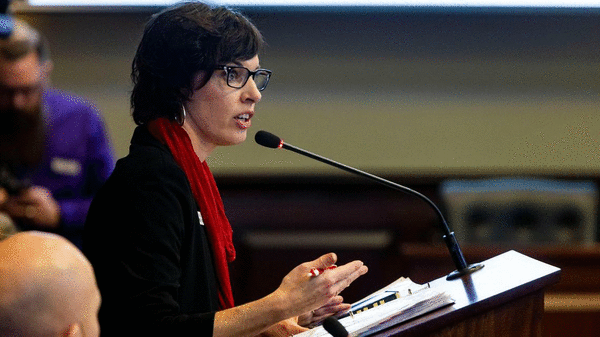
“It updates our current law to prevent money from being made off of criminal notoriety,” Nichols told a Senate committee. “This closes gaps that fail to address modern media and monetization, and ensures victims have a fair opportunity to recover damages, all while fully protecting free speech and due process by regulating only the money — not First Amendment expression.”
Nichols said three recent murder cases were top of mind as she pursued the proposed changes to law: The University of Idaho student murders in Moscow in 2022, to which Kohberger confessed last year; and the trials of Chad Daybell and Vallow Daybell, the husband and wife separately convicted for the 2019 murders of her two children.
Vallow Daybell also was convicted of conspiracy to kill her first husband and her husband’s first wife, while Daybell also was convicted of murder in his first wife’s death and three counts of conspiracy to commit murder.
Nichols was motivated this legislative session to secure any earnings paid to the culprits of such crimes — from the sale of rights or fees for tell-all books, articles or interviews — to cover court-ordered restitution and other monetary damages, she said in an interview with the Idaho Statesman.
“Just seeing trials like that and other trials, how much attention they get, and there’s usually, eventually, book deals, movie deals, things like that,” she said. “I just didn’t feel that it was appropriate for criminals — especially on high-profile, horrible crimes — to be able to profit off of those, and for victims to be revictimized.”
Rep. Elaine Price, R-Coeur d’Alene, is the bill’s co-sponsor in the Idaho House. Three of the four victims in the Moscow murders — Madison Mogen, Kaylee Goncalves and Xana Kernodle — were from Kootenai County. The fourth, Ethan Chapin, was from Washington state.
“I know many people who are friends with the family of the victims,” Price said in an email to the Statesman. “I attend the same church as one of the victims’ family. I just feel strongly that no one should profit from their crime. Victims should not feel continually victimized.”
‘Son of Sam’ laws face constitutional hurdles
The state’s existing statute, commonly known as a “Son of Sam” law, is named for notorious serial killer David Berkowitz, who murdered six people in New York City in the 1970s. He long claimed that he was ordered to kill by his neighbor’s dog, Sam.
In turn, Idaho was among several states, as well as the federal government, that passed similar laws in 1978 — the year Berkowitz was sentenced to life in prison — to limit a prisoner’s ability to make money by sharing details about their crimes.
But in a unanimous decision, the U.S. Supreme Court ruled in 1991 that New York’s Son of Sam law was unconstitutional because it violated First Amendment protections to the right of speech.
The nation’s high court did not weigh in on any other states’ versions of the law. Idaho’s is rooted in the same basic concepts, and it risks a successful legal challenge if it is not retooled to align with constitutional requirements, Nichols said.
“So this bill addresses those concerns by focusing solely on the economic proceeds, adding explicit free speech protections and modernizing outdated procedures,” she told her Idaho Senate peers.
Along with receiving four life sentences, Kohberger was ordered to pay more than $300,000 in criminal fines and fees. That includes about $32,000 in restitution and $20,000 in civil damages to the four victims’ families.
Between her criminal case in Idaho and another in Arizona, Vallow Daybell was ordered to pay more than $700,000 in fines and fees, including nearly $12,000 in restitution.
Moscow Police Chief Anthony Dahlinger, who helped steer the college student homicide investigation, was at the Capitol on Monday along with several police chiefs from across the state. He attended the Senate committee hearing but told a Statesman reporter that he was unfamiliar with Nichols’ proposed legislation.
Her bill includes a handful of exceptions so that prisoners may be compensated for other activities, according to a copy obtained by the Statesman. Those include regular wages or income not related to their crimes; appearances for news or documentaries produced mainly to educate or inform if the prisoner is paid an interview fee; and “works of art or fiction that only briefly mention the crime.”
After a brief presentation of the bill Monday, the Senate committee unanimously advanced it for a future public hearing.
_____
©2026 The Idaho Statesman. Visit idahostatesman.com. Distributed by Tribune Content Agency, LLC.





Comments