Trump's 'Great Healthcare Plan' aims to lower drug prices and insurance premiums
Published in News & Features
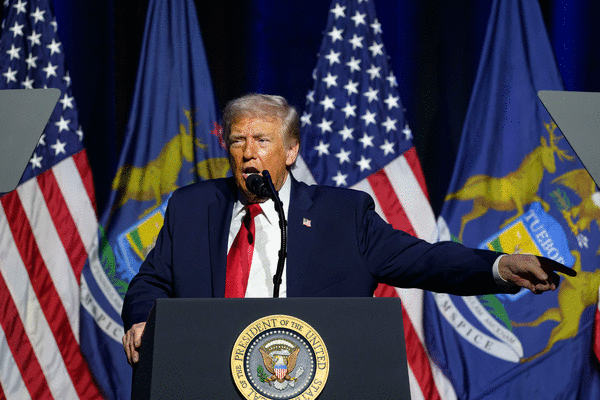
WASHINGTON — President Donald Trump is asking Congress to pass legislation to implement health care reforms he unveiled Thursday aimed at lowering drug prices and insurance premiums, as he moves to address one of his party’s political liabilities ahead of midterm elections.
“I’m calling on Congress to pass this framework into law without delay — have to do it right now so that we can get immediate relief to the American people,” Trump said in a video message, calling his proposal “The Great Healthcare Plan.”
The outline called for “codifying” the voluntary deals Trump has made with drugmakers to lower some prices and making more medicines available over the counter.
It also called for sending billions in subsidies directly to consumers so they can buy health insurance, rather than sending it to the companies to lower premiums. The Trump plan also targets prescription drug middlemen, saying it will “end the kickbacks” paid to “to the large brokerage middlemen that deceptively raise the cost of health insurance.”
The administration also wants more transparency from health insurance companies on medical claims denials, wait times and prices, as well as simpler language to help people better understand their options.
Shares of insurance companies were up on the news, with UnitedHealth Group Inc., Cigna Group, and CVS Health Corp. rising slightly, while most drugmakers fell.
Still, while the White House touted the proposal as a “comprehensive plan,” it lacked many details that would be critical considerations for lawmakers.
It calls for a standard that would require companies to publish rates and coverage comparisons in “Plain English” to help consumers make better decisions. It would require them to publish on their websites the percentage of revenues paid for claims versus overhead costs and profits, the percentage of claims they reject and the average wait times for routine care.
It would also seek to require any health care provider or insurer who accepts Medicare or Medicaid to prominently post prices and fees, and ensure insurance companies comply with price transparency requirements.
Voter anxiety
The president’s announcement is part of a larger effort to counter voter anxiety over high costs of living — including housing, groceries and utilities — that polls show have soured perceptions of his economic agenda. Health care is a center-point for many of those frustrations.
Democrats have seized on crucial subsidies expiring at the start of the year to hammer the administration over affordability worries. The issue’s prominence highlights Trump’s long struggle to undo the Affordable Care Act — popularly known as Obamacare, a signature achievement of his first-term predecessor Democrat Barack Obama — and coalesce Republicans around a replacement plan to address health care costs.
The political stakes are immense. Open enrollment for Obamacare plans end Thursday and Congress is deadlocked on how to reinstate the lapsed subsidies. More than 20 million people face the prospect of premiums, on average, doubling. The tax credits also largely benefited consumers in GOP-led states, a particularly worrying prospect for the president’s party in what will be a closely contested election for control of Congress.
Trump, though, has complicated the efforts toward reaching a legislative solution by threatening to veto bills that revive the expiring subsidies. He instead wants to directly give Americans subsidies to purchase insurance, an arrangement many health experts say is hard to implement and doesn’t guarantee better outcomes for care.
Senators are working on a separate healthcare package that includes reforms to pharmacy benefit managers that is bipartisan and almost passed in a funding bill near the end of 2024 before Trump and Elon Musk sank its chances.
Trump in recent weeks has railed against insurance companies, including an address Tuesday where he cast Obamacare subsidies as a “corrupt payoff to the insurers.” He vowed in December to call insurers in for a meeting in a bid to pressure them to reduce costs.
More broadly, Trump has taken some steps to lower health costs in his current term, striking agreements with numerous pharmaceutical makers to provide cheaper drugs in exchange for tariff exemptions. And he’s insisted to lawmakers that his opposition to Obamacare subsidies will be embraced by voters at the polls.
Health care has long posed a challenge for Trump, who has repeatedly promised to unveil plans tackling the issue and in particular replacing Obamacare. When pressed on how he would do so during the 2024 campaign, Trump said he had the “concepts of a plan.”
The sense of urgency around delivering on his health care promises has only intensified in recent months. Democrats have made the danger of rising premiums a focus of their argument that Trump’s policies have hurt Americans in their pocketbooks.
Democrats tried to pressure Republicans to extend them last year, sparking a six-week government shutdown. GOP candidates also suffered high-profile losses in off-year 2025 elections fueled by voter angst over prices and wage growth.
The clash over health care has laid bare rifts among Republicans, a dynamic that threatens to make it harder for Trump to secure congressional action. Former Representative Marjorie Taylor Greene, who left Congress earlier this month, assailed GOP leaders over their handling of the subsidy fight and some centrist House Republicans have backed legislation to restore the subsidies, though that is unlikely to pass the Senate.
Trump’s signature tax-and-spending package last year also cut about $1 trillion from Medicaid, the public insurance program for low-income and disabled people, reductions that are expected to result in 11.8 million people in the U.S. losing their health insurance over 10 years.
The administration in December announced awards to states from a rural health fund established to soften that blow. Those funds, though, come with a threat of clawbacks if jurisdictions fail to embrace health policy initiatives Trump wants.
Roughly 22.8 million Americans signed up for 2026 health insurance through the ACA, according to the Centers for Medicare & Medicaid Services, less than the 24.3 million who enrolled in 2025. Experts warn that drop-off could rise as consumers are hit when they have to start paying the higher premiums.
Centene Corp., Molina Healthcare Inc. and Oscar Health Inc. are the insurers most heavily involved in selling Obamacare coverage. UnitedHealth, Elevance Health Inc. and Cigna also sell exchange plans that could be hit by lower enrollment.
_____
With assistance from Skylar Woodhouse.
_____
©2026 Bloomberg L.P. Visit bloomberg.com. Distributed by Tribune Content Agency, LLC.






Comments