After Supreme Court defeat, Trump administration looking to settle lawsuit over Illinois National Guard deployment
Published in News & Features
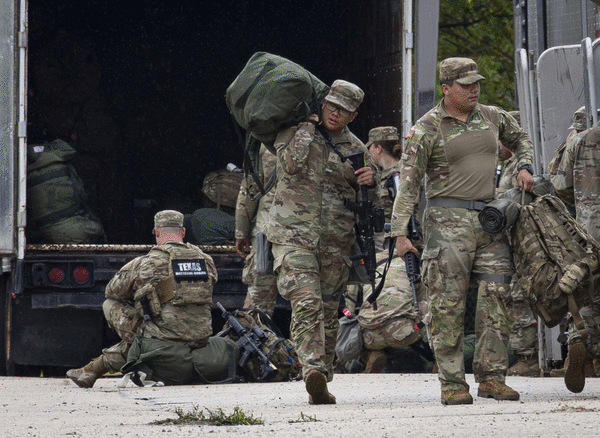
CHICAGO — After a defeat at the U.S. Supreme Court, lawyers for the Department of Justice told a federal judge Wednesday they’re looking to settle litigation over President Donald Trump’s controversial efforts to deploy National Guard troops to the Chicago area to bolster immigration enforcement.
The development came as U.S. District Judge April Perry held a status hearing on next steps in the lawsuit brought by Illinois, which had been headed toward a lengthy preliminary injunction hearing over the legality of Trump’s mobilization of the Guard.
The Department of Justice’s case took a blow, however, three weeks ago when the Supreme Court denied a request from the Trump administration to allow the Republican president to deploy troops to Illinois streets while the court battle played out.
Lawyers for Attorney General Kwame Raoul have since argued that although the high court’s ruling made no final determinations, it “effectively resolves as a matter of law” that the federalization and deployment orders by Trump were illegal.
In court Wednesday, DOJ attorney Christopher Edelman told Perry they have “obtained authorization” from senior administration officials to resolve the case by settlement, and requested a 30-day stay in the case while terms are negotiated.
Christopher Wells, a lawyer for the state, said they were “optimistic” that a settlement can be reached but asked for a quicker timeline.
Perry gave both sides until Jan. 28 to negotiate and submit another status report, and asked the parties to come back for another status hearing on Jan. 30.
Potential settlement terms were not discussed in court.
The amicable hearing was in stark contrast to the emotional proceedings in the case just a few months ago, which played out under dramatically different circumstances.
When the lawsuit was filed in October, Operation Midway Blitz was in full swing, with near-daily clashes between immigration agents and protesters on the streets and outside the Immigration and Customs Enforcement facility in suburban Broadview.
At the time, National Guard troops from Illinois and Texas had already been “federalized” and were assembling at bases for imminent deployment.
Now, those forces have been largely demobilized, though some 195 Illinois National Guard troops remained in Fort Bragg, North Carolina, as of last week “completing the demobilization process,” which was expected to conclude this week.
The fight landed at the Supreme Court days after Perry issued a temporary restraining order barring Trump from deploying Guard troops to the state. That order has since been continued indefinitely pending the resolution of the lawsuit.
On Dec. 23, the divided opinion handed down by the conservative-majority Supreme Court represented a significant political victory for Gov. JB Pritzker and other state Democratic leaders in their escalating battle with the White House’s plans to federalize troops on U.S. soil to assist in mass deportation efforts.
“At this preliminary stage, the Government has failed to identify a source of authority that would allow the military to execute the laws in Illinois,” the high court’s order said. “Thus, at least in this posture, the Government has not carried its burden to show that (the law) permits the President to federalize the Guard in the exercise of inherent authority to protect federal personnel and property in Illinois.”
Three of the court’s conservative justices, Clarence Thomas, Samuel Alito and Neil Gorsuch, lodged dissents, with Thomas and Alito writing that the court “has unnecessarily and unwisely departed from standard practice.”
A week after the ruling, a defiant Trump posted on social media that he was ordering the National Guard removed from Illinois, but threatened to return.
“We will come back, perhaps in a much different and stronger form, when crime begins to soar again – Only a question of time!” the president wrote.
_____
©2026 Chicago Tribune. Visit chicagotribune.com. Distributed by Tribune Content Agency, LLC.





Comments