Gov. Ron DeSantis looks back in opening his final Florida legislative session
Published in News & Features
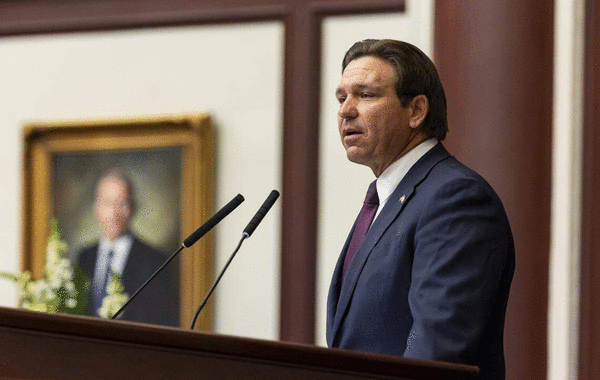
TALLAHASSEE, Fla. — As Gov. Ron DeSantis’ final legislative session at the helm of Florida began on Tuesday, he spent most of his time looking back.
During DeSantis’ eighth State of the State address to lawmakers, his list of what to accomplish this year was quick to the point: cut property taxes, put guardrails around artificial intelligence and curb illegal immigration.
Instead, he spent most of his half-hour speech reflecting on Florida’s change since he entered office seven years ago.
“We have delivered big results and we have set the standard for the rest of the country to follow,” DeSantis said on Tuesday. “We are the free state of Florida.”
But if his speech was meant to set the table for the 2026 session, it left it largely bare.
Democratic leaders in the House and Senate critiqued DeSantis for not focusing on affordability, which they said was the most pressing issue for Floridians.
“How do you take the rostrum and not address the No. 1 issue facing Floridians?,” House Democratic Leader Fentrice Driskell said.
DeSantis wasn’t the only speaker on Tuesday to offer few policy proposals. Senate President Ben Albritton, during his speech, focused mostly on the role of the Senate as a cooling force, while House Speaker Daniel Perez acknowledged that he didn’t know what would come in the months ahead.
And the chaos of last session, which still hangs thick over the Capitol, could affect the ability of all three parties to get anything done.
Shaky ground
The 60-day regular session — and the already-scheduled special session in April on redistricting — mark some of the last chances DeSantis has to secure his agenda ahead of any future campaign he may undertake.
His last few goals as Florida’s governor are clear, but his path to get there isn’t.
For the first six years of his leadership, DeSantis faced little-to-no challenge from legislators. As a result, he was able to grow the size and scope of his office and easily roll through major policy changes that he used to bolster his 2024 presidential campaign.
At the start of 2025, though, Perez and Albritton took the rare step of rebuffing the governor by denying his plan for a special session on immigration and pushing through their own legislation instead. A few weeks later, the parties all stood together while DeSantis signed a compromise bill.
Any public disagreement between DeSantis and the Senate has dissipated since then. The governor called out his support for Albritton’s signature rural investment package during his speech. But tensions between DeSantis and the House have only intensified. The governor did not shake Perez’s hand on Tuesday.
Last session, the House took on an investigation into First Lady Casey DeSantis’ cornerstone program, Hope Florida and its associated foundation. The Hope Florida case went before a grand jury in October.
“We found the voice of this House, and we used it with resounding clarity,” Perez said during his opening address on Tuesday.
During his speech, DeSantis highlighted the Hope Florida program as one of the state’s successes.
Acrimony between the House and Senate reared its head last year when the two chambers were unable to put together a constitutionally mandated budget in time.
The result? Friction between the three parties that need to be on the same page to get anything done.
Already, the House is operating independently on some of DeSantis’ priority issues, like redistricting and property taxes. Perez set up special committees on both in the House to explore the issues, while Albritton hasn’t committed to any specific policy point yet.
Perez, though, when addressing the House Tuesday, said he wouldn’t change anything about the chaotic prior session, even if it was “just for a little more peace or a little more quiet.”
And while he said he doesn’t know how this session will end, he said the House would find its way through.
“We are the Florida House of Representatives, and when we set our mind to it, there is absolutely nothing we can’t do,” Perez said.
DeSantis’ eight years
The DeSantis leaving the Governor’s Mansion isn’t the same DeSantis who stepped into it in 2019.
Among his allies, like Albritton, the DeSantis era of Florida politics was called “trailblazing,” “energetic” and at times “unpredictable.”
Among opponents such as Driskell, the last seven years were described as full of “division, meanness and a growing affordability crisis,” she said on Tuesday.
In his first State of the State address as Florida’s governor, DeSantis touted his pardon of the Groveland Four, a group of Black men in the late 1940s who were falsely accused of raping a white woman.
His speech hardly touched on hotly contested issues — though he spent some time talking about immigration and school choice.
He focused on improving the environment, loosening some job licensing requirements, growing workforce education and helping with prescription drug affordability.
In 2020, DeSantis still demurred, talking about Florida’s future and all the work that needed to be done.
The COVID outbreak transformed him. Starting in 2021, DeSantis’ speeches became more declarative, full of chest-thumping about how Florida was the greatest, freest state.
DeSantis as we know him had arrived.
Subsequent speeches had the governor calling Florida “freedom’s vanguard,” the “escape hatch for those chafing under authoritarian” mandates, a “refuge for freedom and sanity” and a state headed toward “true north.”
The same issues he had talked about previously — education, law and order, taxes — became imbued with more polarizing language. There were more mentions of the “woke mob,” of the “mutilating” of children seeking medical care related to their gender dysphoria, of “indoctrination” in education.
That DeSantis was on display Tuesday, as he quipped about New York City’s “Marxist mayor,” alluding to Mayor Zohran Mamdani, a Democratic socialist.
DeSantis in his speech rebutted one of Mamdani’s recent comments, saying that “people prefer the warmth of Florida freedom to the frigidity of New York collectivism.”
What’s getting done?
Albritton in his speech Tuesday said the ability of the Legislature to influence the cost of living within the 60-day session “is pretty limited.”
He said he intends to put forward a proposal for voters to cut property taxes, but didn’t specify what the policy would be. And he said Florida’s cost of living is largely influenced by national trends and policy.
But Senate Democratic Leader Lori Berman said that “affordability can absolutely be addressed in 60 days,” and said she didn’t know why Albritton “didn’t give us any concrete ideas.”
Still, some lawmakers were hopeful, despite the limited specifics during Tuesday’s speeches.
Sen. Danny Burgess, R-Zephyrhills, said he was bracing for the unexpected, but said “there’s not going to be a shortage of issues to discuss” this year.
Sen. Alexis Calatayud, R-Miami, said she thinks lawmakers will either manage to collaborate on on “big items” or they won’t.
“We passed a lot of good policy last session, even with tensions between the chambers and the governor’s office,” Calatayud said.
And Sen. Debbie Mayfield, R-Melbourne, said she thought the session ahead would be fruitful.
“It’s his last year,” Mayfield said. “Obviously he wants to do something that’s very productive.”
_____
(Tampa Bay Times/Miami Herald reporters Lawrence Mower and Alexandra Glorioso contributed to this report.)
_____
©2026 Tampa Bay Times. Visit at tampabay.com. Distributed by Tribune Content Agency, LLC.






Comments