Trump: Cuba to get no more oil from Venezuela, should make a deal 'before it is too late'
Published in News & Features
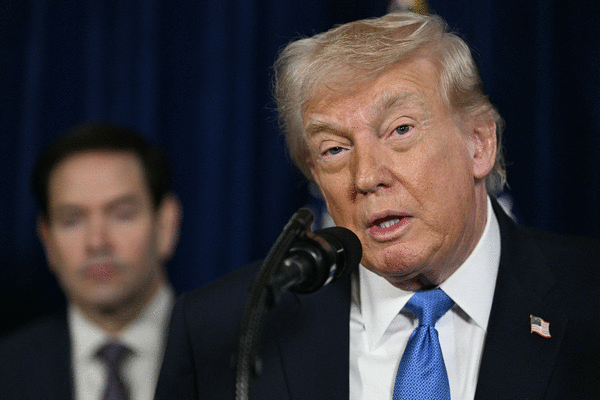
Following the capture of Venezuelan strongman and Cuban ally Nicolás Maduro, President Donald Trump said Sunday Cuba won’t be receiving any more oil from the South American country and warned the government in Havana to “make a deal BEFORE IS TOO LATE.”
In a post on Truth Social, Trump said the Cuba has for many years survived economically thanks to an arrangement to provide security services for Venezuelan leaders Hugo Chavez and Maduro, “BUT NOT ANYMORE,” he said.
After years of denying that it had military and intelligence officers in Venezuela, the government in Havana confirmed last week that 32 Cuban officers died trying to protect Maduro during a raid by U.S. special forces that ended with his capture and transfer to New York City to face narco-terrorism charges.
“Most of those Cubans are DEAD from last week’s U.S.A. attack,” Trump said, “and Venezuela doesn’t need protection anymore from the thugs and extortionists who held them hostage for so many years. Venezuela now has the United States of America, the most powerful military in the World (by far!), to protect them, and protect them we will.”
In his most stark warning yet to the communist regime in Havana, Trump said, “THERE WILL BE NO MORE OIL OR MONEY GOING TO CUBA - ZERO! I strongly suggest they make a deal, BEFORE IT IS TOO LATE.”
READ MORE: With Maduro in U.S. custody, Trump says he now wants to help the people of Cuba
With unusual speed, Cuban Foreign Minister Bruno Rodriguez issued a denial, saying Cuba “does not receive, nor has it ever received, monetary or material compensation for security services provided to any country.”
“Unlike the U.S., we do not have a government that engages in mercenary activities, blackmail or military coercion against other states,” Rodriguez added. “Like any country, Cuba has the absolute right to import fuel from those markets willing to export it and which exercise their own right to develop their trade relations without interference from or subordination to the unilateral coercive measures of the U.S..”
Reacting to Trump’s warning Sunday, Cuba’s leader, Miguel Díaz-Canel, replied with a defiant message on X: “Cuba is a free, independent and sovereign nation. No one dictates to us what to do. Cuba does not commit aggression; it has been subjected to aggression by the U.S. for 66 years, and it does not threaten, but rather prepares itself, ready to defend the homeland to the last drop of blood.”
After Maduro’s capture, Trump and Secretary of State Marco Rubio have repeatedly suggested the administration is turning its attention to the communist government in Havana, which has been in place for 67 years.
Just hours after the raid in Venezuela, Trump said his administration was likely going to “talk about” Cuba and that he wanted to help the Cuban people. On Thursday, he told Fox News he thinks the Cuban government is going to fall on its own and told radio host Hugh Hewitt that “Cuba’s really in a lot of trouble.”
“Cuba gives protection to Venezuela, and Venezuela gives Cuba money through oil — and it’s been that way for a long time — but it doesn’t work that way anymore, so I don’t know what Cuba’s going to do,” he told Fox News on Thursday. “I think Cuba’s going to fail. I don’t think there are alternatives for Cuba.”
On Friday, during a meeting with the CEOs of several U.S. oil companies to discuss investments in Venezuela, Trump again said Cuba would no longer receive Venezuelan oil, after he cut a deal with Delcy Rodriguez, Maduro’s vice president who is currently heading the socialist regime in Caracas, to cede control of Venezuelan oil sales to the U.S. government.
In the meeting with oil executives, Rubio said the administration was “not interested in a destabilized Cuba” but that Cuban leaders have a choice to make: “They can either have a real country, with a real economy, where their people can prosper — or they can continue with their failing dictatorship that is going to lead to systemic and societal collapse.
“We hope they made the right one. We have no interest in a destabilized Cuba, but that would be their fault,” Rubio added. Previously, he said Cuban authorities should be concerned after watching Maduro’s ouster.
The halt of subsidized Venezuelan oil shipments can totally paralyze Cuba’s economy in the short term, experts say. Venezuela exported an average of 30,000 barrels of oil per day to Cuba during 2025, around 50% of the island’s needs, said Jorge Piñón, a senior research fellow at the Energy Center at the University of Texas who closely tracks oil shipments to the island.
“The loss of these imports would be catastrophic for Cuba, as we consider it unlikely that supplies from Mexico and Russia will materialize to fill the gap,” Piñón said. “Other oil-exporting countries and political allies of Cuba, such as Angola, Algeria, Colombia, and Brazil, have not provided, nor do we expect them to provide, the vital supply that the island urgently needs.”
The halt of Venezuelan oil shipments would also have a cascading effect on the island´s economy.
“The thermoelectric power generation sector, which already operates at barely 40% of its installed capacity, would be further affected by the loss of diesel fuel,” he said. “Diesel fuel, which accounts for approximately 20% of Cuba’s total fuel demand, is also essential for transportation, agriculture and the distribution of drinking water.”
Even before the cutoff of Venezuelan oil, Cuba’s economy was already on the ropes.
The island is going through its worst economic crisis in decades, even worse than the so-called Special Period, the years that followed the collapse of the Soviet Union and the loss of subsidies that suddenly caused a large contraction of the island’s GDP. Cuba’s economy never fully recovered.
Cuba’s prime minister recently said the country’s economy was almost paralyzed because of the energy crisis. Long daily blackouts are the new normal; food, medicines and fuel are scarce, the entire electrical grid goes down frequently, and the water supply and trash collection have been severely disrupted.
Cuba also provides thousands of doctors to Venezuela as part of an economic and political arrangement with the leaders in Caracas. If the Cuban medical mission is forced to leave, Havana would lose significant revenue, said Cuban economist Pavel Vidal at the Pontificia University Javeriana in Colombia.
“This would represent a devastating blow to the Cuban economy, which has been in free fall since 2020 and lacks the capacity to replace these flows, especially its oil needs,” Vidal in the Cuban Currency and Finance Observatory’s newsletter.
He believes the consequences would be far worse than when Cuba suddenly lost its main trade and financial partner after the fall of the Soviet Union, when the island’s GDP suddenly plunged 35%.
“Currently, the economic and social damage resulting from a similar shock would be incomparably greater, due to much more unfavorable starting conditions,” he said.
Cuban authorities, so far, have not been moved by the prospects of total economic collapse.
On Saturday, Rodriguez, the foreign minister, said, “We Cubans are not ready to sell out our country or give in to threats and blackmail, or renounce to the inalienable prerogative with which we are building our own destiny, at peace with the rest of the world. “We will defend Cuba,” he added. “Those who know us are aware that this is a firm, categorical and demonstrated commitment.”
_____
©2026 Miami Herald. Visit miamiherald.com. Distributed by Tribune Content Agency, LLC.




Comments