Judge weighs whether First Amendment lawsuit against Trump officials can proceed
Published in News & Features
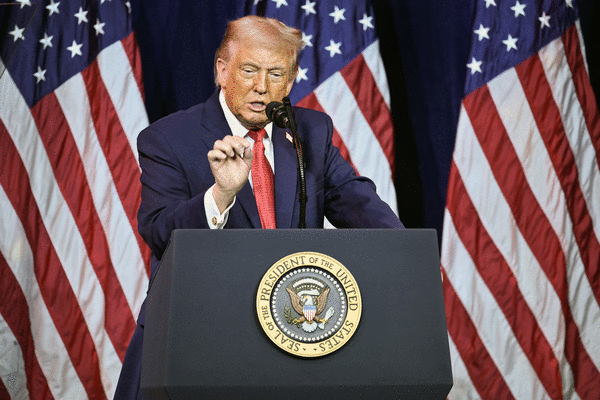
SAN JOSE, Calif. — Lawyers clashed Tuesday in a federal courtroom in San Jose over whether student newspaper The Stanford Daily can proceed with a First Amendment lawsuit alleging the Trump administration used immigration law to punish student speech — a case that could set a legal precedent for the constitutional rights of noncitizen journalists and students nationwide.
Judge Noel Wise pressed government attorneys on how visa-revocation statutes are applied and whether they disproportionately target students who expressed sympathy for Palestinians during Israel’s war in Gaza.
She also questioned whether a chilling effect on speech, absent any formal enforcement action, is enough to show plaintiffs have been harmed. The court had not yet decided on the U.S. government’s motion to dismiss the lawsuit as of press time.
If decided in favor of The Stanford Daily, Wise’s decision could limit the government’s use of immigration laws to target campus activism, shielding student journalists from retaliation.
The lawsuit, filed in August 2025, accuses Secretary of State Marco Rubio, Homeland Security Secretary Kristi Noem, and other officials of using provisions of the Immigration and Nationality Act to revoke visas based on constitutionally protected speech. The plaintiffs — The Stanford Daily and two anonymous international students — cite cases involving students who criticized Israel’s military strikes in Gaza and President Donald Trump’s foreign policy.
Government lawyers urged the court to dismiss the case, arguing no specific plaintiff has faced deportation or visa revocation and that any harm is speculative. They said the administration targets disruptive conduct or alleged links to organizations that pose national security threats, not protected speech by itself, and argued the newspaper lacks standing because immigration advocacy isn’t part of its core mission.
How the government defines speech as a “national security threat” was not discussed in detail during the hearing.
Attorneys for the plaintiffs countered that the statute itself creates an “objective threat,” or in other words, actual danger to any student who speaks out. They pointed to resignations and requests to remove bylines or names attributed to quotes at The Stanford Daily as concrete harm that has already undermined the newsroom’s ability to report.
Student journalists from The Stanford Daily attended Tuesday’s hearing to support the case. At least 55 other student publications filed a legal brief in support of the newspaper in October 2025.
Conor Fitzpatrick, lead counsel for the newspaper with the Foundation for Individual Rights and Expression, said after the hearing he was confident the judge was persuaded the plaintiffs have standing.
“We’re pleased we had the opportunity today to vindicate the First Amendment rights of our clients,” Fitzpatrick said. “No one in the United States should fear being thrown out of the country simply because the government doesn’t like their opinion. It’s about who we are as a country and about whether we actually believe in the freedom of speech enshrined in our Constitution.”
The plaintiffs also cited case law establishing that unnamed individuals do not need to be identified to demonstrate standing.
Assistant U.S. Attorney Kelsey Helland argued that the plaintiffs are seeking a “pre-enforcement challenge” without having faced a “substantial force of enforcement.”
“Enforcement actions were based on more than pure protected speech,” Helland said, citing “aggravating factors” such as disruptive conduct or leadership roles in protests. He contended that the small fraction of students reviewed were targeted for their actions rather than their viewpoints.
Wise pressed the government multiple times during the hearing, asking whether any supporters of Israel’s response in Gaza had been among the roughly 5,000 campus protest cases sent to the Department of Homeland Security for review. Helland admitted he was not aware of any.
Several times during the hearing, Helland asserted that student activists who had their visas revoked were targeted not just for speech but for alleged links to violent groups or for allegedly being disruptive on campus.
Wise asked: “Exactly what else, beyond protections in the First Amendment, were the revocations based upon?” She added, “so … if other students feel uncomfortable, that would be enough to revoke a visa?”
Helland admitted that while the government has a lot of power in these cases, the fact that some students simply feel “uncomfortable” usually isn’t enough on its own to get a visa revoked.
Should Wise rule that the court has jurisdiction in the matter — and deny the motion to dismiss — the court would then hear the merits of the case and could possibly issue an injunction blocking the State Department from revoking student visas based on free speech.
Fitzpatrick said after the hearing such a ruling would demonstrate “that the First Amendment prohibits the government from revoking someone’s visa or rendering them deportable simply because the government doesn’t like their opinions.”
“It’s about who we are as a country and about whether we actually believe in the freedom of speech enshrined in our Constitution,” he added.
Greta Reich, editor in chief of The Stanford Daily, said public reaction to the lawsuit has ranged from skepticism to strong support.
“It was great to see the turnout in the courtroom today of people supporting the case and I’m hopeful for what it means about support for student journalism at large,” Reich said.
_____
©2026 MediaNews Group, Inc. Visit at mercurynews.com. Distributed by Tribune Content Agency, LLC.




Comments