Immigration raids linked to significant California job losses, analysis finds
Published in News & Features
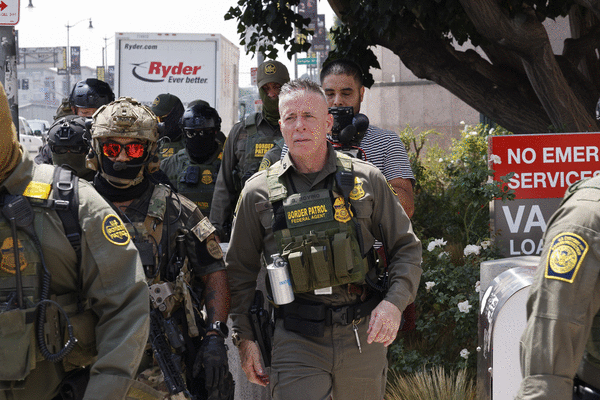
Each month, Edward Flores crunches the numbers. And each month he grows more and more certain of the stark impact of federal immigration raids on California’s economy.
Flores found that the number of people reporting private sector employment in California in late May and early June fell by 3.1% — a drop so significant it was exceeded in recent memory only by the employment downturn during the COVID-19 lockdown.
The associate professor of sociology and faculty director of the UC Merced labor center based his analysis on U.S. census data from those months and published his findings over the summer.
Flores has repeated the analysis for each month since June, with the exception of October, when the federal government shut down and for the first time in some 50 years did not collect these data.
The employment decline grew further, with a 4.9% decrease in the first week of July — 742,492 fewer workers.
Numbers somewhat bounced back in August, after a U.S. district judge temporarily banned roving patrols of immigration agents from stopping people based on the color of their skin, language spoken or vocation. But from May to September, private sector employment fell by 2.9%, Flores said in his latest report.
“We are seeing a pretty persistent trend,” Flores said. “It really underscores the urgency with which our elected officials and policymakers should be devising ways of mitigating the economic harm that is occurring as a result of immigration enforcement actions.”
The analysis shows an outsize effect on noncitizen women, whose reported employment plummeted about 8.6%, or 1 in 12 out of work after raids began to roil Los Angeles in early June.
But citizens also showed a marked decline. From May to July, California citizens accounted for the largest share of the decline in private sector workers, about 415,000 people. But the analysis showed that the decline affected noncitizens more, with their numbers dropping by 12.3%, as compared with the 3.3% decline among citizens from May to July.
California wasn’t the only part of the U.S. to experience an employment downturn linked to immigration enforcement, Flores said.
In August, hundreds of National Guard troops flooded the streets of Washington, some in armored vehicles, as the federal government also deputized local police in its patrols, citing a need to crack down on out-of-control crime, even though data showed crime in the city was down.
In that month, the number of those reporting work in the private sector in Washington, D.C., decreased 3.3%, according to the UC Merced analysis. When federal control of local police in Washington ended in September, the district saw a 0.5% increase in private sector work.
These large declines were not seen in the rest of the country, where the number of private sector workers remained stagnant most months or saw slight increases.
Economists say what’s clear is that the U.S. population of immigrant workers is shrinking, after more than 50 years of growth, which will have consequences for the economy.
In January 2025, there were 53.3 million immigrants living in the U.S., making up close to 16% of the country’s population, according to the Pew Research Center. By June, the nation’s immigrant population had decreased by more than a million, to 51.9 million — and that decline has probably continued.
Giovanni Peri, a professor of international economics at UC Davis, said he expected to see major effects on sectors with an immigrant-heavy workforce, including construction, restaurants and personal services.
Large numbers of deportations are one factor, he said, but besides that, some will decide against immigrating to the U.S., while others already in the country will choose to leave.
Still others will stay home, scared to go to work — particularly in cities hit hard by raids.
“Immigrants are a very important part” of the workforce, he said. “We expect to see less growth of employment. That will be a sign both that immigrants are not coming and maybe some are leaving.”
Flores, the UC Merced researcher, advocates for policies such as cash relief or expanding access to unemployment insurance, which undocumented immigrants are denied despite contributing payroll taxes. Such policies, giving low-income families spending power, not only would provide much-needed relief but also would help inject money into the local economy.
“It’s the holiday season right now. There are so many families that don’t know how to put food on the table or pay their next bill,” Flores said. “As a public, we should be concerned with what is happening to people’s stability during these times.”
_____
©2026 Los Angeles Times. Visit at latimes.com. Distributed by Tribune Content Agency, LLC.






Comments