Immigration traffic stops: Drivers have rights, says the Constitution, lawyers
Published in News & Features
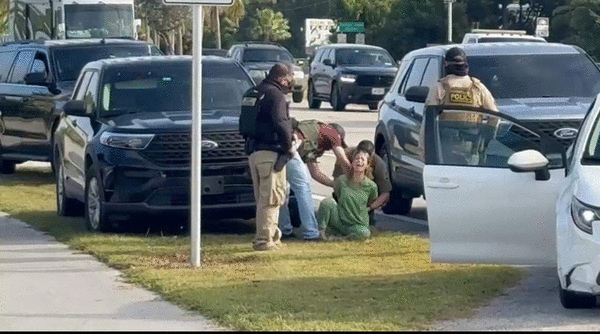
Hundreds of news photographs and social media videos have captured altercations between migrants and masked federal immigration agents, whether it’s outside a courtroom or in a traffic stop.
The videos and photographs have led people to ask about what rights they have in such situations.
Can federal agents search you or search your vehicle? Can they go through your purse, your wallet or cell phone? Do you have to answer their questions?
To answer these questions and others, the Herald spoke to three Miami-area immigration attorneys: Alicia Morgan, John Patrick Pratt and Maureen Porras, also vice mayor of Doral. Their replies have been edited and excerpted here.
Constitutional rights
Morgan spoke with the Herald about traffic stops by federal agents and drivers’ rights under the Fourth Amendment of the U.S. Constitution.
The Fourth Amendment, which applies to U.S. citizens and non-citizens, bars “unreasonable searches and seizures.” That means federal immigration agents cannot search you or your belongings in your car - a purse, a cell phone, papers - without your consent or probable cause that the car contained illegal immigrants or a federal crime was committed.
The Fifth Amendment, which also applies to citizens and non-citizens, guarantees that you have the right to remain silent if a police officer or federal agent asks you questions. “You do not have to answer questions about where you were born, whether you are a U.S. citizen, or how you entered the country,” the ACLU notes in its Immigration Rights website.
You can be detained, however, if police or federal agents have probable cause that a crime has been committed or that you’re an illegal immigrant.
Q: Are random immigration traffic stops allowed?
“The government isn’t really supposed to be doing just, you know, random stops of people. They’re supposed to have an individualized reasonable suspicion [probable cause] when they’re going to pull over any specific car.”
Q: Do people have to hand over their IDs to federal agents?
“Anybody who gets stopped by the police [or federal agent] in a legal traffic stop, they’re supposed to give over their license, their ID. If they’re trying to say that...this is...an immigration stop, then you are able to ask, ‘Hey, am I being detained, or am I free to go?’
“You can, in fact, say I would like to exercise my right to remain silent. You can say you want to talk to an attorney. “ [Both rights fall under the Fifth Amendment.]
Did federal agents have the authority to pull someone out of the car?
“So, in Florida law, when a driver is stopped for a legitimate traffic reason, right, then they’re supposed to provide their driver’s license, car registration and proof of insurance.... An officer can order a driver out of the vehicle [during] a lawful traffic stop for officers’ safety.”
Q: If a person believes their rights have been violated, what are their next steps?
“There are Fourth Amendment rights and also civil rights. One of the things [a person] could do is file a complaint with the Department of Homeland Security for civil rights and civil liberties. It’s called CRCL, which they investigate civil rights abuses involving ICE and CBP [Customs and Border Protection].
“And...[they] could...file with the Office of Inspector General, especially if it involved an excessive use of force. And then if [they] wanted to contact a civil rights attorney, they could help to file any complaints...under the Fourth Amendment, including false arrest, excessive force, unlawful search and seizure.”
Heated interactions
The Herald spoke with Pratt on what best to do when stopped by law enforcement:
Q: How can a person, legal U.S. citizen or not, avoid a hostile interaction with law enforcement conducting immigration enforcement?
“I have immigration colleagues traveling within the United States with their passports to avoid being detained and being dragged. There are reports where U.S. citizens have been detained by ICE, and other agencies, and they make up trumped-up charges.
“So, what are my rights? You have the right to remain silent. You have the right to ask who’s arresting you. You have the right to ask why are they arresting you. But, if you want to avoid [confrontation], then unfortunately you have to be compliant.”
Q: How can a person be compliant, and should they remain so if they believe they were unlawfully detained?
“People have to use, for lack of a better word, common sense based on new realities, which is should I carry proof that I’m a citizen?... [Federal immigration agents] are tackling people and throwing them to the ground and doing all these kinds of other things. If people are afraid of being subjected to that, then they should carry their passport...
“Just be compliant with their requests, don’t fight, don’t scream. Don’t try to escalate or de-escalate the situation because what we have seen is overly aggressive.”
Rights can vary
The Herald spoke with Porras on how a person’s rights can vary across locations and based on their immigration status.
Q: Does a person’s rights during immigration enforcement interactions differ depending on venue?
A: “Yes. So, based on where you are, you have a certain level of a reasonable expectation of privacy. For example, if you are out driving you have less of an expectation of privacy than if you are at home.”
Q: How do rights change within a 100-mile border zone such as the Florida Keys?
A: “The rights and expectation of privacy are diminished when you are within 100 miles of a checkpoint, a port of entry or an entry point, and that applies to both immigrants and U.S. citizens – so, even US citizens have fewer rights at the border.”
Even so, the ACLU notes on its website related to 100-mile border zones, federal agents still must have “reasonable suspicion that the driver or passengers in the car they pulled over committed an immigration violation or a federal crime.”
Q: Do rights vary depending on immigration status?
A: “It can, yeah. Lawful permanent residents have a little more protection because they have lawful permanent status, and so really the only person that can take away your lawful permanent resident status is an immigration judge. That includes lawful permanent residents that are traveling back into the country.
“...They have lawful status, and so they cannot be immediately deported. They are not subject to expedited removal like non-lawful permanent status holders are.”
©2025 Miami Herald. Visit at miamiherald.com. Distributed by Tribune Content Agency, LLC.






Comments