Coloradans snap up over-the-counter naloxone while hospitals offer the overdose-reversal drug to more patients
Published in News & Features
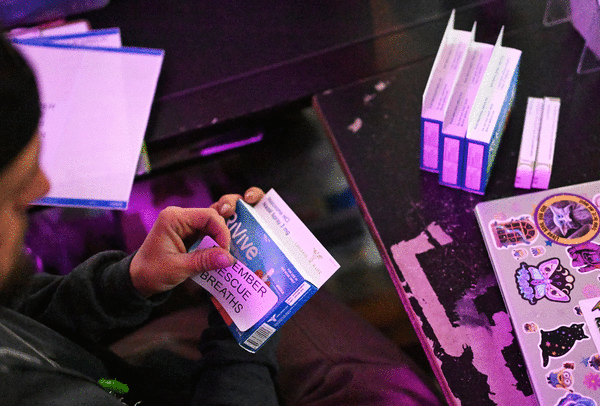
DENVER — Colorado is coming closer to universal access to overdose-reversing medication as residents snap up an over-the-counter version and hospitals offer it to more patients.
Naloxone, sold under the brand name Narcan, counters the effect of opioids so that a person who is overdosing doesn’t stop breathing. For the last decade, Colorado has had “standing orders” that allow anyone to buy it without a prescription.
In 2023, the U.S. Food and Drug Administration allowed over-the-counter sales, sparking additional public discussion about the option to carry the lifesaving drug.
Colorado residents bought 743.7 doses of naloxone for every 1 million residents in the first year after it became legal over the counter in September 2023, according to a report by Rand Corporation. That was more than 80% higher than the national average of 396 units per million people, and behind only Oregon.
In Colorado and nationwide, over-the-counter naloxone sales peaked in the first month, then dropped rapidly. Across the country, pharmacies dispensed almost 18 units of naloxone for every one unit purchased over the counter, and state-funded programs distributed 30 units for every one unit bought at retail.
Over-the-counter naloxone costs about $40 for a two-pack of the single-use spray. While Medicaid covers it in Colorado, commercial plans may charge co-pays.
Doctors also commonly prescribe naloxone to patients who receive opioids for pain following an injury or surgery. Depending on the size of the co-pay that their insurance charges, prescribed doses can be cheaper than those purchased over the counter. Patients may be more likely to follow through if they don’t have to remember to pick up an over-the-counter product while the pharmacy fills their painkiller prescription.
“Over-the-counter naloxone is an avenue to get naloxone into communities, but it pales compared to naloxone filled in pharmacies or distributed” by nonprofits, said Rachael Duncan, a pharmacist and associate director of the Naloxone Project.
While over-the-counter purchases may account for a relatively small share of naloxone distribution, they are an important way to allow lower-risk people to contribute while letting harm-reduction groups focus on those most likely to respond to an overdose, said Lisa Raville, executive director of the Harm Reduction Action Center in Denver.
People who use drugs respond to a disproportionate share of overdoses, both because they’re often nearby and because they don’t feel comfortable calling 911, she said.
“We had a whole bunch of moms coming to us wanting naloxone, and we didn’t have it to give them,” Raville said. The center only has enough to give the antidote to the highest-risk people, who also use drugs.
Studies estimated 80% to 90% of overdose reversals involve a rescuer who also uses drugs, rather than a first responder or another type of bystander, according to the Centers for Disease Control and Prevention.
Raville is concerned that access could take a hit in the coming years, though, if Colorado can’t find a sustainable funding source.
States with highest naloxone sales
Naloxone units sold over-the-counter per million residents:
•Oregon: 973.8
•Colorado: 743.7
•Wyoming: 577.1
•Georgia: 557.4
•Nevada: 553.6
Source: Rand Corporation
In 2022, the legislature appropriated $20 million for the Opioid Antagonist Bulk Purchase Fund, commonly called the naloxone bulk fund, but most of it came from federal pandemic recovery funds that expire at the end of 2026. The fund purchases naloxone at cheaper rates and delivers it to organizations that distribute it to end users.
Projections show the bulk fund will have enough money to continue purchasing and distributing naloxone for organizations working with the highest risk groups through December 2026, said Paul Bishop, spokesman for the Colorado Department of Public Health and Environment.
The fund prioritizes groups working with people who use drugs, which also have a clear distribution plan and can track how many kits they gave out, he said. In the fiscal year that ended in June, the bulk fund distributed about 411,000 doses to 390 organizations, according to its annual report to the legislature.
The goals of getting naloxone into the hands of anyone willing to carry it and focusing on people most likely to use it can be in tension if groups don’t have enough funds to do both, Duncan said. But naloxone’s long shelf-life somewhat mitigates that: doses that go to people who may not need to use them for years aren’t wasted, she said.
The Naloxone Project doesn’t receive donations from the bulk fund and relies on private fundraising to supply hospitals and first responders with doses patients can take home.
Most hospitals already offer naloxone to anyone treated for an opioid overdose and to new mothers deemed high-risk, because overdoses are essentially tied with suicide as the top cause of death during the postpartum period, Duncan said.
While they can’t know if patients use those doses once they go home, overdoses among new mothers dropped from 20 in 2022 to eight in 2023 – a 60% decline, she said. During the same period, overdoses among women of childbearing age in general declined 15%, from 321 to 278.
While they can’t be certain that naloxone distribution caused the greater drop among new mothers, the trend is encouraging, Duncan said. She and her colleagues started crying when they saw the numbers, because it had been so long since overdoses moved in the right direction, she said.
“To see this actually change is wild,” she said.
Offering naloxone on opt-out basis
Montrose Regional Health is piloting a program to offer naloxone to all pregnant patients during the first prenatal visit, and when they take their babies home.
Most decide to take it after learning they could use it years later if they happen to encounter someone in the throes of an overdose, said Jennifer Ackerman, director of women’s services at the hospital. Some say they’d like to have it on hand at work, or in case their older children experiment with drugs, she said.
“It’s kind of an opt-out instead of an opt-in,” she said. “It also takes away the bias” of deciding who might be at risk.
Offering it to high-risk people when they were about to be discharged from the labor and delivery unit produced “hit and miss” results, Ackerman said. Parents receive a great deal of information at discharge time and may not see naloxone as a priority, and providers don’t always have a full picture of risk in a household, she said.
Children’s Hospital Colorado is also piloting a broader distribution plan, offering naloxone to all families with babies in the neonatal intensive care unit as well as high-risk parents of healthy babies.
Ideally, hospitals would be able to offer it on an opt-out basis to anyone giving birth, since overdose risk increases during the postpartum period and babies put everything in their mouths once they’re mobile, said Dr. Stephanie Bourque, a neonatologist.
The hospital improved its screening in recent years to make the questions sound nonjudgmental, but not everyone will disclose substance use struggles even then, and parents may not know if other family members are using opioids, Bourque said.
“We weren’t doing a great job identifying who was at risk,” she said.
While most parents may not need to reverse an overdose, teaching all families prevents tragedies, in the same way that all parents learn about safe sleep and infant CPR, even though sudden infant death syndrome never affected most babies, Bourque said.
“This is just as normal as learning to put your baby on their back to sleep,” she said.
‘People don’t have to die’
Naloxone spray is easy to use, though people who aren’t experienced with drugs may inadvertently give too much because they think the person overdosing needs to wake up, Raville said. As long as the person is breathing, they aren’t in immediate danger, she said.
The experience can be scary, though, for people who haven’t seen an overdose before. Ideally, anyone willing to respond would get trained in advance, so they can give rescue breathing during the three minutes it can take for the naloxone to reach the brain and partially block the opioids, Raville said. The bulk fund offers a free virtual training session each month.
“It’s a miracle drug. You can’t mess it up,” she said. “The only issue is that you can’t really use it on yourself.”
Colorado has generally supported naloxone access; back in 2015, all members of the legislature voted in favor of allowing doctors to write standing orders so individuals who wanted to carry it didn’t need an individual prescription, Raville said.
Now, people are comfortable enough with it that parents pack it for their kids to take to college, just in case they or a friend decides to mix pills and alcohol, she said.
“People don’t have to die of overdoses,” she said.
-----------
©2025 MediaNews Group, Inc. Visit at denverpost.com. Distributed by Tribune Content Agency, LLC.




Comments