NC Education Lottery sales soar as schools' share continues to fall, audit says
Published in News & Features
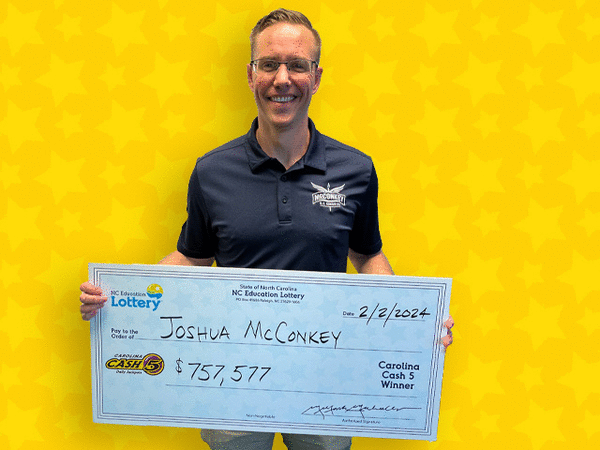
North Carolina Education Lottery ticket sales surged to a record $6.6 billion last year, but the percentage of revenue transferred to public schools continued to decline, according to a new state audit released Monday.
“North Carolinians have a reasonable expectation that if the Education Lottery’s ticket sales go up, money going toward our public schools would increase as well,” State Auditor Dave Boliek, a Republican, said in a news release. “At first glance, these numbers raise a lot of questions. Over the last three years, total revenues have increased by a total of over $3 billion, while contributions to public education have been flat.”
The numbers prompted “a deep dive” into all aspects of the lottery’s finances and operations, Boliek said.
“North Carolinians deserve answers to some tough questions so that we all have a better understanding of the return public schools are getting from the Education Lottery,” he said.
In a letter responding to the findings, lottery officials blamed the decline in the share of revenue transferred on players buying fewer high-margin jackpot tickets and more lower-margin digital instant games, reducing profit, or money left after costs.
The state’s lottery “along with all other lotteries across the country, experienced a decrease in revenues in FY25 from the Powerball and Mega Millions multistate draw games,” Education Lottery spokesperson Adam Owens said in an email. “NC Education Lottery’s expansion of its portfolio that added Digital Instant games helped to make up for these unusual decreases and allowed the lottery to provide more than $1 billion for education programs across the state for the third year in a row.”
The lottery’s FY26 budget “projects that it will increase the amount raised for education year over year,” he added, “and the first five months of sales are on track to meet that goal.”
State law requires that all net proceeds from the state lottery — the money left after expenses — go toward education. That includes any prior year’s surplus.
Historically, that has meant about 30% of the lottery revenue goes to education, according to the state Department of Public Instruction’s website.
Other funding sources for public schools include fines, sales tax and the state’s general fund.
Audit details
In the state fiscal year running from July 1, 2023, through June 30, 2024, the Education Lottery reported $5.38 billion in gross ticket sales and $1.09 billion in operating income, according to the audit.
During that year, the lottery transferred $1.061 billion in net proceeds to the state for education.
In fiscal year 2025, gross ticket sales rose to $6.59 billion, but operating income declined to $1.07 billion.
Cash transfers to the state in 2025 totaled $1.095 billion, a slight increase in dollar terms, but a decrease as a share of overall sales.
Administrative expenses also edged up, accounting for 3.83% of revenue in fiscal year 2025, compared with 3.75% the year before, the audit said.
The overall percentage contributed to public schools fell from 23% in FY 2023 to 20% in FY 2024 and 16% in FY 2025, the news release from the auditor’s office said.
The letter from the Education Lottery included in the auditor’s news release said total sales in FY 2025 reached $6.6 billion, but in-store sales fell by about $254 million. That decline was offset by $2.6 billion in online “Digital Instant” game sales — similar to retail instant-win games such as scratch-offs — which were offered for the first full year.
Games such as Powerball and Mega Millions generate stronger sales when jackpots climb . In FY 2025, they said, fewer jackpots reached those levels, reducing sales for those games. Meanwhile, digital instant games accounted for nearly 40% of the lottery’s overall product mix. Because instant games typically have higher prize payouts than draw games, the shift contributed to a lower profit margin.
The audit was conducted under contract with accounting firm Cherry Bekaert. The financial statement audit released Monday is conducted each fiscal year.
The auditor’s office has also launched a performance audit and has been working on it for the past three months. According to the release, it is the office’s first performance audit since 2008 and the first review of its kind since a narrowly focused investigative report issued by the office in 2012.
The lottery undergoes third-party independent performance audits every two years, said Owens.
_____
©2025 Raleigh News & Observer. Visit newsobserver.com. Distributed by Tribune Content Agency, LLC.






Comments