The Florida Legislature focused on cutting homestead property taxes as cities, counties raise concerns
Published in News & Features
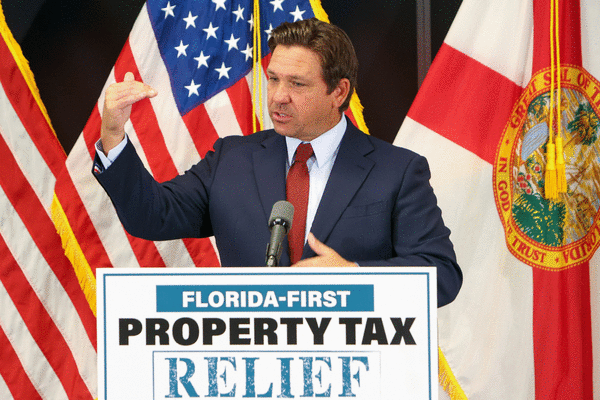
TALLAHASSEE, Fla. — Republicans in the Florida House are quickly moving forward on a smorgasbord of ballot initiatives that would ask voters to dramatically overhaul the state’s property taxes — deepening the anxiety for local officials who rely on those funds for their budgets.
When the Legislature convenes January 13 for its regular 60-day session, House lawmakers will have seven tax proposals they want to pass and then present to voters in November of 2026.
It is far from the first time the Florida Legislature has tackled property tax reform, but the latest proposals may be the most dramatic, especially one resolution calling for the elimination of taxes on homesteaded property. An estimated 5.1 million taxpayers have homestead exemptions on their primary residence that give them a break on their taxes and limit future increases, according to the state Department of Revenue.
“It is our position that the House does not need to limit itself in presenting one single plan, but instead allow the people of Florida the ability to choose some, all, or none of the proposals on the 2026 ballot.” House Speaker Daniel Perez, R-Miami, said in October when the resolutions were first unveiled by a specially appointed committee on property taxes.
All the proposals worry local governments, which use property tax money to fund police, fire and other municipal services. By state estimates, the most far-reaching proposal could mean Florida’s cities and counties lose $18 billion a year. But legislators say they have to do something.
“Local government property tax is increasing at an unsustainable rate and is causing undue financial burden on Florida’s citizens, homeowners and businesses,” Rep. Toby Overdorf, R-Palm City, co-chair of the House Select Committee on Property Taxes, said in November. “It is time to put money back in the hands of Floridians.”
The Legislature, however, cannot simply enact these plans but must put them to voters.
Senate President Ben Albritten, a Republican citrus farmer from rural Wauchula, predicted the Senate will take a more deliberative approach, cautioning that before you tear down a fence, you need to know why it was put up.
“We’ve looked at the House proposals, and every one of those has a certain amount of cost to it and a certain amount of impact to Floridians,” Albritton told a group of reporters earlier this month, saying he is especially concerned about the potential impact on rural communities.
None of the current legislative proposals contemplate wiping out all property taxes, as Gov. Ron DeSantis first proposed in February when he kicked off the current discussion. Instead, most focus on reducing taxes or increasing the exemptions on property that owners claim as their primary or “homesteaded” residence. Some of them spare schools from the tax cuts.
All the proposals would prohibit local governments from reducing law enforcement budgets.
DeSantis has since come around to the focus on homestead taxes, but he hates the idea of giving voters a menu of options, worrying that it will divvy up support and nothing will pass.
“Placing more than one property tax measure on the ballot represents an attempt to kill anything on property taxes,” DeSantis posted on X in October. “It’s a political game, not a serious attempt to get it done for the people.”
But there is little DeSantis can do about it except blast away from his bully pulpit, which has lost its potency since he was defeated in the 2024 presidential primary. Now he is a lame-duck governor with an uncertain future when he leaves office in a year. The governor has no veto power over ballot measures approved by the legislature.
Florida CFO Blaise Ingoglia, a DeSantis loyalist who has been touring the state criticizing cities and counties for what he believes is massive overtaxing and overspending, also has been using those appearances to bolster the cause for eliminating property taxes on homesteads.
In an appearance Thursday in Winter Park, he said the state needs to put one amendment to the voters “that gives the maximum amount of property relief possible.” But he isn’t sure the Legislature will do that.
“We’re hopeful that we can continue having those conversations,” Ingoglia said.
Any legislative constitutional amendment requires that a three-fifths majority of lawmakers in each chamber to put it on the ballot.
The resolutions would require 60% voter approval to become law. Any amendments that pass would not take effect until July 1, 2027 at the earliest.
Currently, all homeowners are allowed two $25,000 exemptions on their properties’ taxable value. The first applies to all property taxes including school district rates, and the second applies to the taxable value between $50,000 and $75,000, not including school taxes.
The Florida Legislature has tinkered with property taxes for decades, making no less than six changes to property taxes between 2006 and 2016, including a second $25,000 homestead exemption and a measure allowing so-called Save Our Homes benefits — which limit how much property assessments can go up for tax purposes — to be transferred to a new home.
“There are people who believe it is out of control … who believe they are being ripped off,” said Bob Jarvis, a law professor at Nova Southeastern University in Fort Lauderdale, referring to the current property tax . “But it’s unrealistic because you would immediately have to bring those taxes back in some other form either a new tax or increase in sales tax or fees.”
Governments favor property taxes because they are a stable source of revenue, he said.
“The real reason we collect property taxes is because it’s the simplest and most efficient kind of tax to collect. It is hard to hide or cheat the government, because real property is dirt. You can never hide dirt.”
In the spring, the Legislature ordered an in-depth comprehensive analysis of the tax proposals. It approved $1 million for a study, but DeSantis vetoed it.
But outside studies show that property tax reform will have a greater impact on smaller cities and counties that don’t have alternative funding sources. The studies also contend it could destabilize local government budgets, hurt critical services and shift the tax burden to renters and small businesses.
Property taxes are “the fiscal backbone of municipal finances, offsetting the volatility of sales taxes and other consumption-based taxes,” according to a recent study by Wichita State University commissioned by the Florida League of Cities.
“Any reform that significantly weakens this base directly compromises municipal finance resilience,” the report’s authors said.
Orlando and Orange County would lose a large chunk of revenue if homesteaded property taxes are eliminated, according to data compiled by Orange County Tax Collector Scott Randolph.
Homesteaded properties account for about 17% of Orlando’s tax revenue, or about $72 million of $454 million of total taxes collected. In unincorporated Orange County, about 24% of its tax revenue comes from homesteaded properties, which comes to about $278 million out of $1.17 billion of all taxes collected.
Of the seven property tax measures introduced in October, the one most closely aligned with DeSantis’ goals, House Joint Resolution 201, is moving quickly through the House committee process. It would exempt homesteaded properties from all all non-school property taxes and would mean cities and counties would lose $18 billion of a total $55 billion collected, according to the state Revenue Estimating Conference.
Another measure, also moving quickly, would create an alternative second homestead exemption on insured homes. That would cost local governments $6.6 billion the first year and have a recurring impact of $8.6 billion a year, the conference estimates.
Legislative Democrats view the tax proposals as the ultimate swipe against the independence of cities and counties.
“All of these joint resolutions are about politics, not about saving homeowners money, not about creating economic stability for our counties and our cities,” Rep. Kelly Skidmore, D-Boca Raton, said during a recent committee hearing.
If voters approve any of them, cities and counties will immediately file lawsuits challenging their constitutionality as they look for other sources of revenue to make up for the loss of income from property taxes, Jarvis predicted.
“At the end of the day this is just a shell game,” Jarvis said.
---------
©2025 Orlando Sentinel. Visit at orlandosentinel.com. Distributed by Tribune Content Agency, LLC.






Comments