States eager for final decisions on $50 billion health care fund
Published in News & Features
WASHINGTON — States are expecting clarity within days for a key feature of Republicans’ signature budget reconciliation law — a $50 billion rural health care fund that has an end-of-year deadline for the administration to announce its plans.
The wide-ranging law reduces health spending by about $1 trillion over a decade, primarily from changes and cutbacks to Medicaid and the Affordable Care Act’s insurance exchanges. But the Senate added the rural fund as a sweetener to secure the necessary votes from lawmakers worried about the law’s potential effects on rural health.
Republicans have since touted the fund, dubbed the Rural Health Transformation Program, as a game-changer for rural areas — which experience higher rates of hospital closures, health workforce shortages and chronic conditions.
States are watching for how the Centers for Medicare and Medicaid Services will allocate a discretionary portion of the fund before the Dec. 31 deadline. By statute, each state is entitled to $500 million for having submitted an application before Nov. 5. That accounts for half of the money. CMS has broad leeway, however, to evaluate and distribute the other $25 billion.
A funding announcement highlighted the agency’s criteria, such as projects described as making rural America healthy again or investing in sustainable and innovative care models.
“I’m very much curious to see where the chips fall on the discretionary piece of the funding approvals,” said Lisa Hunter, senior director of federal policy and advocacy for the left-leaning United States of Care, whose organization advised several states on their applications and in providing technical assistance.
CMS is authorized to claw back and reallocate funding, though, if states fail to meet performance metrics. That has some states worried.
The reconciliation law limits some pathways states used for shoring up health funding, such as provider taxes and state-directed payments — changes that have already prompted some rural facilities to close or scale back more costly services like obstetrics care.
That added to the difficult circumstances rural areas have faced for years, leaving some skeptical that temporary money can cure their ills.
“It’s really hard to solve those problems critically in any way,” said Katherine Hempstead, senior policy adviser at the Robert Wood Johnson Foundation, noting the fund’s five-year horizon.
Seeking answers
State officials don’t yet know how equally the discretionary pool will be dispensed or their maximum allotment under the program. With a one-time fund, they may not know what will be sustainable without additional money.
That has some wondering about the how the money will be spent.
“I didn’t see or interpret most of what states put forward as tackling true, long-term sustainability,” said Michael Baker, director of health care policy at the center-right American Action Forum.
That echoes concerns stemming from congressional negotiations, as some lawmakers complained the fund wasn’t big enough.
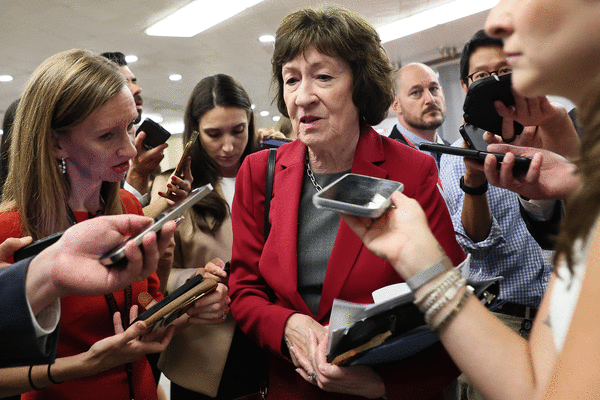
Sen. Susan Collins, R-Maine, fought for a larger $100 billion fund. She cited rural health care issues as among the reasons she eventually voted against the legislation.
The University of Pennsylvania Leonard Davis Institute of Health Economics shared findings with Senate Finance Democrats in December that project the fund is unlikely to compensate for the broader Medicaid cuts.
It’s unclear how much focusing on “Make America Healthy Again” policies might boost a state’s application.
West Virginia touted its progress banning certain food dyes and securing a waiver to exclude soda from its Supplemental Nutrition Assistance Program in its application, though those efforts began before the creation of the fund.
Hempstead is interested in how CMS will weigh different aspects of an application, including perception of the state’s needs and where states generally stand on certain policy issues.
The states that did not expand Medicaid under the Affordable Care Act, she said, are in some ways less vulnerable to the reconciliation law’s Medicaid cuts because those states avoid provisions targeted toward the expansion population, like work requirements.
“On the other hand, you know, a lot of those states, I think, are more kind of aligned with the administration,” she said.
Some proposals include commitments that require state legislatures to pass certain policies. Yet there’s no guarantee that any bill can make it into law; only ten states have full year-round sessions, while four state legislatures — Montana, Nevada, North Dakota, and Texas — meet biennially.
Baker is watching how much weight is given to promises to take legislative action because even states that are sympathetic to the administration’s priorities may not have moved before the deadline.
“If you’re looking at evaluating, let’s say, a MAHA-esque state law, there are states that maybe didn’t know that they would have needed to pass one to be successful in this grant program,” he said.
Patterns at play
Nearly all state proposals have focused on workforce, technology and sustainability projects. Expanding the workforce serving rural areas has been a longstanding issue.
States’ solutions included promises to increase the scope of practice for some health care workers, while seven states mentioned providing incentives to beef up their rural workforce.
Scope of practice refers to what a health care professional is authorized to do based on state statutes and licensing boards. Wyoming said its legislature would aim to expand the scope of pharmacists’ duties to allow them to order and perform lab tests.
Nevada proposed using first-year funds for subsidizing housing, relocation costs, educational stipends and a bonus to recruit new providers to rural areas who stay for five years.
But states are also facing a new obstacle this year, immigration enforcement changes and higher visa fees. Rural counties rely on physicians with H-1B sponsored visas twice as much as urban areas, according to researchers at two Boston-area teaching hospitals, Mass General Brigham and Beth Israel Deaconess Medical Center.
“When we had more immigration it was a great way to get providers to rural areas. And that’s, you know, that’s also been kind of complicated,” Hempstead said.
Every application mentioned telehealth as an important tool in reaching more rural populations, but people living in these areas often face limited access to broadband internet used for such health visits.
Hunter said she’s seen states pitching plans to improve their health information systems and data systems, as well as references to how to use artificial intelligence to improve rural health.
She said that’s “exciting on the one hand, and also really ambitious, especially given the access and broadband challenges that we know a lot of states face.”
©2025 CQ-Roll Call, Inc., All Rights Reserved. Visit cqrollcall.com. Distributed by Tribune Content Agency, LLC.





Comments