Ten Commandments in schools, DEI bans among 2026 'culture war' proposals in SC
Published in News & Features
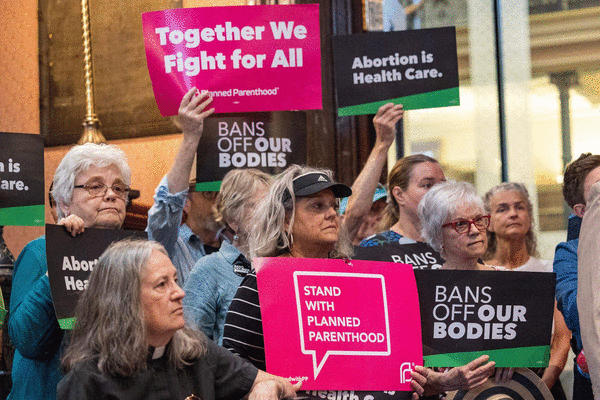
COLUMBIA, S.C. — Requiring the Ten Commandments in schools, banning public diversity initiatives and restrictions on who can use which bathroom could all be topics of ideological battles waged in the South Carolina statehouse next year.
Culture war issues, including diversity, equity and inclusion policies, abortion and book bans, have shaped previous legislative debates in South Carolina. Now, prefiled bills from state House and Senate lawmakers offer a preview into the issues that may be discussed in Columbia in 2026.
Senators filed 69 bills, with six relating to “culture war” issues. House members filed 258, and an estimated 12 relate to a culture war issue.
State lawmakers will be back Jan. 13. House and Senate members can propose bills at any point during session. Over 812 pieces of legislation were prefiled last year, and many were only introduced and never discussed. Of the almost 2,250 bills and resolutions introduced last year, only 97 bills passed the General Assembly and were sent to the governor’s desk.
Bathroom restrictions in public schools
A bill to restrict which bathrooms or changing rooms students in public and higher education schools can use received broad support from Republican House lawmakers. The bill would require multistall bathrooms and changing rooms to be designated for one gender. South Carolina students, teachers and visitors would only be allowed to use multistalled bathrooms or changing rooms that match their gender assigned at birth.
South Carolina lawmakers have previously passed one-year budget items that remove some state funding for school districts that allow students to use multistalled bathrooms or changing rooms that don’t match their gender assigned at birth. The budget provision was challenged in federal court by a Berkley County transgender teenager and his family.
Drag show, LGBTQ+-related content bans
South Carolina lawmakers proposed legislation aimed at keeping children from accessing LGBTQ+-related content and performances, including drag shows.
State Sen. Carlisle Kennedy, R-Lexington, prefiled two bills: one restricting drag performances in front of minors and another that would force online platforms, including streaming services and social media, to allow parents to opt their children out of seeing anything sexual in nature or “content that features transgender individuals.”
Kennedy’s drag show ban would pull state funds from any institution that hosts a drag show or drag story hour for minors. The bill also prompts the attorney general to fine the host organization $500 for every minor in attendance. Drag performances are categorized in the bill as any performer exhibiting a gender identity that is different from the gender assigned at birth.
Diversity, equity and inclusion
Some of the states most influential Senators, including Senate President Thomas Alexander, R-Oconee, sponsored bills banning all race-based quotas in public institutions, including schools, state agencies and colleges.
The bill follows Gov. Henry McMaster’s order for agencies to stop using race-based quotas while awarding contracts earlier this month. McMaster argued the minority quotas were unconstitutional following a 2023 U.S. Supreme Court decision dealing with affirmative action in college admissions.
“State agencies are caught in between state law and federal law, and so what we want to do is align with federal law and what the United States Supreme Court has ruled on that issue,” House Speaker Murrell Smith, R-Sumter, said Friday during a press conference. “So that’s the reason why we’re doing this.”
Rep. Wendell Jones, D-Greenville, filed a bill increasing reporting requirements for universities aimed at ensuring admissions are truly merit based.
Abortion and pregnancy
Though a proposed near-total ban on abortion failed to make it out of subcommittee in November, South Carolina lawmakers still filed bills on other abortion bans and legal rights for fetuses.
A House bill with support of over 30 sponsors, including Smith, targets medication abortions, which is considered the most common and accessible way people end a pregnancy in the state. Cracking down on abortion pills, including mifepristone and misoprostol, would be a priority for House Republicans next year, according to a handout from the caucus. The bill would reclassify mifepristone and misoprostol and place penalties on possessing and distributing abortion pills in some instances.
Possessing and distributing abortion pills, like mifepristone, was also targeted in a bill filed by state Rep. Melissa Oremus, R-Aiken.
Oremus also proposed banning the sale of “embryos created through in vitro fertilization.”
State Sen. Josh Kimbrell, R-Spartanburg, who is running for governor, wants to give the parents of an “unborn child at any stage of development” the right to sue for wrongful death. The father could also sue for wrongful death if a woman has an abortion that violates the state’s current restrictions, under the proposed bill. A similar bill was also proposed in the House.
“We say we’re pro-life, but right now, if you lose your baby while he or she is still in the womb, there is no protection for that child,” Kimbrell said in a social media video about the bill.
State Rep. John McCravy, R-Greenwood, filed a bill that would restrict Medicaid funds from family planning services from any provider that offers abortions.
Another bill would create a new office that distributes information about pregnancy. Among other adjustments and new requirements, it changes language referring “embryo and fetus” to “pre-born human.” The bill was filed by state Sen. Billy Garrett, R-Greenwood. Garrett was one of three sponsors on a restrictive abortion ban voted down by a panel of lawmakers this fall. He abstained from voting to move the bill out of subcommittee, with concerns over the penalties for people that had an abortion.
Education and libraries
From book bans in K-12 schools to House Freedom Caucus crusades against higher education employees and curriculum, educational institutions in South Carolina have been at the center of several culture war debates.
A bill with 49 House sponsors, including Smith and House education committee chair Rep. Shannon Erickson, R-Beaufort, would aim to give parents more oversight of public school curriculum. Among other requirements for education and healthcare, the bill would require notice and consent from parents before discussing gender roles and sexuality.
Public classrooms could be required to hang up the Ten Commandments under another filed bill with support from many House Republican lawmakers.
A bill requiring schools to allow students’ absence from class for religious instruction was filed by state Sen. Jeff Zell, R-Sumter. Currently, schools are allowed to adopt a policy for excused absences for private religious exemptions, but it is not required. The House parental rights bill creates a similar requirement.
New librarians would not have to meet qualifications of the State Library Board, under a bill proposed by state Sen. Rex Rice, R-Pickens. A county library board would also be barred from requiring, or even considering, whether a candidate has certifications from the American Library Association or has a master’s degree from a program certified by the organization. The American Library Association has been critical of book bans such as South Carolina’s policy on restricting certain titles.
©2025 The State. Visit at thestate.com. Distributed by Tribune Content Agency, LLC.






Comments