Weather might cause issues, but ULA, SpaceX could fly 3 launches within 12 hours
Published in News & Features
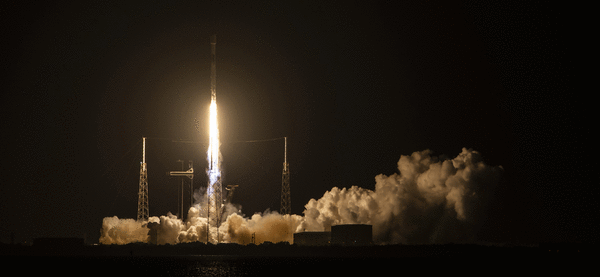
Dicey weather could cause issues, but three rockets from SpaceX and United Launch Alliance are lined up to launch from the Space Coast beginning Sunday night that could set a record with three Florida-based missions launched within 12 hours.
Up first is a SpaceX Falcon 9 on the Starlink 6-82 mission with 29 Starlink satellites from Cape Canaveral Space Force Station’s Space Launch Complex 40 targeting 9:46 p.m. during a launch window that runs from 9:43 p.m.-1:43 a.m. overnight.
This will be the ninth flight of the first-stage booster, which will aim for a recovery landing downrange on the droneship A Shortfall of Gravitas stationed in the Atlantic.
Space Launch Delta 45’s weather squadron, though, forecasts only a 30% chance for good conditions at the launch site in addition to low-to-moderate concerns for the booster recovery weather. While a 24-hour delay improves weather chances for launch to 95% at the pad, the booster recovery weather chances worsen.
The poor conditions come from a cold front approaching the region Sunday afternoon with a surge of of northerly winds on Sunday evening that will get worse overnight.
That also bodes poorly for the planned early morning launch for ULA, with SLD 45 citing only a 20% chance for good conditions during its launch window.
ULA is aiming for what would be the company’s fourth mission for Amazon flying what had been previously called its Project Kuiper satellites but is now dubbed Amazon Leo.
The ULA Atlas V on the Amazon Leo 4 mission looks to lift off from Canaveral’s Space Launch Complex 41 during a launch window that runs from 3:49-4:18 a.m. carrying 27 more satellites for Amazon’s growing broadband internet constellation that seeks to compete with SpaceX’s Starlink.
A 24-hour delay would see weather conditions improve to 95%.
SpaceX has actually flown three missions for Amazon, while ULA, which has dozens more lined up, has flown three previous all on Atlas V rockets this year. Its larger Vulcan rocket will be used for the majority of those starting next year.
With this seventh launch in the books, Amazon’s constellation would increase to 180 satellites of the planned 3,236 total needed to be in orbit by July 2029.
SpaceX meanwhile has already launched more than 10,000 of its Starlinks since the first operational mission in 2019, including 3,000 alone in 2025.
And it has more Starlinks ready to go for what would be the final launch of a busy run on the Space Coast.
A SpaceX Falcon 9 is set to launch on the Starlink 6-99 mission with 29 Starlink satellites from Kennedy Space Center’s Launch Pad 39-A during launch window that runs from 8:11 a.m.-12:11 p.m.
This will be the 6th flight of the first-stage booster, which will aim for a recovery landing downrange on the droneship Just Read the Instructions stationed in the Atlantic.
SLD 45’s weather squadron cites the same cold front wind issue giving the launch a 40% chance for good conditions at the launch window’s opening, which improve to 80% by the end of the window. But booster recovery weather would be a moderate concern, and while a 24-hour delay would improve launch site odds to better than 95% at the launch site, booster recovery weather would remain a low-to-moderate watch item.
If all three launches go, they will mark the 107th, 108th and 109th from all providers on the Space Coast this year.
SpaceX and ULA teamed up twice this year to knock out similar trios of launches back on both April 27-28 and again from Sept. 24-25 sending up three missions in just over 24 hours.
This trio would best those and set a record with three missions in potentially in as little 10 hours, 25 minutes, although the weather issues could see delays for all three missions.
SpaceX will have flown all but eight of those, with the Sunday night mission marking its 100th from either KSC or Canaveral in 2025 and the Monday morning launch its 101st.
ULA will have flown five with four Atlas V rockets and a lone Vulcan mission.
Blue Origin makes up the last two launches having sent up its first and second ever missions for the heavy-lift Blue Glenn.
Blue Origin, ULA and SpaceX combined to fly four missions from four pads within 34 hours in November.
The record for shortest time between two launches from Space Coast pads, though, still goes back more than half a century, from four Gemini program missions that flew in 1966. Those featured double launches from two different pads on what was then Cape Kennedy.
Those would send crew up in the Gemini capsule on Titan rockets about 100 minutes after Atlas boosters had sent up Agena Target Vehicles with which they would rendezvous in space. The record remains the two launches with Gemini 11, which sent up Pete Conrad and Richard Gordon from Launch Complex 19 only 97 minutes and 25 seconds after the Agena launch from Launch Complex 14 just over 1 mile to the south.
SpaceX has at least one more mission on tap from Florida this year: another Starlink mission from Canaveral’s SLC-40 now targeting Saturday during a window that runs until 3:17 a.m.
_____
©2025 Orlando Sentinel. Visit orlandosentinel.com. Distributed by Tribune Content Agency, LLC.






Comments