Europe sees Trojan horse for Russia in Trump's Ukraine plan
Published in News & Features
European officials are growing concerned that an emerging U.S.-brokered peace deal in Ukraine could be exploited by Russia, paving the way for a reinvasion of territory in the war-battered nation’s eastern Donbas region.
The fear, a main sticking point in recent talks, is that the U.S. plan for a demilitarized zone would give the Kremlin cover to deploy covert forces in the contested area, according to people familiar with the matter. The Kremlin might then use hybrid tactics, including so-called false flag operations, to undermine U.S. security guarantees and manufacture the premise for a new invasion, they said.
Nearly four years after Russia’s full-scale attack, control over territory is at the center of complex negotiations between Washington, Kyiv and Moscow as officials inch closer to an accord. Russia is demanding that Ukrainian forces withdraw from the eastern Donetsk and Luhansk regions — including territory Russia doesn’t control — while Kyiv is refusing to concede land.
Details of the talks are in flux. Ukrainian President Volodymyr Zelenskyy said the U.S. has discussed turning the Donbas region into a “free economic zone” under special administration, while Russia has opted for a “demilitarized zone.” Zelenskyy this week floated the idea of a referendum on potential territorial resolutions for the area.
But Russia could take advantage of any withdrawal of Ukrainian troops from areas that Kyiv controls, the people familiar said on condition of anonymity as talks take place behind closed doors. That makes Europe’s main objective in the coming days and weeks to ensure that any peace deal doesn’t contain a Russian Trojan horse.
The White House didn’t immediately respond to a request for comment on those concerns.
While Russian President Vladimir Putin likely retains his maximalist goals in Ukraine, a key question is whether Moscow continues to reject any peace deal or tactically backs American attempts to get an agreement over the line in the coming weeks, according to the people familiar.
In addition to the potential to exploit a peace framework with its familiar arsenal of hybrid attacks, another risk is Moscow’s interference with a public referendum or election that may follow a peace settlement, they said.
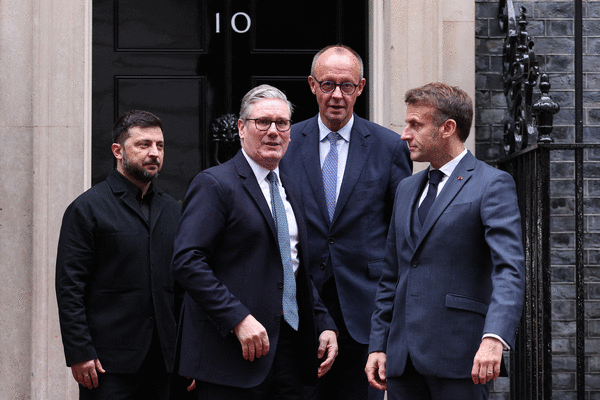
U.S. envoy Steve Witkoff is set to meet Zelenskyy and European leaders in Berlin over the weekend, according to a White House official. Continued talks are expected Monday involving Zelenskyy, German Chancellor Friedrich Merz, U.K. Prime Minister Keir Starmer and others.
Peter Ricketts, a former British national security adviser, said the Europeans were right to be concerned by the U.S. proposal for a demilitarized zone. Once American attention drifted elsewhere, Putin could “create incidents as pretexts” — such as protecting Russian speakers, to move in, he said.
“This would leave the rest of Ukraine vulnerable to the next Russian advance,” Ricketts said. “So this is not just a technical point, but a fundamental issue — for Ukraine and for European security.”
NATO Secretary General Mark Rutte this week warned of a threat beyond Ukraine’s borders, saying Russia will come for the rest of Europe if its warmongering isn’t checked now.
“We are Russia’s next target. And we are already in harm’s way,” Rutte said in Berlin. “We must be prepared for the scale of war our grandparents and great-grandparents endured.”
The status of a demilitarized zone and who would police it is unclear, some of Ukraine’s allies have said. American negotiators have talked about the region being under special administration, but have also suggested Donetsk and Luhansk, which compromise Donbas, should be recognized as de facto Russian, along with Crimea.
Two partially occupied regions to the west, Zaporizhzhia and Kherson, would be frozen along the current contact line.
Kremlin aide Yuri Ushakov appeared to endorse the idea of a demilitarized zone, suggesting that instead of Russian troops controlling the area, its national guard or police could be deployed there instead.
Such a suggestion would be seen as unworkable by Ukraine and its allies, European officials said.
For its part, Kyiv has consistently rejected conceding territory — and sought air-tight security guarantees that would resemble NATO’s mutual-defense mechanism, known as Article 5. Earlier this week, he said his top focus was to find out what Western allies were prepared to offer.
“There is one question I — and all Ukrainians — want to get an answer to,” Zelenskyy told Bloomberg News on Monday. “If Russia again starts a war, what will our partners do.”
———
(With assistance from Daryna Krasnolutska, Andrea Palasciano and Ros Krasny.)
©2025 Bloomberg L.P. Visit bloomberg.com. Distributed by Tribune Content Agency, LLC.





Comments