Larry Printz: Aston Martin Has two new ways to make your neighbors hate you
Published in Business News

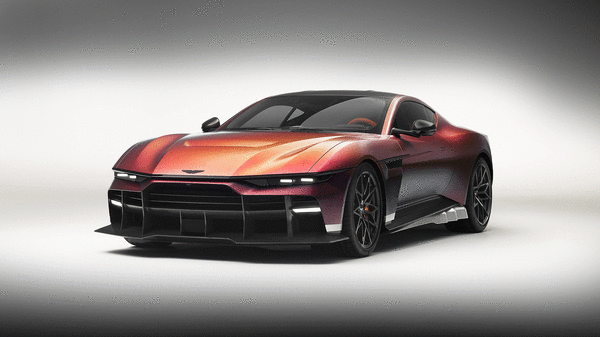


Aston Martin has looked at the modern sports car and decided that what the world really needs is something with 838 horsepower, a body made almost entirely of carbon fiber and an exhaust system loud enough to make the neighbors consider moving to a different zip code. And then, just to make sure nobody misses the point, it’s building only 150 of them.
This is the Valen, a new V-12 special that abandons the company’s recent obsession with looking backwards and instead has a stab at what the future might look like. And it looks rather angry.
Unveiled earlier this year at Monterey Car Week in California, the Valen is based on Aston Martin’s front-engine sports-car architecture. But calling it a Vanquish with a different body would be like describing a tiger as a slightly irritable house cat. Engineers have removed about 240 pounds, revised the chassis and aerodynamics, and installed the most powerful V-12 the company has ever produced.
The 5.2-liter twin-turbocharged engine develops 838 horsepower. It drives through an eight-speed ZF automatic transmission, incorporating lessons from Aston Martin’s GT4 racing program. The software has been revised to make downshifts sharper, while a new launch-control system helps get all that power off the line without immediately turning the rear tires into expensive smoke.
The weight reduction comes courtesy of a full carbon-fiber body, standard magnesium wheels and a titanium exhaust. The latter has four outlets arranged in two pairs, because apparently two exhaust pipes simply wouldn't convey the necessary level of menace. Aston Martin says the Valen is six decibels louder than the Valor, which is presumably good news if you enjoy hearing your car from several counties away.
The chassis has received modified Bilstein dampers, carbon-ceramic brakes and a solid-mounted subframe intended to improve the driver's connection with the road. Sport, Sport Plus and Track modes let you choose your preferred level of hooliganism, while bespoke Pirelli tires use Cyber Tire technology to provide temperature and pressure information to the electronic stability-control system.
Visually, the Valen is a departure from the retro-inspired Valor and Valiant. The headlights are so thin they disappear when switched off, while the muscular rear haunches and prominent vortex generators give the car the appearance of something that has spent too long in a gym. The aerodynamic details help manage airflow, although Aston Martin admits their principal purpose here is visual drama.
The launch car wears satin Andromeda Red, available through the company's Q personalization program. Customers can choose from other paint finishes, exposed carbon fiber and a variety of bespoke treatments. In other words, if you have the money and the imagination, Aston Martin will happily help you make your car look like nothing else on the road.
Inside, there are new Sports Plus seats, 3D-printed lattice structures and a narrower center console. Two 10.25-inch screens handle instrumentation and infotainment, while a Bowers & Wilkins sound system comes standard. That's all very nice, although I suspect the engine will provide most of the entertainment.
But the Valen isn't the only sign that Aston Martin is determined to make life interesting. The company has also unveiled the Valhalla Spider, an open-cockpit version of its mid-engine plug-in hybrid supercar, which made its global debut at the 2026 Concours at Wynn Las Vegas on Halloween weekend.
Where the Valen celebrates the traditional V-12, the Valhalla Spider embraces the future, albeit a future in which the internal-combustion engine hasn't yet been sent off to a retirement home.
Its 4.0-liter twin-turbocharged V-8 works with three electric motors to produce a combined 1,064 horsepower and 811 pound-feet of torque. Top speed is electronically limited to 217 mph, whether the roof is fitted or removed.
The roof itself comes in two forms. The standard black fabric roof allows speeds of up to 124 mph, while an optional carbon-fiber hardtop permits the car to reach its full maximum speed. Aston Martin has also revised the aerodynamics and stability-control calibration to accommodate the different airflow conditions with the roof on or off. The active aerodynamic system can generate more than 600 kilograms of downforce with the roof fitted.
Deliveries are scheduled to begin in the third quarter of 2027.
Together, these two cars demonstrate that Aston Martin isn't putting all its eggs in one technological basket. The Valen is a celebration of noise, weight reduction and traditional V-12 theatrics. The Valhalla Spider combines hybrid power with mid-engine engineering to deliver extraordinary performance while allowing its occupants to enjoy the fresh air.
One looks to the future by making the past louder. The other looks forward by adding electric motors. Either way, the new Valen and Valhalla Spider approach this problem from different directions, but both share the same basic philosophy: more power, more noise, more carbon fiber, and absolutely no interest in making life easier for your driver’s license.
And if Aston Martin will have proved anything, it’s that no matter how sophisticated cars become, there will always be people willing to pay a fortune for a car that makes an entrance, makes a noise and makes absolutely no attempt to be sensible.
©2026 Tribune Content Agency, LLC










Comments