Musk seizes on SpaceX momentum with push toward Tesla merger
Published in Business News
Elon Musk capitalized on a strong quarter of earnings at SpaceX to openly press for combining the business with Tesla Inc. in what would be the biggest merger of all time.
Toward the end of a call about SpaceX results that far exceeded expectations, the chief executive officer initially said he was “tap dancing through a minefield” when asked about the prospect of merging the two companies currently worth a total of almost $3.5 trillion.
“I have to be thoughtful about what I say here,” Musk said.
The world’s richest man then let loose with inside-the-boardroom details, disclosing for the first time that both SpaceX and Tesla had formed special committees to consider the idea. The committees consist of independent directors, Musk said, and he can’t be part of the discussions because he’s a conflicted party.
That didn’t stop Musk from offering his view.
“Do I think it would be a good idea? Yes,” Musk said. After cautioning that getting enough support from Tesla shareholders may be tricky and that neither committee has settled on terms, he reiterated his support not once, but twice.
“There’s a lot of merit to combining the companies,” Musk said. “I think it would be a good idea, but it’s really up to the special committees of both companies.”
SpaceX and Tesla shares both extended gains following the comments, climbing as much as 8.6% and 1.7%, respectively, in late trading. SpaceX is the larger of the two, having closed with a market capitalization of $2 trillion.
A merger of SpaceX and Tesla would be a blockbuster, creating a conglomerate spanning electric vehicles, energy storage batteries, rockets and satellites. The stated rationale for bringing those disparate interests together lies in their shared ambitions to leverage artificial intelligence for data centers in space, driverless cars and humanoid robots.
“There’s no question that Musk wants the merger, and he wants to get it done sooner rather than later,” said Gene Munster, founder of Deepwater Asset Management, which has invested in both companies. “It was a key question on the call, and Elon said it was a good idea about three times. He’s getting people excited about it, and he wants to bump up the enthusiasm.”
Musk made the comments after SpaceX posted $4.4 billion in net income for the quarter ended in September, far better than analysts’ average projection of $1.88 billion. Revenue increased 161% from a year ago and also beat expectations.
Revenue from SpaceX’s AI business — now going by Super Intelligence, or SI — soared to $7.56 billion in the quarter, more than nine times what the company generated a year ago. SpaceX has become a major compute and infrastructure supplier to Anthropic PBC, Alphabet Inc. and others, and in August acquired Cursor, the developer of a popular AI-powered coding tool.
Those factors — along with increased adoption of Grok, the large language models developed by Musk’s xAI — contributed to SpaceX’s AI business posting $431 million of income from operations in the third quarter. A year ago, the business recorded a $1.7 billion loss.
“Super Intelligence was the standout growth driver for the quarter,” SpaceX Chief Financial Officer Bret Johnsen said during the call, pointing to increased demand from clients seeking more computing power, as well as Grok enterprise sales.
SpaceX expects total revenue to rise to as much as $37 billion in the first quarter of next year, Johnsen said. He indicated that the company expects to keep borrowing, saying there are “a number of available pools of debt capital that we are talking to at the moment.”
SpaceX said subscribers to its satellite-internet service Starlink — its biggest income generator — reached 13.6 million by the third quarter, short of the number analysts were expecting. Revenue from the company’s connectivity business still managed to beat expectations, rising 69% from a year ago to $5.25 billion.
Whereas SpaceX’s AI and connectivity businesses have taken off, revenue from the company’s unit focused on designing, manufacturing and operating launch vehicles and spacecraft rose just 6% to $1.77 billion in the third quarter.
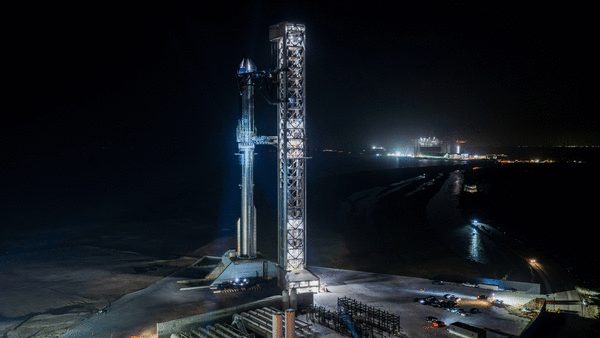
On a conference call, Musk said SpaceX expects to catch both the booster and the ship for the 15th test flight of his giant Starship, planned for next month. The vehicle is expected to be fully reusable, a feat no other rocket has achieved. President Gwynne Shotwell later added that the company expects to attempt the first demonstration of on-orbit refueling with Starship early next year.
On-orbit refueling will be necessary for Starship to master for SpaceX’s contract to land humans on the moon for NASA. The company is supposed to have a prototype ready by next year that can dock with NASA’s Orion spacecraft for Artemis III mission, a precursor to a moon landing planned for 2028. Whether that will be ready on time remains uncertain.
Starship is also essential for launching upgraded Starlink satellites that can provide greater capacity and data speeds than the current spacecraft in orbit. Shotwell said she expects the additional capacity from flying what the company refers to as V3 Starship satellites on a much larger vehicle will allow SpaceX to expand across new markets.
“Connecting cars, robots and the adoption of superintelligence will increase communication demands not in percentages, but in many orders of magnitudes,” Shotwell said. “We expect Starlink alone to represent a significant portion of global internet traffic.”
Starlink’s growth was driven by momentum in the aviation industry for in-flight WiFi and Starshield, a militarized version of the service that is more encrypted and secure, Johnsen said.
Starshield has come under renewed scrutiny since Ukrainian President Volodymyr Zelenskyy accused the White House and Musk of placing restrictions on the technology, which his country’s forces have used for battlefield communications and operations. Both Musk and Trump have denied involvement in the limitations, igniting a firestorm over technology that’s become indispensable to Ukraine’s war against Russia.
When commenting on a potential SpaceX-Tesla combination, Musk said that he suspects “people out there assume” the merger is a certainty. While he said this would be an overstatement, the deal would have the support of Chad Anderson, the chief executive officer of Space Capital, an early SpaceX investor.
“It makes a ton of sense,” Anderson said. “Combined, it would be the only company owning the full physical-AI stack, from chip fabrication to orbital data centers to autonomous devices on the ground. No competitor has an analog.”
(With assistance from Dana Hull, Allyson Versprille and Ed Ludlow.)
©2026 Bloomberg L.P. Visit bloomberg.com. Distributed by Tribune Content Agency, LLC.





Comments