Millions of trucks to be reclassified as cars after Trump overhaul
Published in Business News
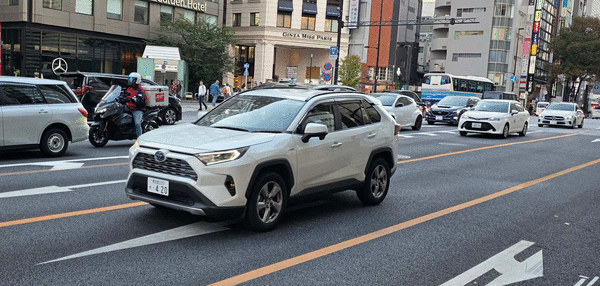
WASHINGTON — Millions of light-duty trucks spanning more than 100 nameplates will soon be recognized as passenger cars thanks to a regulatory overhaul by the Trump administration.
The planned shift for model year 2030, according to regulators, could push automakers to offer fewer unnecessary features and improve fuel economy for wallet-conscious consumers. It will affect top sellers like the Toyota RAV4, Honda CR-V and Ford Bronco Sport, among many other models.
The change will also toughen automakers' ability to comply with rules for fuel efficiency and — technically — reverse a decades-long trend of climbing truck popularity with American drivers.
The landmark move is an unusual one under President Donald Trump, whose top officials have typically worked to loosen environmental regulations rather than strengthen them. The reclassification came embedded in new miles per gallon targets far looser than Biden-era ones, though the definition change could make even those lower goals tricky for some automakers.
"It didn't go to easy. It just went to less hard," said Stephanie Brinley, principal automotive analyst for Mobility Global, of the new standards.
The National Highway Traffic Safety Administration said in its new standards for corporate average fuel economy that reclassifications were overdue after car and truck makers made a habit of designing vehicles to meet regulatory loopholes rather than consumer needs.
"Indeed, while 68 percent of the light-duty fleet meets the current light truck regulatory definition, the majority of these vehicles ... cannot realistically operate off highway and have little value moving cargo," the agency wrote in a regulatory filing.
"Instead, most of these vehicles are designed and intended primarily to move passengers but have additional features solely to meet regulatory definitions — resulting in little added functionality, reduced fuel economy performance, added cost, and a homogenous design lacking in creativity."
The Trump CAFE standards set a fleetwide goal of roughly 34.9 miles per gallon by 2031, a number automakers already achieved in 2024. The Biden target for 2031 was 52.5 mpg, though the adjusted truck definition and other elements of the new rule complicate comparisons across administrations.
The reclassification makes compliance more difficult for automakers because the federal government sets different standards for cars and for trucks, a less stringent category that currently includes most crossovers and SUVs. Millions of those vehicles will shift into the car category starting in 2030.
Light-duty trucks currently make up about 70% of the U.S. new vehicle market, the result of a longstanding trend toward the segment, while passenger cars make up 30%. The new reclassification effort will essentially swap those numbers.
Will the change affect consumers?
Brinley said it is hard to predict how the regulatory change would impact consumers and the mix of products available to them. "There are always unintended consequences of any rulemaking process. And the reality is, it's hard to see what those are until a few years out," she said.
The analyst noted that past relaxations of fuel economy rules helped shift the market toward crossover models in the first place, in part, because automakers wanted the easier mpg targets that came with selling vehicles that functioned like cars but were technically defined as trucks. But then customers took a liking to those models.
"Consumers clearly have decided that's the form factor they want," the analyst said.
Others were skeptical that the truck definition change would have much of an impact on the product mix for the U.S. vehicle market.
"The change happening now likely won't affect much since the regs themselves are so extraordinarily weak, set roughly at levels first achieved around 2017," said Chris Harto, Consumer Reports' senior policy analyst for transportation and energy.
"(S)o no one, even Stellantis with their plans to shove a V8 in everything, will have much trouble meeting them. Not that it matters because all enforcement mechanisms were eliminated already," he added in a social media post.
His comment referenced a law change by Trump and Republicans in Congress to zero out all penalties for non-compliance with CAFE. That move — at least for the time being — has made all fuel economy regulations toothless.
NHTSA, even with the truck reclassifications, estimated that automakers would save a combined $60.6 billion in technology costs thanks to the new CAFE standards. The regulator said General Motors Co. would have the biggest savings at $20.4 billion — more than a third of the entire industry total.
Stellantis NV ranked next at $6.4 billion, followed by $5.3 billion for Hyundai Motor Co., $5.1 billion for Ford Motor Co. and $4.5 billion for Toyota Motor Corp.
How will the change impact automakers?
Some of the popular models set to be affected by the reclassification include the Toyota RAV4, Honda CR-V, Ford Bronco Sport, Chevrolet Equinox and Jeep Compass, according to NHTSA filings.
All of Subaru Corp.'s vehicle lineup — including the Forester, Crosstrek and Outback crossovers — will be shifted into the car category, barring significant design changes. The same is true for Kia Corp., which makes the Telluride SUV and Mazda Motor Corp., maker of the CX-5.
The shift cuts at fuel-economy compliance in two directions.
In the light-duty trucks regulatory bucket, crossover models tended to buoy automakers' fuel economy averages. That category will soon have a higher share of traditional, less fuel-efficient pickup trucks and off-road models thanks to the definition change. The fuel economy target for those vehicles in 2031 is 26.4 mpg.
In the passenger cars regulatory bucket, some crossover models may drag down the averages for sedans and other economy models. The fuel economy target for those vehicles in 2031 is 40.2 mpg.
The new NHTSA rule adjusts the definition of a truck by doing away with blanket inclusion of vehicles with foldable third-row seating that provides additional storage space when needed.
Vehicles can qualify as trucks in two ways: One is to have towing plus payload capacity at or above 8,500 pounds. The other is off-road capability that meets four eligibility tests.
Automakers opposed the reclassification changes to varying degrees, though the industry did lobby successfully to push implementation back from model year 2028 to 2030.
"Ironically this is the type of thing consumer and environmental advocates have been arguing for for nearly 2 decades," said Harto, the Consumer Reports analyst. "Not shocking that the industry has fought this tooth and nail ... they are responsible for these loopholes and always seem to win concessions around them whenever regs are updated."
Brinley said adjustments to the new definitions will "be different from automaker to automaker."
"There will be some automakers with enough electrification and with good enough fuel economy from their crossovers that they may not need to worry about it. But automakers that are truck-heavy are going to feel the loss of a crossover shifting to a car more heavily," she said.
Hyundai CEO José Muñoz weighed in on the new fuel economy rules and vehicle reclassification.
"We compete in all markets with all the standards, etcetera," Munoz said. "So we try to do our best in the market with different standards (and) with these ones. So it will change the dynamics, and we will adjust to the new dynamics. So that's all."
He said the rule change won't upend the automaker's $26 billion U.S. investment plan, as well as newly announced plans to build the Tucson hybrid and Santa Fe ERV in Montgomery, Alabama. He said Hyundai does not plan on saving money from the mpg change. "Hybrids are definitely helping us a lot," he said. "They are the biggest growth for us in America."
General Motors was among the sharpest in its opposition to truck reclassification, writing earlier this year in a public comment that proposed changes by NHTSA "underestimated the extent of this vehicle shift and the potential market distortions."
GM President Mark Reuss spoke more about the new CAFE rule on Sept. 29. He did not comment on reclassifications but did say that his company will continue developing EV offerings regardless of federal standards.
"It's a capital-intensive business," Reuss said. "Whipsawing that around today's headlines or regulatory environment or whatever that is puts a lot of people's livelihoods at stake."
©2026 www.detroitnews.com. Visit at detroitnews.com. Distributed by Tribune Content Agency, LLC.









Comments