Washington tackles rounding rules as nation phases out penny
Published in Business News
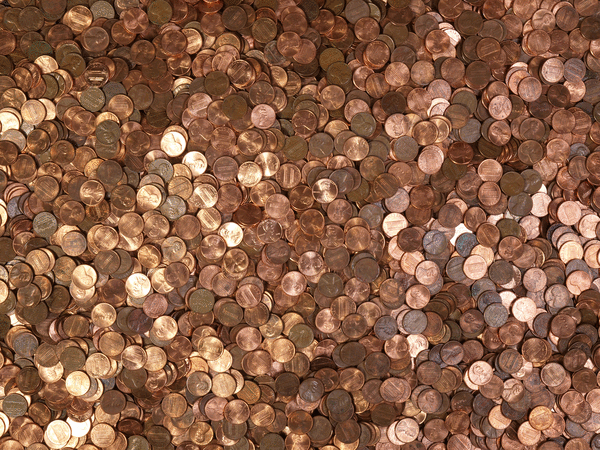
As the U.S. says goodbye to pennies, Washington state lawmakers have reached a solution for how local businesses should handle rounding during cash transactions.
Gov. Bob Ferguson received a bill on Thursday that would authorize asymmetrical rounding to the nearest nickel for cash transactions. It had yet to be signed as of Monday afternoon.
The measure would use this guidance: If the total ends in 1 or 2 cents, it rounds down to zero, and a total ending in 3, 4, 6 or 7 cents rounds to 5. A total that ends in 8 or 9 cents rounds up to 10.
Washington, like other states, rushed to put the rules in place after President Donald Trump directed the U.S. Treasury Department to halt the production of new one-cent coins in February 2025. The last penny was minted on Nov. 12.
This federal change has left states and businesses in a difficult position," said Rep. April Berg, D-Mill Creek, in a Jan. 9 statement when she introduced the bill. "Without clear guidance, cash-only businesses have been unsure of how to handle rounding, which can create confusion and errors in transactions."
Noncash transactions, such as credit-card payments, would remain unchanged.
The Washington Food Industry Association, which represents the state's independent grocers, convenience stores and their suppliers, is cheering the bill's progress.
"We needed this legislation to support and protect our members as pennies are removed from circulation and we update our (point-of-sale) systems," association president and CEO Tammie Hetrick said Monday.
Sara Whitesides, a cashier at City Market on Capitol Hill, considers the proposed rounding rules by state lawmakers to be a reasonable deal for shoppers and cashiers alike.
"It feels fair," she said, "because, honestly, I do that in the first place. Expecting me to give someone 99 cents is absolutely absurd. I am rounding up and giving you a dollar back."
Like Whitesides, business operators have been testing their own approaches.
Beloved local chain Dick's Drive-In has already started to round to the nearest nickel when patrons shell out dollars and cents.
"We have been implementing these changes since late last year, as we were already facing challenges with sourcing pennies," Lena Duckworth, executive assistant and board liaison at Dick's, said Monday.
End of 'little piece of bronze metal'
The federal government decided to put the kibosh on copper-colored coins to save money.
"Over the past 10 years, the total production cost of the penny has risen from 1.3 cents to 3.69 cents per penny," the agency wrote in a set of recommendations in December 2025. "The U.S. Mint projects an immediate annual savings of $56 million in reduced material costs by stopping penny production."
But cash — and even pennies — still remain relevant.
Cash transactions account for 14% of all U.S. consumer payments, according to the Federal Reserve Financial Services' 2025 "Diary of Consumer Payment Choice."
Some consumers prefer cash for its anonymity or the freedom it provides from digital devices. Others, such as unhoused people, have to use cash because they lack a permanent residential address, which is necessary to open a traditional bank account and obtain a bank card.
The Federal Reserve Financial Services found that "amid increasing digitalization of payments driven by credit card usage, mobile phone usage and remote payments, consumers continue to use cash and keep it handy."
However, credit cards are the dominant payment method, making up 35% of payments, and debit cards constitute 30% of payments.
Employees at small shops in Seattle said they largely haven't felt the absence of pennies yet.
"I wouldn't say it's really had any real immediate impact, other than being short a few pennies here and there," said Doug Robinson, who works in sales at Pacific Supply, a hardware store on Capitol Hill. "The majority of people pay with card."
Around 114 billon pennies remain in circulation, and they continue to hold their value, per the U.S. Treasury Department.
The plethora of existing coins means City Market's Whitesides isn't concerned about responding to any immediate changes.
"I honestly think that it's really not that big of a deal," she said Monday. "There are absolutely bigger fish to fry, and a little piece of bronze metal should not make you worry."
The neighborhood grocery store regularly sees customers who pay for their purchases with rolls of coins and handfuls of change toward the end of each month when money is tight, Whitesides said.
When it comes to pennies, "maybe, eventually, they'll start being a little bit harder to find," she said. "But I think it's going to be a very, very long time.
©2026 The Seattle Times. Visit seattletimes.com. Distributed by Tribune Content Agency, LLC.










Comments