Chicago Reader, the city's struggling alt-weekly, is going monthly under new owners
Published in Business News
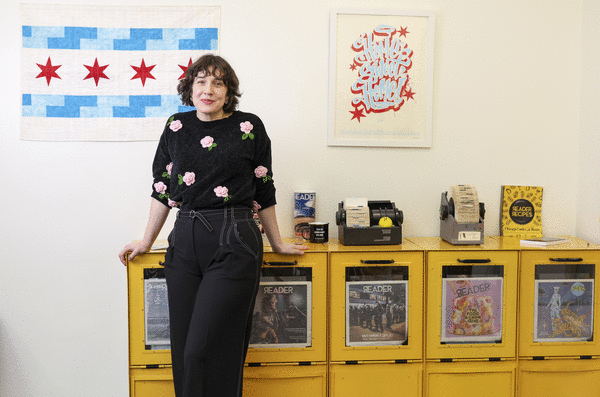
The Chicago Reader, the groundbreaking alternative weekly which has been on the brink of dissolution for years, will become a monthly in February under new owners, who are looking to reinvent the storied newspaper while turning red ink to black.
Noisy Creek, a startup publisher on a mission to restore alternative weeklies to their offbeat journalistic glory, took over operations at the Reader last fall, with plans to install a novel profit/nonprofit formula it has used since acquiring The Stranger in Seattle and the Portland Mercury in 2024.
“The vision is to bring an innovative business model to help support a trusted and beloved network of alt-weeklies around the country,” said Brady Walkinshaw, 41, a former Washington state representative and founder of Seattle-based Noisy Creek.
The Reader stopped the presses in December as part of a reboot that involves everything from a new editor-in-chief to a revised publication schedule belying the alt-weekly category it helped create more than a half-century ago.
The blueprint involves scaling back to a monthly publication and implementing a hybrid business model where the Reader reverts to a for-profit newspaper, backed by philanthropic support. The Reader will also pursue alternative income streams to advertising, including a Noisy Creek-owned ticket service.
So existential was the plight of the Reader, which has continued to lose money since converting to a nonprofit nearly four years ago, that its board handed over the keys to Noisy Creek in August in a complex ownership transfer that has yet to be consummated.
“Noisy Creek is currently operating the Reader under an agreement with the board, which we moved quickly to establish to save the publication from shuttering,” Walkinshaw said. “We’re keeping it alive, and we’re investing a lot in it, far more than the actual value.”
Launched in 1971 by a group of Carleton College graduates as a free weekly, the Reader became known for its ambitious long-form journalism, arts news and unusual classified ads. Like many publications, the Reader struggled in the digital age, leading to a series of ownership changes, financial challenges and near-death experiences.
The Reader has changed hands a half-dozen times during the new millennium, fetching as little as $1 in 2018 before converting to a nonprofit in 2022. Operating as a 501(c)(3) under the banner of the Reader Institute for Community Journalism did not improve its fortunes.
In January 2025, with the Reader facing the “imminent risk of closure” amid mounting losses, the CEO resigned and the paper slashed costs, reducing its editorial ranks through layoffs. The Reader’s nonprofit board and foundational partners sought help from Noisy Creek, an upstart publisher bucking the trends and betting on the future of alt-weeklies.
Despite the closures of everything from the Village Voice in 2018 to most recently, the Pittsburgh City Paper, which abruptly shut down this month, Walkinshaw believes alternative newspapers — in print, no less — are ready for a renaissance.
“I think that people want to come back to things that they can touch and trust,” Walkinshaw said. “And I believe very strongly that the voice and kind of a reinvention of what alt-weeklies were is super relevant to the future.”
Under the terms of the purchase agreement, Noisy Creek is assuming the Reader’s debt and investing in its rebirth as a hybrid for-profit monthly publication supported by the new owner’s nonprofit arm, the Fund for Alternative Journalism.
It’s the same business model Noisy Creek has employed since acquiring Seattle alternative weekly The Stranger and its sister paper, the Portland Mercury, from Index Newspapers for an undisclosed price in July 2024. That deal also included events site EverOut and Bold Type Tickets, both of which will be imported to Chicago, Walkinshaw said.
“When you look at media models that work, I believe you need some sort of special sauce or innovation in different kinds of revenue,” Walkinshaw said. “I don’t believe that subscriptions and advertising are enough, that you need to have something else.”
While he hopes the Reader will become more self-sufficient through diversified revenue streams, it will still need philanthropy to fund investigative projects and long-form journalism, Walkinshaw said.
Since taking control of the Reader, Noisy Creek has installed longtime Index Newspapers executive Robert Crocker as interim publisher, and injected capital to keep the Chicago alt-weekly afloat. Under new management, the Reader is already undergoing significant changes.
“We’ve supported the operations since August,” said Crocker, 58. “We’re investing and concentrating on rebuilding it to a sustainable model.”
An essential part of the Noisy Creek hybrid model involves turning alternative weeklies into monthlies, a pathway paved by The Stranger and the Mercury.
The Reader, which moved from weekly to bi-weekly and back to weekly in recent years as it struggled financially under different owners, went on print hiatus after the Dec. 18 issue ahead of the new publishing cadence.
As part of the change, the Reader switched from Tribune Publishing to rival Chicago commercial printer Topweb to produce the new supertabloid monthly, with its first run of 63,000 copies set to hit the streets Feb. 4.
The monthly edition will be distributed the first Wednesday of each month, with weekly restocking to keep the Reader in circulation. The paper will remain free under the new model, with paid subscriptions available.
Overseeing the task of filling those pages is Sarah Conway, 39, a Pulitzer Prize-winning investigative journalist who joined the Reader as the new editor-in-chief in January.
“I think the Reader is going to retain its legacy, and then also, I really want to bring some of my approaches to doing investigative and feature work that centers on people, and is generative and expansive to the paper,” said Conway.
In 2024, as a senior reporter and special projects manager at the nonprofit City Bureau, Conway won the local reporting Pulitzer for co-authoring “Missing in Chicago,” a seven-part investigative series focused on how police mishandling of missing person reports disproportionately impacts Black women and girls.
At the Reader, Conway intends to bring her investigative chops and the alternative newspaper’s heritage of long-form journalism back to prominence on its pages. She is also leaning in on the Reader’s long-standing history as an arts and entertainment authority.
New features include a monthly curated calendar of music, film, performing arts and cultural events.
The March “Best of Chicago” issue will mark the return of longtime Reader film critic Jonathan Rosenbaum after nearly two decades to opine about cinema and life in the digital age. It will also introduce a new column by incarcerated writers across Illinois.
“We’re going to still have the heart of the classic Reader and move into this new, evolved place with Noisy Creek,” Conway said.
The Reader’s heart has needed something akin to multiple angioplasties to survive the new millennium.
The original ownership group sold the Reader in 2007 to Creative Loafing, a small chain of alternative weeklies based in Atlanta. Atalaya Capital Management, a New York-based hedge fund, acquired the Reader out of bankruptcy in 2009. Wrapports, a Chicago investor group that acquired the Sun-Times in late 2011, added the Reader to its portfolio in 2012 for about $2.5 million.
In 2018, Chicago attorney Len Goodman and real estate developer Elzie Higginbottom bought the Reader from the Chicago Sun-Times for $1 and the assumption of debt, rescuing it from dissolution and pumping more than $1 million each into the alternative newspaper to keep it afloat.
The Reader went nonprofit in 2022 under then-publisher Tracy Baim in a tumultuous process that pitted Goodman against Higginbottom before picketing employees helped push it over the finish line.
In 2024, the Reader lost close to a half million dollars and started 2025 by cutting staff and its $4 million budget, seemingly on the verge of its epilogue. Instead, Noisy Creek and the Reader are writing a new chapter in 2026, and a potential playbook for legacy alt-weeklies.
“I’d like to see us apply this model in a number of new places in 2026,” Walkinshaw said.
While Noisy Creek will be looking to expand into other cities to breathe new life into legacy alt-weeklies, it may be racing the clock, with Pittsburgh City Paper the latest on a growing list of casualties.
City Paper ceased operations in early January after 34 years as Pittsburgh’s alternative weekly, with Ohio-based owner Block Communications citing “economic realities facing news organizations.” Block Communications subsequently announced it was also shuttering the Pittsburgh Post-Gazette, the city’s legacy daily newspaper, in May.
The one-two punch in Pittsburgh reflects broader trends. The number of newspapers in the U.S. has declined by nearly 3,500 over the past 20 years, while the industry has lost more than three-quarters of its jobs, according to the 2025 State of Local News report by Northwestern’s Medill School of Journalism.
Walkinshaw, a Princeton graduate who previously ran Grist, a national nonprofit media outlet covering environmental issues, believes the decline of local newspapers makes saving alternative newspapers even more crucial.
“I believe there’s an opportunity for these alternative newspapers to fill a void that has been left by the decline in daily papers around America,” Walkinshaw said.
Conway, a graduate of New York University’s Arthur L. Carter Journalism Institute, spent nine years at City Bureau, a nonprofit news startup on the South Side. She has also contributed freelance work to the Reader.
In her new role, Conway now leads a downsized staff of 16 mostly remote journalists from a small South Michigan Avenue office on a mission to make the Reader relevant again.
For Chicagoans of a certain age, the Reader once meant an engaging journey into the otherwise untold stories of their city — from the seedy to the sublime — that made it a must-read, ink-smearing pickup every Thursday at the nearest bar, bookstore or bodega.
The new editor-in-chief understands the assignment.
“The Reader has a really special place in the hearts of Chicagoans,” Conway said. “It’s been for decades, a place that people go to find out about arts and cultural events, to find out about weird and wonky Chicagoans, and then also investigative journalism. I really want to revitalize that history.”
©2026 Chicago Tribune. Visit at chicagotribune.com. Distributed by Tribune Content Agency, LLC.





Comments