Pittsburgh Post-Gazette to publish final edition and cease operations on May 3
Published in Business News
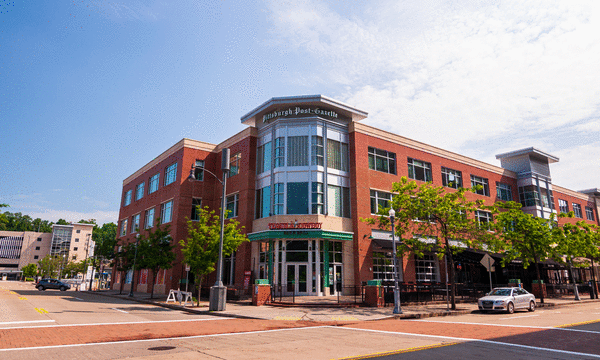
Pittsburgh Post-Gazette owner Block Communications Inc. said Wednesday that it will cease publication of the newspaper May 3, an announcement that came just hours after the U.S. Supreme Court declined to consider a stay on enforcement of a lower-court ruling the newspaper had called onerous.
The decision from the company follows an extended legal battle with its unions at a time when the overall newspaper industry is struggling with declining advertising revenues and changing reader habits.
In November, the Third Circuit Court of Appeals ruled against the Post-Gazette in its fight with a union representing newsroom employees, ordering the newspaper to restore the terms of a labor agreement that expired in 2017 — including comparable health insurance coverage. A company appeal to the nation’s high court brought a temporary stay in the case, but that ended with Wednesday’s ruling.
The company, in announcing its decision to shut down the Post-Gazette, said the past 20 years have seen BCI lose more than $350 million in cash operating the newspaper. The company, which traces its roots to the late 1700s, said the realities facing local journalism make “continued cash losses at this scale no longer sustainable.”
“Since 2007, the Post-Gazette has operated at a significant loss, supported by hundreds of millions of dollars of the Block family's continued investment to keep the Post-Gazette open,” Jodi Miehls, Block Communications president and chief operating officer, told employees in a video on Wednesday. “Despite those efforts, the realities facing local journalism have brought us to the sad moment.”
Block Communications is a privately held media holding company founded in 1900. The company’s headquarters are in Toledo, Ohio.
In a statement, the Block family said it deeply regretted how the decision will affect Pittsburgh and the surrounding region. The Block family said it was “proud of the service the Post-Gazette has provided to Pittsburgh for nearly a century.”
Union leadership quickly criticized the decision and vowed to seek options to support local journalism, while public officials decried the loss of a important institution that kept citizens informed and pushed for transparency in government and other organizations.
Newspaper Guild of Pittsburgh President Andrew Goldstein said the decision to close punished journalists and the city.
“Instead of simply following the law, the owners chose to punish local journalists and the city of Pittsburgh,” he said in a prepared statement. “Post-Gazette journalists have done award winning work for decades and we’re going to pursue all options to make sure that Pittsburgh continues to have the caliber of journalism it deserves.”
In a statement, Allegheny County Executive Sara Innamorato said the end of the Post-Gazette would be a “major loss” to the city.
“This is a major loss to the people of Pittsburgh when it comes to transparency in government, accountability from our institutions and learning about what is happening in our communities,” she said.
Ms. Innamorato, who expressed concerns about the public’s ability to access trustworthy and fact-checked information, said she “will be engaging local leaders to assess options for a more robust and sustainable local news ecosystem.”
A similar reaction came out of Harrisburg.
"Local news is a critical part of our democracy," Will Simons, a spokesman for Gov. Josh Shapiro, told the Post-Gazette Wednesday evening. "For nearly 250 years, journalists and staff (at the PG) have been asking questions, holding leaders accountable, and keeping Pennsylvanians informed about what's going on in their community. This is a sad day for Western Pennsylvania and Pittsburgh."
The Post-Gazette traces its origins to 1786, when it was a four-page weekly called the Pittsburgh Gazette, the first newspaper published west of the Allegheny Mountains. The paper acquired its current identity in 1927 when Paul Block acquired its assets.
Word of the Post-Gazette’s plan to close in May came a week after Block Communications announced it was ending publication of its Pittsburgh City Paper, which had been published for 34 years under various owners.
The closing fits a trend that began in 2025, according to a new study by the Northwestern University’s Medill School of Journalism.
The newspaper industry has been under stress for years, with the closing of more than two newspapers per week on average due to changes in reader preferences, a decline in advertising revenue and other factors. But last year, most of the closures were newspapers belonging to smaller chains and independent owners, according to the Northwestern University report.
Wednesday’s announcement will not affect publication of the Toledo Blade, the Post-Gazette sister newspaper in Ohio.
The company and its unions have been unable to negotiate new contracts for several years.
A switch to a different health insurance plan for employees in 2020, after the company said a bargaining impasse had been reached in contract negotiations, prompted a walkout in 2022 by five unions representing Post-Gazette employees. The company said the switch was needed to pare ongoing operating losses.
The court later ruled that the two sides had not truly reached an impasse.
The company reached agreements with four of its five unions, with about 30 Pittsburgh Newspaper Guild reporters, photographers and other editorial staff remaining on strike before returning to work in late November after the Third Circuit ruling.
During the walkout, many employees continued working, producing digital and print editions of the newspaper.
The closure will affect about 180 Post-Gazette employees.
Ms. Miehls said, in her video statement, that separation packages will be negotiated for union-represented employees, and severance packages offered to non-union employees who stay through the closing.
©2026 PG Publishing Co. Visit at post-gazette.com. Distributed by Tribune Content Agency, LLC.









Comments